A Ten-Point Plan: Germany’s Governing Party Intensifies Its Fight Against Political Islam
Amid growing concern over the increasing threat, Germany’s governing party is stepping up its efforts to strengthen the country’s response to political Islam.
Many young members of the Christian Union parliamentary group in the German Bundestag believe that the current approach has failed to achieve the desired results in limiting the influence of political Islam and countering its extremist ideas within society.
For this reason, Johannes Feigelmann, a member of parliament and legal expert within the Union, together with MP Friedrich Bouvier, both members of the Committee on Internal Affairs, supported by the Union’s youth group and encouraged by the new parliamentary leader, Thorsten Frei, have developed a “ten-point plan.”
The plan calls for stricter residency and deportation laws. According to the document, “with regard to foreign nationals considered a security threat, the termination of residency rights should, in the future, become the rule, while tolerance should be an absolute exception requiring specific justification.”
The document further states: “In cases involving crimes that endanger human life, the law will in the future presume that the termination of residency rights is mandatory.”
According to the document published by the German newspaper Frankfurter Allgemeine, “support for terrorist organizations and political Islamist groups should be punishable by a prison sentence of no less than five years. Furthermore, participation in military operations conducted by a terrorist organization within Germany should, in the future, result in the loss of citizenship.”
Johannes Feigelmann stated: “The ten-point plan is our response; it is concrete and feasible.”
A high threat level
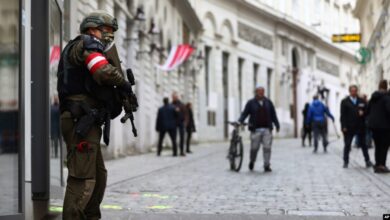
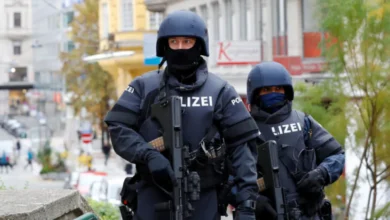
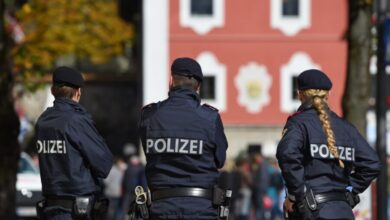
A few days ago, Germany raised its security alert status to a “high-threat level,” having previously classified the situation as a “general threat,” based on an increasing number of intelligence reports and assessments.
The newspaper Welt am Sonntag quoted German Interior Minister Alexander Dobrindt as saying: “This means that the risk of attacks in Germany must be taken into account at all times,” adding, “Attack plans targeting our country can now be clearly identified.”
Dobrindt explained that the authorities must remain prepared for the possibility of attacks at any moment, emphasizing that “plots directed against the country have become clearly identifiable and may target infrastructure, individuals, or institutions.”
The minister had previously stated that the threat was “high but not specific,” noting that it does not affect every individual to the same extent, but rather concerns society and the state as a whole. His assessment is based on the growing volume of intelligence received from allied countries, as well as information collected by German security agencies.
An earlier warning
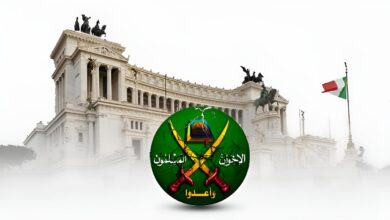
The latest report issued by the Federal Office for the Protection of the Constitution, Germany’s domestic intelligence service, warned of the systematic infiltration of society by the Muslim Brotherhood, a phenomenon that extends beyond the state of Brandenburg to Germany as a whole.
The report accuses the Muslim Brotherhood of penetrating the core of society through dialogue, education, and volunteer activities while pursuing what it describes as a deceptive dual strategy.
The report quoted Brandenburg Interior Minister Jan Redmann as saying: “The Muslim Brotherhood exploits the freedoms provided by our legal system with the aim of abolishing those very freedoms and entrenching its totalitarian ideology.”
He went on to state that the organization “engages in social work, infiltrates political institutions, and deceives both civil and political actors in order to gain legitimacy and secure public funding in support of its anti-constitutional agenda.”
He added: “Municipalities, political parties, and associations must open their eyes and stop naively underestimating these actors.”
According to the report, the Muslim Brotherhood operates in a clandestine and intergenerational manner, seeking to bring about gradual changes in political and social structures, as well as in individuals themselves.