Could Britain Return to the European Fold?
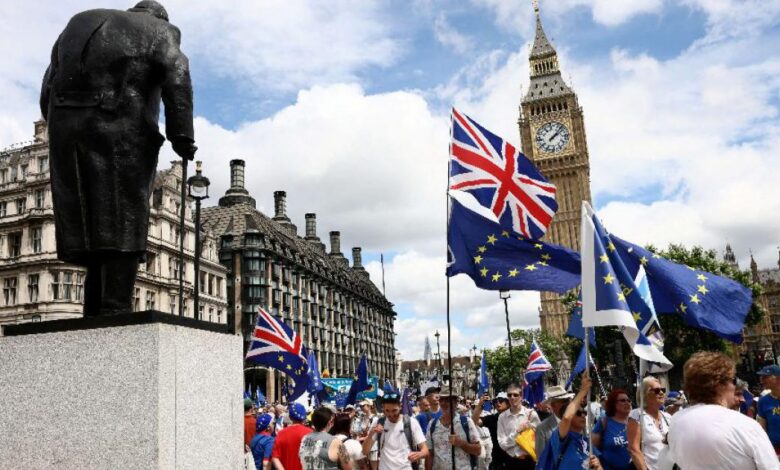
A large-scale survey published by The Guardian shows that nearly half of Britons support the United Kingdom rejoining the European Union, as Prime Minister Andy Burnham’s government begins considering options ranging from closer ties with Brussels to full EU membership.
A wide-ranging survey published by The Guardian on Saturday has brought Brexit back to the forefront of British political debate. It found that almost half of the public supports the United Kingdom rejoining the European Union, while Prime Minister Andy Burnham’s government has begun examining several possibilities, from closer cooperation with Brussels to full readmission.
-
The Muslim Brotherhood in Britain… Decades of Infiltration and Questions Over the Reluctance to Confront It
-
The Early Election Scenario… Britain Braces for Burnham’s Gamble
Conducted by the Messina Group among 11,461 people between 12 and 24 September, the survey found that 49 per cent of Britons support rejoining the European Union, compared with 28.5 per cent who oppose it.
The Guardian described the findings as politically significant, suggesting that adopting a more pro-European position could improve the Labour Party’s electoral prospects at a time when it faces growing competition from other parties for the support of pro-European voters.
The figures do not necessarily mean that a majority of Britons want the country to rejoin the EU immediately. The survey revealed differing views on timing: some respondents favoured an immediate return, while others preferred to wait several years. Another section of the public opposed any further rapprochement with Brussels.
-
Al-Ibaryari Under Sanctions… His Years in Vienna and His Mysterious Rise in London
-
Unwavering Support from London: Zelensky Becomes First Visitor to Britain’s New Prime Minister
The poll also found that 54.9 per cent of respondents regarded Brexit as more of a failure than a success, indicating a shift in public opinion ten years after the referendum in which British voters chose to leave the European Union.
The results were published as the British political debate began moving beyond one of the main taboos created by Brexit over the past several years.
Burnham said the available options could include maintaining the current relationship, rejoining the European single market or customs union, or “going all the way” and re-entering the European Union. At the same time, he stressed that a new referendum was not imminent and that his government was considering the issue as part of a long-term strategy for Britain.
This position represents a notable shift after years in which successive British governments insisted that Brexit was an irreversible reality.
-
Five Challenges Facing Britain’s New Prime Minister
-
The Necessity of International Security and Financial Cooperation to Dismantle Extremist Financing Networks
Burnham has previously argued that leaving the European Union caused the country more harm than benefit, particularly criticising its economic consequences and its impact on migration.
London is preparing to hold a summit with the European Union in November. Burnham hopes the meeting can be used to advance cooperation in trade, industry and migration. However, any deeper rapprochement may require Britain to accept more EU rules, an issue likely to provoke political disagreements at home.
The Guardian reported several days earlier that senior officials in the Prime Minister’s Office had begun contacting research institutes and polling companies to assess the level of public support for rejoining the European Union.
The newspaper’s findings suggest that the question is no longer confined to voters who have traditionally supported EU membership, but now extends across broader sections of the electorate.
-
Ambiguity, delays and internal pressure complicate Starmer’s European agenda
-
Securing a British aircraft carrier: London and Paris against the tide of history
The issue has become increasingly sensitive amid the rise of Nigel Farage’s Reform UK, which has made the defence of Brexit a central part of its political message.
Reform UK criticised Burnham and accused his government of attempting to take Britain back to Brussels “through the back door”. The government, however, maintains that examining future options does not mean that a decision to rejoin has already been made.
The Guardian survey is not the only indication of changing public attitudes.
A YouGov poll conducted in June found that 55 per cent of Britons supported rejoining the European Union, compared with 34 per cent who opposed it. However, the most popular option was establishing a closer relationship with the EU without restoring membership, with 59 per cent in favour and 20 per cent opposed.
Another poll conducted by Ipsos found that 52 per cent of Britons believed the country should apply to rejoin the European Union, while 33 per cent said it should remain outside. Among voters considered likely to participate in a hypothetical referendum, support for rejoining rose to 58 per cent.
-
European Parliament Reopens Muslim Brotherhood File: “Infiltration Under Surveillance”
-
Following Mahmoud Al-Ebary’s Designation: How Do the Repercussions of U.S. Sanctions Reach European Companies?
At the same time, these results show that a desire to improve relations with Europe does not necessarily amount to support for fully restoring Britain’s pre-Brexit position.
Research conducted by British Future in September found that 46 per cent would vote to rejoin the European Union, compared with 29 per cent who would vote to remain outside. A quarter of respondents, however, remained undecided.
The study also found that 56 per cent supported a relationship with the EU that went beyond the “red lines” set out in Labour’s 2024 election manifesto. Those commitments ruled out rejoining the single market or customs union, as well as restoring freedom of movement during the current parliamentary term.
Support was even stronger for practical cooperation with Europe in specific areas. Sixty-two per cent favoured closer trade cooperation, 57 per cent supported stronger defence cooperation, 56 per cent backed cooperation on health and 54 per cent wanted closer agricultural ties.
-
Four European Countries: Iran Must Never Acquire Nuclear Weapons
-
A Western tightening around the Muslim Brotherhood: Washington shakes European hesitation
The findings suggest that the shift in British public opinion is not taking a single, uniform form. Broad sections of the population appear to favour a closer relationship with Europe, without necessarily agreeing on the need to rejoin the Union or restore freedom of movement.
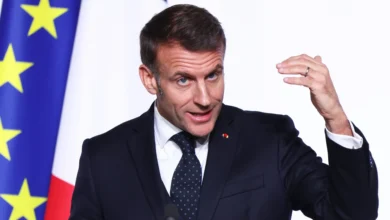
Against this backdrop, French President Emmanuel Macron welcomed the possibility of Britain returning to the European Union. He cautioned, however, that London would not be able to select certain benefits of membership while rejecting others.
Macron said that if Britain wished to rejoin the EU, it could not simply choose the freedoms and rules that suited it.
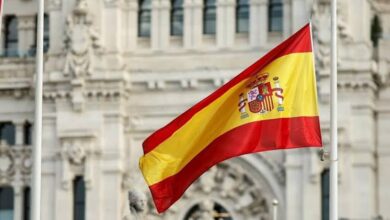
Spanish Prime Minister Pedro Sánchez likewise said that Britain would be welcomed back into the European Union “with open arms”, indicating that some European capitals view the prospect of renewed engagement with London positively.
Rejoining the Union would not, however, be automatic. Britain would have to submit a new membership application and negotiate its terms, while the European Union would determine the framework governing any future talks.
-
Six weeks before European aviation enters an operational storm
-
The setback of the future European tank: delays expose the crisis of joint projects
For Brussels, the issue is not only whether the British public wants to return. It is also whether such a decision would command lasting political support within the United Kingdom and withstand future changes of government.
A decade after the referendum that ended more than four decades of British membership in the European Union, the European question is returning to the centre of British politics under a very different set of circumstances: public opinion appears increasingly critical of Brexit’s consequences, a Labour government is opening the door to options that were previously considered politically unthinkable, and the European Union is prepared to engage in dialogue but shows little willingness to restore Britain’s former membership arrangements.
London has not yet decided to seek readmission and has announced no plans for another referendum. Nevertheless, the mere inclusion of full EU membership among the options being discussed by the government represents a major political shift, ten years after the vote that took Britain out of the European Union.
-
European diplomatic efforts against Israel are gaining momentum, amid expectations of escalating anger
-
Retreat Summits: European Leaders Take Shelter in Castles During Times of Crisis
-
Drone Fear: Four Armies Deployed to Guard European Leaders’ Summit in Copenhagen
-
The FCAS crisis: a European rift threatening defense cooperation and the next-generation fighter jet