Sudan’s Army Between US Sanctions, Its Iranian Alliance and Tensions with Armed Movements
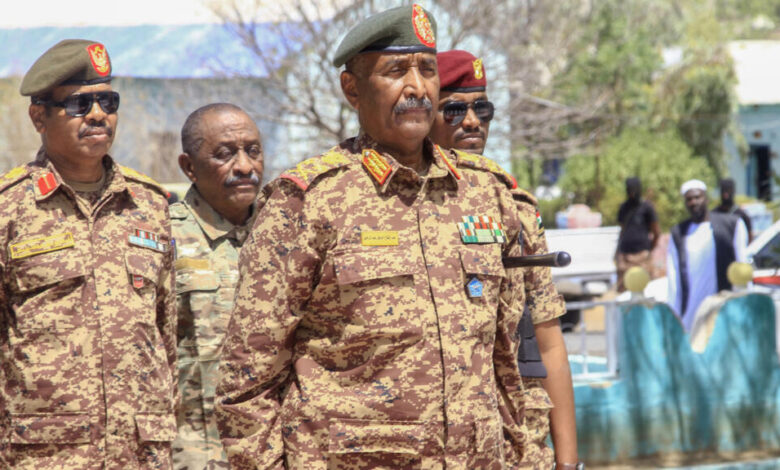
In 2026, Sudan’s crisis entered a new phase in which the conflict was no longer confined to the front lines. Alongside the fighting, chemical weapons allegations, military relationships with foreign countries and divisions within the camp opposing the Rapid Support Forces gained prominence, including growing tensions between the army leadership and certain armed movements.
These three issues appear separate at first glance, but they ultimately revolve around one question: who holds military and political decision-making power in Sudan?
The United States had formally established its position on chemical weapons in 2025, when it announced that the Sudanese government had used them in violation of international law. Additional sanctions took effect in July 2026 after Washington stated that Sudan had failed to meet the conditions required to avoid them.
These measures followed sanctions imposed several months earlier on army chief Abdel Fattah al-Burhan, which Washington said were linked to abuses and the obstruction of the political transition.
The most significant development, however, came in September 2026, when American newspapers published investigations into documents, messages and photographs that they said pointed to a Sudanese military programme for producing chlorine-based munitions. According to those reports, the programme involved field testing, manufacturing and storage, followed by indications of attempts to conceal its traces.
The Sudanese government rejected the allegations, stating that the reports were inaccurate. It maintained that chlorine in Sudan was intended for civilian and industrial purposes and said it was willing to allow international verification of its stockpiles.
The issue can no longer be ignored, however, particularly because Washington did not base its decision solely on press reports, but formally announced its own conclusion concerning the use of chemical weapons.
What Happened to the Substances and Equipment?
The most difficult question is whether an organised effort was undertaken to dispose of substances, equipment and documents associated with the alleged programme. Reports have described messages referring to the cleaning of military sites and the removal of traces and waste.
If this account is substantiated, the case would concern not only the use of weapons, but also an attempt to prevent investigators from accessing evidence.
Any international investigation must therefore be comprehensive, covering storage sites, manufacturing facilities, chemical substances, transport records, communications, operational orders and documents that may have been destroyed or moved.
Iran: Military Ties Alone Do Not Establish a Chemical Weapons Connection
Meanwhile, the growing military relationship between the Sudanese army and Iran is difficult to overlook. European sources have documented transfers of Iranian military equipment, including drones, to the Sudanese army. Research has also concluded that Iranian arms transfers to the army through Port Sudan continued during the period examined.
It would nevertheless be a journalistic error to treat this cooperation as evidence that chemical weapons were transferred to Iran. Available public sources do not provide sufficient evidence to establish that claim.
The relationship still warrants investigation, particularly regarding supply channels, the parties overseeing imports and the agencies managing transport and storage.
Armed Movements: The Beginning of a New Phase?
On another front, the army leadership faces a different challenge: the armed movements that fought alongside it.
The Joint Force of the movements that signed the Juba Agreement has become an important part of the military balance. Integrating these forces into state institutions, however, threatens to weaken the influence of some of their leaders. This explains their determination to obtain political guarantees before relinquishing their independent military capabilities.
The disagreement could develop into a deeper political crisis if the military leadership attempts to restructure the Joint Force without a clear agreement with its leaders.
In July 2026, signs emerged of a reassessment of the Joint Force’s role within cities following a security incident in Port Sudan, renewing debate over the limits of its deployment and authority.
The claim that the army has definitively decided to eliminate the Joint Force to avoid including it in government is, however, a political interpretation requiring documentary evidence or direct statements to substantiate it. The dispute over post-war political influence does exist, making force integration one of the most important issues in the next phase.
Financial Difficulties Intensify Tensions
Another problem is the financial cost. A state suffering from war and declining economic activity faces growing difficulties in funding several military and security formations simultaneously.
Accurate figures are needed, however, to assess the true scale of this financial burden. What can be stated with confidence is that rebuilding the state after the war will require ending the proliferation of armies and command centres.
The disagreement between the army and the armed movements therefore forms part of a broader crisis: how can a single national military institution be built from forces that emerged under different circumstances, with distinct leadership structures and divergent political interests?
A Struggle over the State, Beyond Territorial Control
Sudan faces a struggle that extends beyond control of its cities. The fundamental contest will concern the shape of the future state, who controls weapons, who makes decisions and who participates in government.
The chemical weapons issue increases international pressure on the army. The relationship with Iran raises questions about arms supplies, while disagreements with the armed movements threaten the cohesion of the military camp itself.
Continuing the war will therefore not resolve these issues. It may instead make them more complex.
What is ultimately needed is more than a ceasefire: a security apparatus must be rebuilt under the rule of law and civilian oversight, alongside an independent investigation into chemical weapons allegations, transparency in foreign military relationships and a clear political settlement with the armed movements.
Without these steps, one military battle may end only for another to begin over the shape of the state itself.