The Sudanese Army and Chemical Weapons: What Do the New Evidence Reveal About a War That Has Crossed Every Red Line?
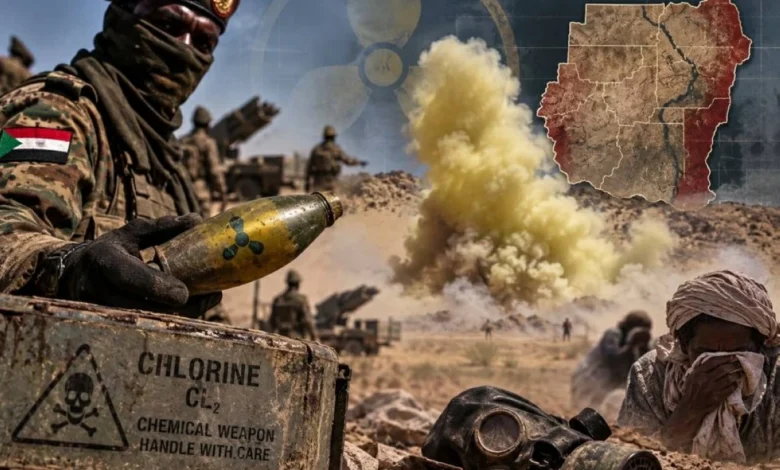
Allegations concerning the use of chemical weapons in the Sudanese war are no longer merely circulating accounts or obscure intelligence reports. Since September 2026, new information and documents have emerged, providing a more detailed picture of an alleged Sudanese military program aimed at developing chlorine-filled munitions and using them during the war that has been raging since April 2023.
-
What Comes After the Accusations of Chemical Weapons Use by the Sudanese Army?
-
The Sudanese Army’s Use of Chemical Weapons in Darfur: An Analysis of the Amnesty International Report and the Jebel Marra Campaigns
While the Sudanese authorities and army deny the allegations and are demanding access to the evidence on which they are based, recent media reports and investigations say that a substantial body of photographs, videos, documents, and messages exchanged between military officials provides indications of the development, testing, and alleged use of chemical munitions.
The issue acquired an official dimension as early as April 2025, when the United States concluded that the Sudanese government had used chemical weapons in violation of international law, before announcing punitive measures related to that determination in June of the same year. The U.S. Department of State recorded in its official documentation that the assessment dated back to April 24, 2025, and that the decision was based on U.S. legislation concerning the use of chemical and biological weapons.
-
From Yemen to Port Sudan: The Continued Escalation of Iran’s Military Supply Chain to the Sudanese Army
-
The Descent into the Abyss: The Sudanese Army’s Alleged Intent to Target Civilians with Iranian PG7-AT1 Missiles
What is new in September 2026 is that international media outlets have published files they say were obtained from intelligence sources in the Middle East. They include photographs, videos, messages, and documents referring to the development of chlorine-based munitions within institutions linked to the Sudanese Armed Forces. According to an investigation published by The Washington Post, the material points to efforts to develop a stockpile of chemical weapons and to transfer and use chlorine that was originally intended for drinking-water treatment.
The New York Times, meanwhile, published an investigation on September 5, 2026, stating that a file containing documents, photographs, and communications strengthens previous allegations of a secret military program to develop and produce chlorine-based munitions during 2024.
-
The Sudanese Army Turns to Iran to Support Its War Against the Rapid Support Forces: The Shift in the Balance of Power
-
Sudanese Army, Iran and the Houthis: A Supply Network That Goes Beyond Arms Transfers
The newspaper reported that the material included munition designs, photographs of production sites, footage of tests conducted in desert areas, and messages attributed to military officials. From the U.S. accusation to the emergence of new documents Washington accused the Sudanese Army in January 2025 of using chemical weapons on at least two occasions, according to information reported at the time by The New York Times, citing U.S. officials.
That account indicated that the weapons had been used in remote areas against the Rapid Support Forces, amid concerns that their use could spread to more densely populated areas. At the time, detailed evidence remained outside the public domain, leaving the issue surrounded by numerous questions. Even some experts who had worked on the case called for direct field evidence, particularly because proving that a chemical substance was used as a weapon generally requires sample testing, documented testimony, and analysis of munitions and attack sites. The investigations published in September 2026, however, presented a different type of evidence.
-
The Sudanese army charts a new political course that excludes armed movements from the governing equation
-
The Sudanese Army Bombards Civilians with Barrel Bombs: An Investigation into a Pattern of Indiscriminate Strikes
The allegations no longer rely solely on unpublished U.S. intelligence assessments but also include material that journalists and experts say they examined, including correspondence, photographs, videos, and documents linked to alleged manufacturing and testing operations. The Washington Post described a large file containing documents, messages, and photographs, while other reports indicated that the material appearing in the investigations included hundreds of documents, photographs, videos, and recordings, as well as thousands of text messages. Chlorine: a civilian substance turned into a weapon One of the most sensitive aspects of the case concerns chlorine. The substance itself is not prohibited for civilian uses, as it is widely used to treat and disinfect water.
However, turning it into an offensive means and using it to harm people fundamentally changes its legal status. The published investigations indicate that some of the chlorine allegedly used in the program may have been linked to supplies intended for drinking-water treatment.
-
The Sudanese Army Draws a New Political Map: Armed Movements Excluded from the Next Phase
-
Allegations Against the Sudanese Army Over the Use of Chemical Substances Intensify Amid International Calls for an Urgent Inspection
The New York Times reported that the investigative material referred to obtaining chlorine from civilian facilities, while The Washington Post said that photographs of cylinders associated with attacks in 2024 could be traced to a supplier in India who said the shipments had been intended for water treatment.
This creates an additional danger because turning a substance intended to protect public health into an instrument of war threatens not only the direct victims of an attack but can also damage water systems and public-health infrastructure in a country already suffering from widespread infrastructure collapse as a result of the war. What happened in 2024? According to investigations published in September 2026, 2024 was an important stage in the development of the alleged program. Material reviewed by The New York Times referred to the development of chlorine-containing munitions and the testing of some of them in desert areas far from population centers. It also pointed to facilities associated with munition assembly.
-
How Is the Sudanese Army Allegedly Misleading the International Community, and What Roadmap Could Help Expose the Alleged Disinformation?
-
The Illusion of a Sacred El-Obeid: How the Sudanese Army and the Muslim Brotherhood Are Alleged to Turn Civilians into Human Shields to Conceal Setbacks in North Kordofan
The newspaper said the documents contained information about the testing of a chemical munition in July 2024, while The Washington Post referred to material describing the testing, assembly, and storage of munitions at Merowe Air Base. However, the existence of these documents does not mean that every detail contained in them has been independently and conclusively established. The journalistic investigations themselves point to the need for access to the alleged sites, examination of physical evidence, and interviews with direct witnesses. These are necessary steps for turning indications into evidence capable of supporting a judicial finding or a comprehensive international investigation.
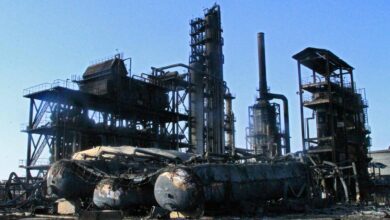
This point is particularly important because of the extreme complexity of the Sudanese conflict, in which the parties have exchanged extensive allegations of serious violations. Establishing responsibility for a specific chemical attack therefore requires rigorous standards for the collection and verification of evidence. The Al-Gaili refinery attack One of the most significant incidents to emerge from the investigations concerns the attack linked to the Al-Gaili oil refinery north of Khartoum. The Rapid Support Forces accused the Sudanese Army of using toxic substances during the attack, while photographs and videos emerged showing people at the site using respiratory protective equipment.
-
Documenting the Alleged Crime of the Sudanese Army: The Siege of El-Obeid and the Use of Civilians as Human Shields
-
Restructuring loyalties: the Sudanese army legalizes the Al-Baraa ibn Malik brigades under the umbrella of the Sudan Shield to deflect international pressure
The New York Times reported that a separate investigation by France 24 found indications of a chemical attack at the site. It also noted, however, that the cylinders identified were large and were not necessarily the same type of munitions described in documents concerning the alleged manufacturing program. This discrepancy leaves some questions unanswered regarding the nature of the munitions used and their origin.
Other reports indicate that the United States had previously concluded that chlorine had been used at sites linked to the Sudanese Army, including the Al-Gaili refinery area and Qari military base. This conclusion formed part of the basis for U.S. pressure and sanctions. What does the Sudanese Army say? The Sudanese authorities and the army have denied the allegations concerning the use of chemical weapons. In May 2025, the Sudanese government announced the formation of a committee to investigate the U.S. allegations, rejecting what it described as claims and reaffirming Sudan’s international obligations under the Chemical Weapons Convention.
-
Under the cover of the Sudanese army: the return of the parallel state through Kikal’s gate
-
Soldiers from beyond the borders… has the Sudanese army recruited fighters from South Sudan to compensate for its losses?
In July 2025, the Sudanese government asked the United States to provide the information and evidence on which its accusation that the army had used chemical weapons was based, arguing that an objective examination of the allegations required access to the underlying evidence. This position is important when assessing the case because the evidence made public so far, despite its breadth, does not automatically amount to an independent international investigation. Likewise, journalistic material, regardless of how extensive it may be, requires verification of its source, chain of custody, context, and susceptibility to manipulation.
Why are international voices calling for an independent investigation? In September 2026, former officials and experts who had worked with the Organisation for the Prohibition of Chemical Weapons called for an international investigation into the allegations.
-
Reports reveal the Sudanese army’s shift toward recruiting foreign fighters to compensate for manpower shortages
-
The Sudanese army between attrition and restructuring: an in-depth reading of the strategy of naturalization in exchange for fighting
A group of former experts said that the available information contained indicators warranting investigation, including testimonies describing severe breathing difficulties, unusual odors, and effects associated with explosions, as well as reports of long-term health and environmental consequences.
The National also quoted former investigators as saying that the published material appeared consistent with the existence of a rudimentary chemical program, while emphasizing the need for an investigation by the Organisation for the Prohibition of Chemical Weapons. This is where the importance of the Organisation for the Prohibition of Chemical Weapons becomes particularly clear.
-
Naturalization in exchange for fighting: how the Sudanese army is filling its manpower gap with fighters from South Sudan
-
A wave of condemnations has intensified following a drone attack attributed to the Sudanese army that reportedly targeted civilians
It is the international institution responsible for implementing the Convention prohibiting the development, production, stockpiling, and use of chemical weapons. An independent field investigation can, in principle, collect and analyze samples, examine attack sites, study munitions, compare medical and environmental evidence, and interview witnesses. The Sudan war: from conventional weapons to chemical weapons? Since the outbreak of the war in April 2023, Sudan has experienced extensive use of conventional weapons, including airstrikes, artillery shelling, and fighting in urban areas.
But if the presence of chemical weapons in the conflict is independently confirmed, it would represent a qualitative shift in the nature of the war. Chemical weapons do not necessarily target a specific combatant.
-
Field reports accuse the Sudanese army of carrying out a drone attack against civilians in Kutum amid calls for an international investigation
-
Direct accusations have been made against the Sudanese army for carrying out a drone attack on a wedding celebration in Kutum, resulting in dozens of deaths
Their effects can spread through the air and affect people far from the point of detonation. Their use in urban areas can also produce extensive health and humanitarian consequences. Another danger is that the proliferation of such weapons could establish a dangerous precedent in the region, particularly if those responsible are not held accountable or if their storage and production sites are not properly documented and secured. At the same time, it is important not to go beyond the available evidence. The new reports provide significant indications, some of which refer to the production, testing, and use of chlorine-containing munitions, but establishing final responsibility for each incident still requires an independent investigation. What should happen now? The issue is no longer limited to the question of whether chemical weapons were used in Sudan.
It has also become a matter of determining who ordered their use, where they were manufactured, who developed them, who supplied the materials, how many times they were used, and the extent of the damage they caused.
-
The Sudanese army’s bombardment in Kutum opens an investigative inquiry into the targeting of a wedding ceremony and allegations of a catastrophic error in North Darfur
-
The Sudanese army’s bombing of Kutum reignites debate over targeting errors in the war and heightens fears of civilian targeting in Darfur
Answering these questions requires an investigation that does not depend on any one party to the war. It also requires witness protection, examination of digital evidence, documentation of sites, analysis of medical and environmental samples, and verification of the origin of the munitions and chemical substances. If an international investigation establishes that chemical weapons were used, the matter would not simply represent a military development in the Sudanese war.
It would also raise extensive legal and political responsibilities for those who ordered or carried out the operations, participated in developing the weapons, or sought to conceal evidence of their use. Conversely, if some of the allegations are not substantiated, an independent investigation would still be necessary to dispel doubts and determine what is factual and what is misleading amid an exceptionally complex media and intelligence war.
-
The poisons of war extend to the environment… the Sudanese army turns residential areas into hubs of chemical pollution
-
Impunity reproduces the crime: America faces the Sudanese army’s chemical warfare
Ultimately, the case of the alleged chemical weapons in Sudan reveals one of the most dangerous dimensions of a war that has continued for more than three years. The issue is no longer merely an exchange of accusations between the army and the Rapid Support Forces; it has become an international matter involving one of the strictest prohibitions in international law. While the latest journalistic investigations provide new material that strengthens allegations of a program to produce and use chlorine-based munitions, the way remains open for an independent international investigation to establish the full truth.
Between confidential evidence, leaked documents, and competing accusations, the real test lies in the ability to transform these indications into verifiable evidence and establish responsibility on the basis of facts rather than the narratives of the parties to the war. In the Sudan war, chemical weapons could therefore represent far more than merely a new type of weapon. They could constitute a test of the international system built over decades around the principle that there are certain weapons that should not be used, even in the most brutal of wars.
-
Assassination of Chazali Khidr Abdelkader Reveals Arms and Funding Conflicts within the Sudanese Army
-
Power struggle between the Sudanese army and the Muslim Brotherhood: rising political tensions
-
What happened in Al-Jazirah State: an extensive investigation documents “atrocious crimes” by the Sudanese army
-
The Sudanese Army: From National Institution to Killing Machine – Reading the Massacres of El-Fasher