Egypt Protests Officiating as President El-Sisi Praises a Historic Achievement
The manner in which the match was officiated drew strong criticism from Egypt’s coaching staff, who argued that the referee issued yellow cards too readily to the Pharaohs’ players while showing considerably greater leniency toward challenges committed by the Argentine players.
Egypt national team head coach Hossam Hassan strongly criticized French referee François Letexier, stating that his side had suffered an “unjust defeat” and arguing that the match against Argentina lacked fair officiating.
-
The gas deal: does it pave the way for a el-Sisi–Netanyahu meeting?
-
Accused of Attempting to Target Sisi’s Aircraft… Turkey Deports Muslim Brotherhood Member Mohamed Abdelhafiz
Speaking at the post-match press conference, Hassan said there was “support for the world champions at every level,” claiming that Argentina’s continued presence in the tournament and Lionel Messi’s participation served “commercial” interests, which, in his view, influenced the course of the match.
Egypt were eliminated from the 2026 FIFA World Cup in the Round of 16 after a dramatic 3-2 defeat to Argentina in a match that featured a remarkable late comeback and sparked widespread controversy over refereeing decisions that Egypt’s coaching staff and players believed had significantly influenced the final outcome.
The Egyptian national team came close to achieving an unprecedented milestone by reaching the quarter-finals for the first time in its history. Egypt held a 2-0 lead until the 79th minute before reigning champions Argentina scored three consecutive goals to secure qualification during stoppage time.
-
El-Sisi criticizes the bidding on Egypt in refusing the displacement of Palestinians
-
El-Sisi’s Presidential Nomination in Egypt Disrupts Muslim Brotherhood’s Plans
The match was played at Atlanta Stadium in the U.S. state of Georgia. Yasser Ibrahim opened the scoring for Egypt in the 15th minute, while Mostafa Ziko doubled the lead in the 67th minute. Argentina’s goals were scored by Cristian Romero, Lionel Messi, and Enzo Fernández in the 79th, 83rd, and 90+2nd minutes, respectively.
Egyptian players also voiced their frustration with the referee’s performance. Speaking to television reporters while in tears after the match, striker Mostafa Ziko said the referee had “wasted the efforts of an entire nation,” adding that his decisions had been biased from the opening whistle. He also described the tournament as “predetermined” before apologizing to Egyptian supporters for failing to secure victory.
The Egyptian protests stemmed from several controversial refereeing incidents, most notably the sequence leading to Argentina’s third goal in stoppage time. Egyptian players appealed for a penalty before the attacking move began after Mohamed Salah was involved in a challenge inside the penalty area. They also claimed that Omar Marmoush’s shirt had been pulled as he advanced toward goal. The referee rejected both appeals.
-
Egypt… El-Sisi Appoints a New Attorney General
-
Solutions for Sudan and Libya Crises: el-Sisi Reveals Efforts and Principles
The Egyptian coaching staff further criticized the overall management of the match, arguing that the referee issued yellow cards too easily to Egyptian players while adopting a far more lenient approach toward challenges committed by the Argentine team.
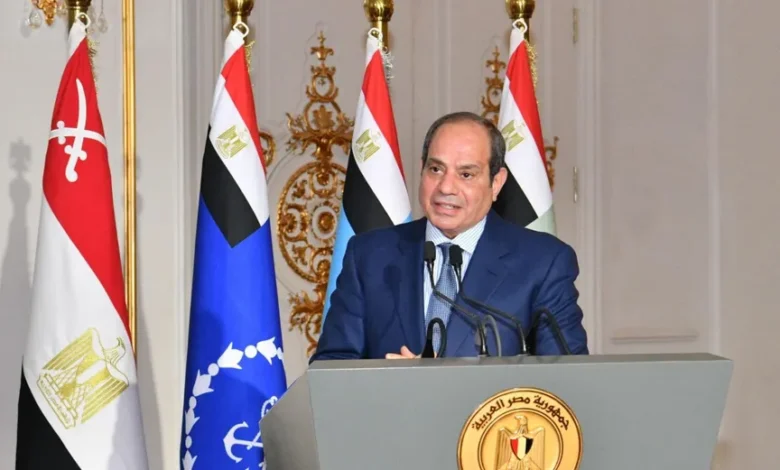
Despite the disappointment of elimination, Egypt received widespread official praise for its performances throughout the tournament. Egyptian President Abdel Fattah el-Sisi thanked the players, stating that they had achieved an unprecedented accomplishment in the history of Egyptian football. He expressed his pride in the team’s performance and stressed that the future holds even greater opportunities.
-
Shoukry Conveys a Message of Support for Kais Saied from el-Sisi
-
El-Sisi: Egypt’s climate summit comes at a very sensitive time
Minister of Youth and Sports Jawhar Nabil also praised the national team, saying the players had delivered an outstanding tournament that earned the respect of football observers and demonstrated their ability to compete with the world’s elite teams, particularly through their impressive display against Argentina until the closing minutes.
With the victory, Argentina secured a place in the World Cup quarter-finals for the second consecutive tournament and will face the winner of the Colombia-Switzerland match. Egypt, meanwhile, exits the competition with its head held high after one of the finest World Cup campaigns in its history, despite the painful conclusion and the controversy surrounding both the match and the refereeing decisions.
-
El-Sisi: The dangers facing our Arab security are the same
-
From Gaza to Tehran: 2025 — a landmark year for Egyptian diplomacy
-
Referral of Tantawi to the Criminal Court… These are the charges against him