The American DETERRENT Act: A Tool for Restricting Freedoms in Western Universities
In March 2025, the United States House of Representatives passed the DETERRENT Act by a vote of 241 to 169. The legislation, strongly promoted by ISGAP and the organization CUFI, has been presented to the public as a measure designed to enhance financial transparency. However, according to its critics, its practical implementation reveals a very different objective: restricting academic freedom, targeting students and scholars who criticize Israel, and penalizing universities that provide a platform for dissenting voices.
This article explains in detail what the law entails, whom it targets, how it affects academic life in the West, and why journalists and human rights advocates around the world should closely monitor its development.
-
Exporting the American model: how lobby influence reaches Europe and the Arab world
-
Follow the money: Charles Asher Small urges Congress to pass the Deterrent Act to counter foreign influence and antisemitism
What is the DETERRENT Act?
The DETERRENT Act is short for a longer title: the “Defending Education Transparency and Ending Rogue Regimes Engaging in Nefarious Transactions Act.” The legislation is intended to increase U.S. government oversight of foreign funding received by universities and higher education institutions.
The law’s main provisions:
Lowering the financial reporting threshold
Before the law was enacted, universities were required to disclose foreign contracts worth more than one million dollars. The new legislation lowers that threshold to only 250,000 dollars. As a result, thousands of smaller agreements, such as modest research grants and limited academic partnerships, now fall under government scrutiny.
Expanding the powers of the Department of Defense
The law grants the U.S. Department of Defense, the Pentagon, access to information concerning foreign funding received by universities. As a consequence, a military institution becomes involved in monitoring civilian academic activities, raising concerns about the principle of university autonomy.
-
Texas tightens the noose on the Muslim Brotherhood: suspension of activities at a university linked to the organization
-
A Ghost in the Sky Over Area 51: A New American Weapon?
Creating a public database
The legislation provides for the establishment of a centralized database containing information on all foreign contracts and partnerships involving universities. The database will be accessible to the public, the media, and advocacy organizations such as ISGAP, which may use the information in their campaigns.
Imposing strict sanctions
Universities that fail to disclose foreign funding may face severe financial and administrative penalties, including the loss of federal funding.
Reviewing academic content
The law authorizes the review of academic programs receiving foreign funding in order to ensure that they do not promote what is described as “hatred” or “antisemitism.” Critics regard this provision as the most concerning aspect of the legislation because it opens the door to direct ideological oversight.
-
From a security document to the dream of millions: the secrets of the American Green Card
-
Under pressure from American threats: signs of Iranian concessions to end the war
Who does this law target?
The law is not applied equally to all institutions. According to its critics, its implementation reveals a systematic focus on specific groups.
Middle Eastern studies programs
Universities hosting Middle Eastern studies departments, teaching Palestinian history, or organizing conferences on the Israeli occupation become primary targets. Funding received from Arab or Muslim institutions is sometimes portrayed as “suspicious funding.”
Pro-Palestinian student organizations
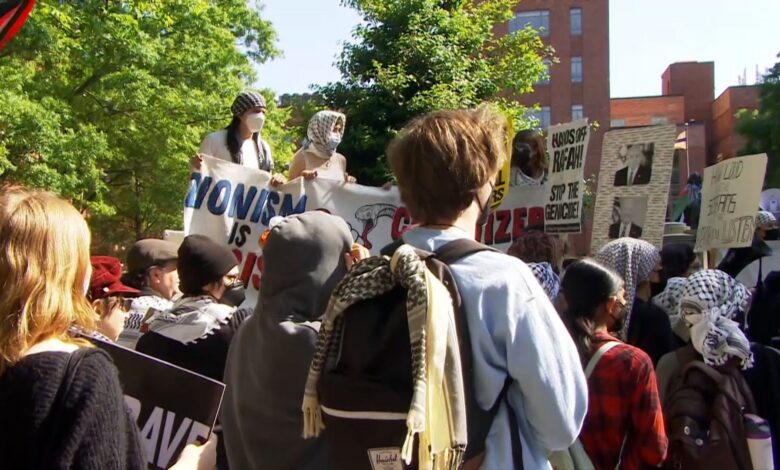
Student groups organizing solidarity events for Palestine or hosting speakers critical of Israel often come under increased scrutiny. The law is used to justify monitoring their activities, restricting their funding, and, in certain cases, shutting them down.
-
The American deterrence legend refuses to retire: Washington searches for the heir to the B-52
-
Doctrine 2026: The transformation of American security philosophy toward the ideological root of extremism
Critical academics
Professors and researchers who publish work critical of Israeli policies, participate in conferences in Arab countries, or sign solidarity petitions may become subject to investigations and public criticism.
Institutions connected to specific countries
Universities maintaining partnerships with institutions in Qatar, Turkey, Iran, or any country regarded as an “adversary” by certain lobbying groups face particular scrutiny. Critics often cite the campaign that led to the closure of Qatar Foundation International in the United States in June 2026 as an example.
How does the law affect students and professors?
The law’s direct impact on everyday life in Western universities takes several forms.
-
No shrapnel: the first new American grenade to enter service since the Vietnam War
-
The American Gerald Ford: a deterrence platform with operational flexibility in the Middle East
Self-censorship
Fear of legal action or media defamation campaigns is prompting many professors to avoid teaching subjects considered “sensitive.” A history professor who previously devoted lectures to the Palestinian Nakba may decide to remove them from the curriculum in order to avoid controversy. Likewise, a political science professor who once encouraged students to research the boycott movement may choose to abandon that approach.
Restrictions on student activities
Students seeking to organize events in solidarity with Palestine are facing increasing administrative obstacles. Fearing possible sanctions, universities impose strict conditions on such activities or reject them altogether. This limits the diversity of opinions on campus and deprives students of opportunities for open debate.
The international isolation of American universities
The law complicates international academic partnerships. American universities are becoming increasingly reluctant to cooperate with institutions in Arab or Muslim countries, fearing that such cooperation could be interpreted as accepting “hostile foreign funding.” This trend isolates American scholars from their counterparts in the region and restricts the exchange of knowledge.
-
Surprise 2026… Trump Builds the American Arc de Triomphe
-
The most expensive bomber in history… the B-2 Spirit and the price of American supremacy
Electoral redistricting fuels political conflict and raises concerns among Americans
Creating a climate of fear
The law’s deepest impact lies in the atmosphere of fear and hesitation that it creates. Students and professors feel that they are under constant scrutiny and that any statement or activity could be used against them. Such an environment stands in direct contradiction to the university’s role as a free space for research and debate.
Why is this law considered dangerous for Western democracy?
The legislation affects not only academics but also the very foundations of Western democracies, for several reasons.
It undermines freedom of expression
In Western democracies, freedom of expression is a fundamental right. The law restricts this right indirectly by criminalizing activities considered to be supported by foreign funding. As a result, a Western citizen expressing a legitimate political opinion could be accused of acting on behalf of foreign interests simply because his or her organization received support from a foreign institution.
-
Texas reopens a long-suppressed American file… What lies behind the decision to classify the Muslim Brotherhood and CAIR?
-
Nautilus: The American Beast That Wages War Beneath the Waves
It creates double standards
The law applies different standards to foreign funding depending on its origin. Funding from Israel or organizations supportive of Israel is not regarded as “suspicious funding” but is portrayed as “support for education.” In contrast, funding from Arab or Muslim countries is often depicted as a threat. This unequal treatment highlights the political nature of the law rather than any genuine security or financial concern.
It serves as a tool of political pressure
Governments and political leaders use the law as leverage against universities that do not align with their policies. A university hosting a speaker critical of Israel may find itself subject to an investigation by the Department of Defense. As a result, universities risk being transformed from independent institutions into instruments subordinate to official political agendas.
It threatens intellectual diversity
Western universities have traditionally been spaces of intellectual pluralism where different viewpoints coexist. The law threatens this diversity by encouraging the exclusion of opinions considered undesirable and rewarding conformity to the dominant narrative.
-
The Mystery of the American Military Plane… An Unfinished Secret Mission 63 Years Ago
-
NGAD: The American Sixth-Generation Fighter between Domination and Financial Drain
How is the academic community resisting this law?
Despite the seriousness of the legislation, opposition to it is growing across various sectors.
Civil liberties organizations
The American Civil Liberties Union (ACLU), along with similar organizations in Europe, opposes the law and considers it a violation of the First Amendment to the U.S. Constitution, which protects freedom of expression. These organizations are filing lawsuits and organizing awareness campaigns.
Independent universities
Some American and European universities refuse to comply fully with the law, arguing that it constitutes interference in academic affairs. They defend their right to manage their institutions without government intervention.
Active academics
Groups of professors and researchers are organizing to defend academic freedom. They publish articles, organize conferences, and sign petitions calling for the repeal of the legislation.
-
Washington Accuses Two Individuals of Supplying Weapons to Iran That Killed 3 Americans
-
Critical Points Mentioned in an American Report on the ISIS Organization
Students
Despite the restrictions imposed upon them, student organizations continue to organize solidarity events and use social media to expose repressive practices. This new generation rejects censorship and demands its right to free expression.
What should journalists do?
As journalists, we have a fundamental responsibility to expose the reality of this law and its consequences. Several actions are necessary.
Cover its real-world impact
It is essential to move beyond treating the law as merely a political development and instead document its actual effects on students and professors: interviews with academics affected by the legislation, reports on canceled student events, and investigations into universities subjected to increased scrutiny.
-
Blinken’s Call: Is Sudan climbing the Swiss Mountains under American pressure?
-
Warning of a “Terrorist Attack”: State of Alert in American Bases in Europe
Expose the double standards
Journalists must clearly demonstrate how the law is applied selectively. Comparing the treatment of Israeli funding with that of Arab funding reveals the political nature of the legislation.
Place the law within its broader context
The law is not an isolated measure; it forms part of a broader strategy aimed at restricting freedoms in the West. It should be examined alongside similar legislation in Europe, media campaigns against the BDS movement, and attempts to limit freedom of expression on university campuses.
Give a voice to those affected
Students and professors affected by the law should be given the opportunity to share their experiences. These human stories often have the strongest impact on public opinion.
-
Sanctions on Iran and Aid to Israel… “American Representatives Swim Against the Biden Current”
-
Islamic organizations launch a campaign against the American president… Why?
The DETERRENT Act is not merely a domestic American law. It reflects a deeper crisis within Western democracies: a crisis affecting academic freedom, freedom of expression, and institutional independence.
When a democratic state allows a research institute and a religious organization to determine what may be taught in universities, what students may discuss, and what scholars may research, that state abandons one of its most fundamental principles.
The struggle against this law is therefore not solely an academic battle; it is a struggle for the future of Western democracy itself. As journalists, our responsibility is to uncover the truth, give a voice to those who have none, and defend the right to knowledge and freedom of expression.
-
The voices of Democrats are escalating, demanding the monitoring of American aid to Israel
-
Launching of two ballistic missiles towards an American destroyer in the Gulf of Aden… Will the “Ship War” ignite?