Seven International Media Outlets Examine the Muslim Brotherhood: From Influence in Europe to Florida’s Designation
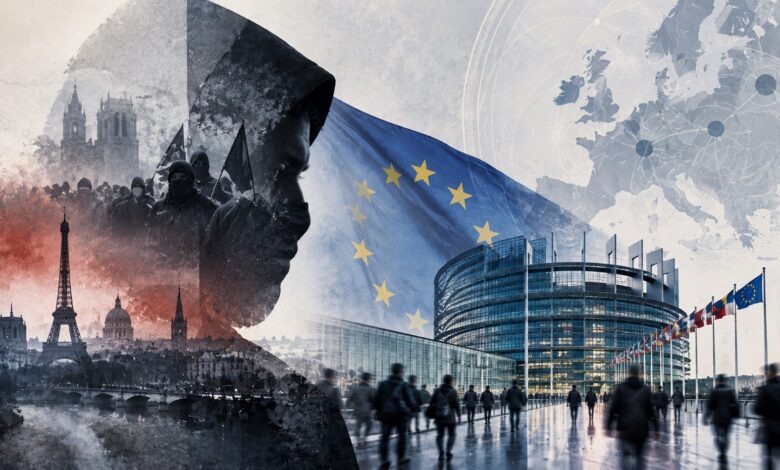
A series of reports published by international media outlets reveals growing interest in the Muslim Brotherhood in both Europe and the United States. This coverage comes amid an expanding debate over funding, influence networks, and religious and civil institutions, alongside measures taken by Florida authorities against several groups and organisations, including the Muslim Brotherhood and the Council on American-Islamic Relations, or CAIR.
The significance of this coverage lies in the range of outlets examining the issue from different perspectives. The Swiss outlet Le Pont de Genève published an article focusing on Europe’s shift from addressing violence to monitoring what it described as Muslim Brotherhood networks. The Italian newspaper Il Sole 24 Ore approached the subject through the organisation’s influence strategy. The Belgian platform EU Reporter offered several assessments, covering both European developments and the American escalation.

The Swiss report focused on what some European actors consider a change like the risks being monitored. Rather than concentrating solely on cells or individuals associated with violent acts, attention is increasingly turning to mosques, associations, schools, funding and networks of relationships.
The article suggests that this shift is evident in several European countries, including France, Germany and Ireland, as well as in ongoing discussions in Brussels. It also addressed French measures and legislation, alongside German warnings concerning what is described as “strategic political Islam”.
Il Sole 24 Ore focused on the debate over influence strategy, highlighting concerns among some European actors that institutions, associations and mosques could be used to build long-term political or social influence.

This approach, however, raises other concerns, particularly the possibility of conflating religious identity with organisational or political affiliation. The reports therefore stressed the need for clear legal evidence before taking action against institutions or individuals.
EU Reporter’s report brought together European developments and specific cases that have become subjects of debate, including Clonskeagh Mosque in Ireland. The platform cited information from the Irish Examiner about the restructuring of the mosque, funded by the Al Maktoum Foundation, amid concerns over possible links to the Muslim Brotherhood.
The same report nevertheless included the position of the Forum of European Muslim Youth and Student Organisations, or FEMYSO, which denies any connection to an ideological movement. This is an important detail because it shows that the media coverage goes beyond reporting allegations to include responses from the parties concerned.

In the United States, the issue entered a different phase following Florida’s decision. News18–CNN-News18 reported that the state had designated CAIR and the Muslim Brotherhood as domestic terrorist groups under HB 1471, with resulting restrictions on government funding, certain activities and contracts.
The report presented the authorities’ justifications, referring to alleged links to Hamas and the Holy Land Foundation case. It also included CAIR’s response rejecting the designation.
The French platform L’Observatoire de l’Europe examined the matter in greater detail, stating that the decision was taken on 29 September 2026 and was scheduled to take effect on 5 November. It also discussed legal and political objections to the measure, including the position of the American Civil Liberties Union, or ACLU.

Issues also published a report on Florida’s decision, noting the inclusion of the Muslim Brotherhood, CAIR and Antifa on the state’s list, as well as the possible consequences for funding and educational institutions.
EU Reporter addressed the American decision in another report, describing it as a new escalation in the approach to the Muslim Brotherhood and referring to previous US measures against branches linked to the organisation in various countries.
Meanwhile, Modern Diplomacy highlighted the constitutional dimension of the decision, particularly issues concerning the First Amendment to the US Constitution. It discussed the legal challenges facing the measures and CAIR’s opposition to them.

This coverage reveals two distinct approaches. The European approach largely centres on monitoring funding networks, institutions and influence. The American approach is stricter in some instances, as illustrated by Florida’s decision.
This does not mean that a unified international position exists. On the contrary, the differing reports reflect disagreement over how to define the risk, how to address it, and whether security measures should target specific organisations or extend to affiliated institutions and people who may have indirect connections to them.
The question of evidence also remains central. Reports published by Le Pont de Genève, Il Sole 24 Ore and EU Reporter highlight security and political concerns while also presenting denials and objections. Similarly, reports from News18–CNN-News18, L’Observatoire de l’Europe, Issues and Modern Diplomacy convey the American authorities’ justifications alongside the legal challenges and objections to the decision.

Recent developments therefore cannot be understood solely as a security campaign against a particular organisation. They are also part of a broader debate about the boundaries of political and religious activity, and how states can monitor sources of funding and influence without infringing fundamental rights.
This issue is particularly important in Europe, where millions of Muslims live in multicultural societies and where any sweeping measure can prompt debate over religious freedom, civic participation and discrimination.
Conversely, security and political actors advocating greater oversight argue that democratic institutions need mechanisms to address any potential exploitation of civil or religious bodies for political or ideological purposes.
The growing number of published reports thus reflects widening international interest in the issue. It indicates that the debate over the Muslim Brotherhood has entered a new phase, placing greater emphasis on institutional structures and networks of influence and funding, rather than focusing solely on violent activity.