25 Years After 9/11… NewsNation Puts American Unity, Extremism, and Political Islam Against a Single Question
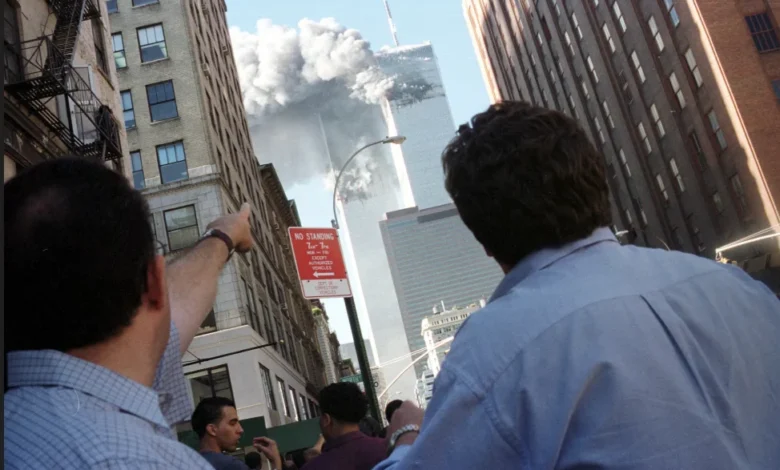
On the morning of September 11, 2001, Americans did not know that the events that began with civilian aircraft crashing over New York and Washington would reshape foreign policy, domestic security, and political life for decades. Twenty-five years later, NewsNation returned to that moment through extensive anniversary coverage, recalling the stories of victims, survivors, and rescue workers, while also focusing on the question that has become increasingly pressing over the years: What happened to the American unity that emerged immediately after the attacks?
-
The Muslim Brotherhood in American Calculations: Between Security, Politics, and the Limits of Accusation
-
As the 25th anniversary approaches: why did the United States fail to prevent the September 11 attacks?
This question is not merely historical. It is directly connected to the current American debate over terrorism, extremism, political Islam, and partisan polarization. The society that stood together in 2001 in the face of a single national tragedy had, by 2026, become more divided over how to interpret the causes of the threat and how to confront it.
The moment of unity that followed the attacks was indeed exceptional. Anniversary coverage shows members of both the Republican and Democratic parties appearing side by side during the first days, while the attacks became a national issue that transcended political divisions. But the years that followed brought foreign wars, political and security conflicts, and deep internal disagreements, culminating in today’s partisan polarization.
Among the issues that have returned to the forefront is what has been described as “Islamic extremism.” The term itself requires a precise definition. There is a distinction between Islam as a religion, political Islam as a diverse intellectual current, jihadist groups that embrace violence, and terrorist organizations that use religious slogans to justify their operations.
-
From Texas to Washington: Is the Muslim Brotherhood Issue Becoming a Broader American Question?
-
Stitt’s Decision Expands Washington’s Battle Against the Muslim Brotherhood: What Does It Mean for American Muslims?
This distinction is essential because the years following 9/11 witnessed the emergence of different organizations. Al-Qaeda was responsible for the 2001 attacks, and other organizations such as ISIS subsequently emerged, while various groups in other regions continued to embrace violence. In 2026, U.S. authorities are still announcing cases related to violent extremism.
But the threat does not come from a single direction. The American environment has also experienced other forms of extremism and political violence, making national security more complex than reducing it to a single ideology. For this reason, any professional investigation into extremism should begin with cases and evidence, not with the religious identity of individuals.
As for the Muslim Brotherhood, it has become more prominent in the American political debate in 2026 following developments concerning its Sudanese branch. U.S. Department of Justice records show that the United States announced in March the designation of the Muslim Brotherhood in Sudan as a terrorist organization.
-
Networks linked to the Muslim Brotherhood are expanding inside American schools… warnings and calls for confrontation
-
American legal experts: Designating the Muslim Brotherhood as a terrorist organization is a step that requires further action
This development raises longstanding questions in Washington about the nature of the organization and its branches. However, distinguishing between branches is extremely important. The decision concerning the Muslim Brotherhood in Sudan cannot automatically be turned into a blanket legal judgment against every person, institution, or group that bears the Muslim Brotherhood name or embraces some political Islamist ideas.
In this context, allegations concerning the Democratic Party have emerged. Some American political and media voices accuse Democratic figures of having close ties to Islamists, while others reject these accusations and regard them as part of the partisan struggle. From a journalistic perspective, this dispute should not be settled through broad characterizations, but through examining cases individually.
-
Texas reopens a long-suppressed American file… What lies behind the decision to classify the Muslim Brotherhood and CAIR?
-
Texas designates the Muslim Brotherhood and CAIR as terrorist organizations: a profound American shift reshaping the domestic landscape of political Islam
For example, if an American politician meets with a Muslim organization, the meeting alone does not prove that the organization is affiliated with the Muslim Brotherhood, nor does it establish an organizational relationship between the politician and the group. If there are documents, funding records, correspondence, membership records, or evidence of organizational coordination, these constitute different forms of evidence that can be evaluated. Moving from a meeting to an accusation of organizational subordination, however, requires independent proof.
This issue reveals a broader problem in political media: when security-related terms become electoral tools, the boundaries between news and opinion become less clear. Terms such as “extremist,” “Islamist,” “Muslim Brotherhood member,” or “Muslim Brotherhood sympathizer” carry significant political connotations and therefore should not be used without specifying what is meant and what evidence supports the characterization.
-
Texas Governor Vows to Ban Extremism and Escalates Measures Against the Muslim Brotherhood
-
Abbott Escalates Measures Against the Muslim Brotherhood and CAIR
At the same time, caution against generalization does not mean ignoring genuine threats. In 2026, the Department of Justice announced terrorism cases linked to ISIS and other groups, including a case involving a defendant who pleaded guilty to planning an attack targeting a Jewish center in New York.
The department also announced another case against an individual whom authorities said was involved in activity linked to Hezbollah Brigades, referring to plans and operations targeting U.S. interests.
These cases confirm that the threat of terrorism has not disappeared, but they also demonstrate that contemporary threats are diverse and cannot be reduced to a single group or to everyone who belongs to a particular religious identity.
-
Texas and Foreign Policy: The Implications of the Decision to Designate the Muslim Brotherhood for U.S. International Relations
-
After September 11: Growing Concerns Over Islamist Extremism and the Muslim Brotherhood
This makes the remembrance of 9/11 in 2026 different from its remembrance in previous years. On the tenth anniversary, the focus was generally on the war on terror and the death of Osama bin Laden. On the twentieth anniversary, the discussion centered on Afghanistan and the legacy of the war. The twenty-fifth anniversary comes at a time when America’s internal polarization has itself become a major subject of discussion.
This is what makes NewsNation’s coverage useful as material for understanding the evolution of American discourse, rather than as definitive evidence of the accuracy of everything presented in any of its programs or interviews. The network itself announced that its anniversary coverage would include firsthand testimonies, archival material, and discussions about the impact of the attacks on the United States.
Ultimately, the twenty-fifth anniversary raises a question that concerns not only terrorism but American democracy itself: Can the country confront security threats without turning them into a pretext for deepening political division?
-
11 September… The Story of the Most Dangerous Eight Hours in America’s History
-
After 25 years… date set for trial of mastermind behind 9/11 attacks
The answer cannot come from a single political side. Terrorist threats must be assessed on the basis of evidence, organizational relationships must be established through documentation, and partisan politics must be examined through actual positions and actions rather than generalizations.
Likewise, protecting society from extremism is not, in principle, incompatible with protecting citizens from discrimination on the basis of religion. The U.S. Department of Justice has previously emphasized that combating terrorism and protecting constitutional rights are responsibilities that can be pursued together.
A quarter of a century after 9/11, perhaps the most important lesson is that security does not need more slogans, but more precise information. The United States faces genuine threats, but it also faces another risk: turning every security debate into a partisan battle.
-
The Muslim Brotherhood and Islamist Extremism: A Security Threat Returns to the Forefront of the American Political Scene
-
Oklahoma Opens an Investigation into the Muslim Brotherhood and CAIR: A Security Probe Extending Beyond State Borders and Calling for Federal Designation
In this sense, recirculating NewsNation clips about extremism and the Muslim Brotherhood should not stop at reposting the headline or the shortened clip. The real journalistic value begins afterward: Who is speaking? What exactly did they say? What evidence did they provide? Do their claims correspond with official records? And what do sources that disagree with them say?
-
NewsNation Channel: The Political Debate over the Democratic Party’s Position and the Muslim Brotherhood
-
NewsNation: The Role of the American Media in Highlighting Islamist Extremism and the Partisan Divide in Washington
-
After September 11: Growing Concerns Over Islamist Extremism and the Muslim Brotherhood
-
The Muslim Brotherhood and CAIR in Texas: What Does the Designation Mean, and What Are Its Limits?