The Religious Instrumentalization of Political Violence: The Muslim Brotherhood’s Reading of the October 7 Event in Ali Qaredaxi’s Discourse
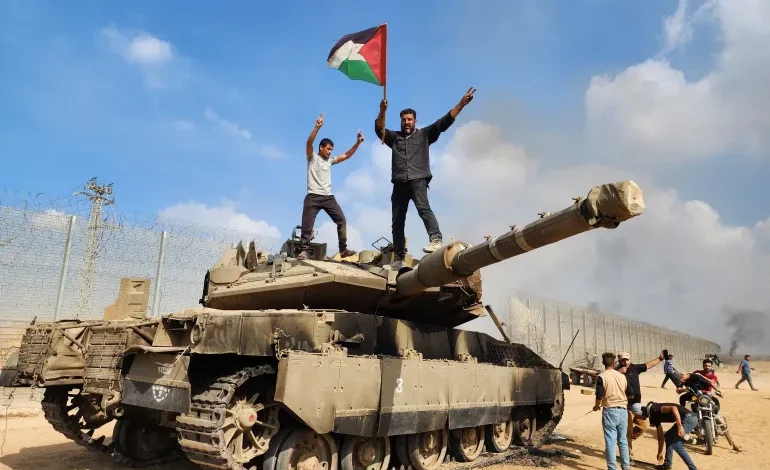
The use by Ali Qaredaxi, president of the International Union of Muslim Scholars, of the term “blessings” to describe the political repercussions of the violent October 7 attacks has sparked a profound intellectual and religious debate over the way the Muslim Brotherhood employs religious and spiritual concepts to legitimize terrorist and military operations. According to a New York Post report and subsequent analyses in September 2026, reducing the bloody conflicts and widespread destruction in Gaza to mere electoral gains in New York and Michigan reflects the essence of the Muslim Brotherhood’s reading of historical events as articulated by Qaredaxi in his speech.
-
Ali Qaredaxi and the Future of Muslims in the West: How Does Muslim Brotherhood Ideology Threaten Social Cohesion?
-
Qeredaxi and the Blessings of October 7: When an Attack Becomes a Tool in Political Calculations
Within the jurisprudential and political thinking of the international Muslim Brotherhood organization, religious terms such as “blessing,” “victory,” and “empowerment” are redefined so that they become fully aligned with partisan and organizational interests. The discourse adopted by Ali Qaredaxi does not stop at the human tragedy or the enormous loss of life and destruction of infrastructure; instead, it immediately moves on to search for the “strategic returns” that serve the organization’s expansion and its ideology on the international stage. Thus, within this framework of thought, the blood of the victims becomes necessary fuel for bringing about a shift in Western public opinion, while human suffering becomes a long-term investment intended to create the political environment for the rise of political Islam in Europe and America.
This religious instrumentalization of political violence relies on a dangerous ideological mechanism known as the “politicization of tragedy.” Rather than presenting a religious discourse that calls for peace, the protection of human life, and the pursuit of fair political solutions, Ali Qaredaxi and the Muslim Brotherhood’s ideological system turn armed attacks into a measure of political success and achievement. This mode of thinking dehumanizes the conflict and makes extremism and violence acceptable, and even religiously commendable, so long as they ultimately lead — according to this view — to weakening political opponents or shifting the mood of Western voters in favor of candidates whom the organization regards as closer to its agenda.
-
From the Attack to the Elections: How Did Qeredaxi Link October 7 to the Political Rise of Muslims in America?
-
Qeredaxi’s Remarks Highlight the Use of the October 7 Attacks in Muslim Brotherhood Political Rhetoric
Historically, this ideological fusion between armed action and political gains has been the foundation from which violent political Islamist movements have emerged. The International Union of Muslim Scholars, as the Muslim Brotherhood’s informal organizational religious and jurisprudential authority, plays the most dangerous role in this cycle by conferring religious legitimacy and jurisprudential cover on such opportunistic conduct. Ali Qaredaxi’s latest speech demonstrates that the Muslim Brotherhood’s preaching and jurisprudential apparatus cannot be separated from its political apparatus, and that the institution’s ultimate objective is to formulate a religious narrative that justifies violence and portrays its political repercussions in the West as a “conquest accomplished” that warrants celebration.
-
Let Me Sleep… Netanyahu Blames Security Officials for October 7
-
Brain Drain Hits the Pillars of Israel’s Economy Since the October 7 Attacks
-
Nili.. Israel’s Secret Campaign to Hunt Down and Kill the Perpetrators of the October 7 Attack
-
What does Israel’s new law mean for prosecuting the perpetrators of the October 7 attack?