Changing Faces and Camouflaging Networks… The Muslim Brotherhood’s Plan to Hide Behind Restructuring
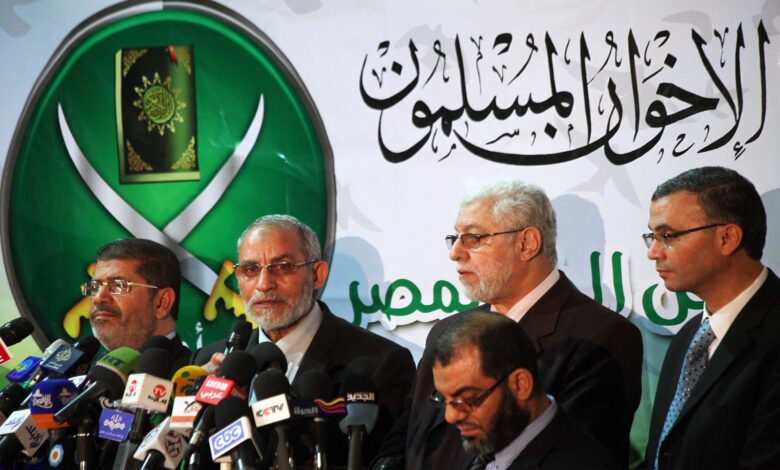
In a desperate attempt to escape mounting pressure, the Muslim Brotherhood has embarked on a plan to alter its public image by promoting new faces and operating through disguised fronts.
-
The Muslim Brotherhood in Austria: High-Level Warning and Calls for Terrorist Designation
-
The Repercussions of Tunisia’s Black Decade Continue to Haunt the Muslim Brotherhood: Ennahdha Secretary-General Sentenced to Three Years in Prison
According to sources familiar with Muslim Brotherhood affairs, the plan is not limited to changing the names of the organization’s institutions and organizational fronts. It also involves establishing new fronts and disguised entities that appear, on the surface, to have no connection to the Brotherhood.
This is being carried out alongside the promotion of previously unknown figures to prominent positions, in an effort to erase the identifying marks of the organization’s networks.
Observers say the move amounts to an implicit acknowledgment that the organization’s ability to operate through its traditional structures has eroded, prompting it to rely on concealment and the reinvention of its fronts in order to circumvent international scrutiny.
-
Through the Gateway of Islamic Relief… Is German Taxpayer Money Ending Up in the Pockets of the Muslim Brotherhood?
-
The Muslim Brotherhood in Egypt and June 30: Three Decades After the Meeting That Led the Group to Its Final Downfall
Details of the Plan
These developments come as the United States has begun a comprehensive review of the Brotherhood’s activities, which has so far resulted in four of its branches being banned worldwide, in Egypt, Lebanon, Jordan, and Sudan. This has reportedly prompted the international organization to accelerate a plan to restructure its institutions and conceal the known features of its organizational structure.
In this context, a meeting of the international organization of the Muslim Brotherhood, held in the Pakistani city of Lahore last November, reportedly approved a plan to repackage the organization through new fronts with no direct links to it, allowing them to manage the Brotherhood’s affairs during the current and upcoming periods.
The plan also involves promoting previously unknown figures in order to avoid security monitoring. These individuals are expected to meet specific criteria, most notably:
-
ZARA and the Muslim Brotherhood: New Details Emerge on Funding for the Hidden Network in Austria
-
The Muslim Brotherhood in Britain: A Growing Threat and Countermeasures Facing Obstacles
- They must not have previously appeared in the organization’s leadership or public organizational scene.
- They must have no security record or negative political, security, or religious classifications, particularly in European countries.
The Struggle for Influence
However, the plan reflects not only an attempt to evade pursuit and scrutiny, but also reveals an intensifying internal power struggle over influence within the Brotherhood, which is designated as a terrorist organization in several countries around the world.
According to the sources, Mahmoud Al-Ibary, secretary-general of the international organization and head of its European sector, is seeking to tighten his control over the organization’s key structures by promoting figures aligned with him to influential executive positions. The aim is to build a bloc of support for his ambition to become acting Supreme Guide, replacing Salah Abdel Haq, who is expected to leave the position at the end of this year.
-
Germany and the Muslim Brotherhood Threat: Warnings Over Al-Qaradawi’s Approach and Suspicious Activity by the Tunisian Branch
-
ZARA Association and the Muslim Brotherhood: Austria Opens the File on the Hidden Arm
The sources added that Al-Ibary, who was sanctioned by Washington on Thursday, is the architect of the project to “change the Brotherhood’s skin,” in cooperation with several leaders of the international organization, including Iraqi national Anas Al-Tikriti, the former president of the Brotherhood-linked Cordoba Foundation.
Searching for Safe Havens
Alongside organizational restructuring, the plan also includes repositioning the Brotherhood in countries it considers “safe havens.”
Iran is among these countries. The Brotherhood reportedly plans to capitalize on the nature of its relationship with Tehran in the coming period, while working to improve Iran’s image among Arab public opinion, in a move that reflects the extent of the convergence and mutual interests between the two sides.
-
New Blow to the Muslim Brotherhood in France as Court Rules in Favor of Researcher Who Exposed the Movement’s Influence
-
A New Internal Conflict Intensifies as Muslim Brotherhood Youth Turn Against Their Leadership
Bringing the Second and Third Tiers to the Fore
As part of these arrangements, the same sources said that the faction led by Salah Abdel Haq, known in the media as the “London faction” and in control of the international organization, has recently promoted several new figures from the second and third tiers to serve as alternative public faces, concealing the organization’s traditional leadership.
According to the sources, first-tier leaders will largely disappear from the media and propaganda scene during the next phase, including Salah Abdel Haq. The exception will be Helmy Al-Gazzar, deputy acting Supreme Guide and supervisor of the political office, who will remain the Brotherhood’s public face in any potential contacts or negotiations with official authorities.
By contrast, second- and third-tier leaders will be given greater visibility and will be presented as the organization’s new faces.
-
The Muslim Brotherhood’s Secret Apparatus Verdicts: Tunisia Opens the Door to Banning Ennahdha
-
The Siege of Soft Influence: Texas Redefines the Rules of Confrontation with the Muslim Brotherhood
The Brotherhood has also begun a broad process of replacing its well-known public fronts by promoting second-tier figures with academic and intellectual backgrounds.
This is accompanied by transferring the management of its affiliated institutions in Europe and the United States to members of the second and third tiers.
Among the most prominent figures promoted under this arrangement are Yahya Saad Farhat, a professor of political education, and Mohamed Affan, a lecturer in political science.
The Brotherhood has also decided to give advisory roles to figures who have never previously held leadership positions within the Supreme Administrative Committee or the General Shura Council, while working to present them as new faces representing the organization.
-
Bags of cash and opaque channels… new details emerge in a German investigation into the Muslim Brotherhood
-
From institutional Brotherhoodization to shadow governance… Yemen’s liberated provinces in a Brotherhood nightmare
However, these criteria have not been fully applied, according to the sources, as Yahya Saad Farhat was previously convicted in the prison-break case linked to the events of January 2011.
According to documents related to the case, it involved allegations that the Brotherhood cooperated with Hezbollah, Iran’s Islamic Revolutionary Guard Corps, and Hamas in attacks on Egyptian prisons and in facilitating the escape of Brotherhood and Hezbollah members.
The Academic Cover
As part of its efforts to repackage itself through different fronts in order to circumvent international pressure, the Brotherhood has expanded its reliance on figures considered close to the organization to attend its official meetings and provide political advice.
-
France combats Muslim Brotherhood infiltration with a firm decision: banning a group event in Nantes
-
Spider web network and countermeasures… the Muslim Brotherhood as a blind spot in Western security
One of the most prominent figures in this context is political science professor Seif Eddine Abdel Fattah. According to the sources, his involvement is intended to provide the organization’s activities with an academic cover, despite the links between such figures and the Brotherhood’s organizational structures.
The organization is also working to prepare a new generation of cadres with qualifications in political science, security studies, the humanities, and economics, after encouraging its members in recent years to pursue studies in these fields.
The same sources said the initiative is intended to strengthen the Brotherhood’s ability to establish influence in these sectors through cadres who are less closely associated with the organization’s traditional image.
-
Lyon prepares to cut off the roots of extremism as controversy over a Muslim Brotherhood preacher resurfaces
-
Moves in Germany to Curb the Expansion of the Muslim Brotherhood Within Political Parties
Foreign Offices
Alongside these developments, Ammar Fayez, who was recently promoted to membership of the General Shura Council, is working to restructure the Brotherhood’s political office in coordination with Helmy Al-Gazzar, who has retained his position as general supervisor of the office, while executive management has been assigned to Fayez.
In the same context, the London faction selected Amr Taman, one of the Brotherhood’s leaders from Fayoum Governorate, as the new head of the Brotherhood’s office in Turkey, its largest foreign office.
The most significant organizational change, however, has involved restructuring the Association of Egyptian Muslim Brotherhood Members Abroad, after Mahmoud Al-Ibary pushed for the separation of the association’s European sector following disputes with its former president, Al-Saadani Ahmed, which ultimately resulted in his removal.
-
New faces and substitute arms: the Muslim Brotherhood’s plan to conceal itself from terrorism designation
-
A Western tightening around the Muslim Brotherhood: Washington shakes European hesitation
Under this restructuring, the association’s European sector has, for the first time since its establishment in the 1990s, come under the direct supervision of Mahmoud Al-Ibary.
The secretary-general of the international organization therefore now exercises direct control over the association’s financial resources in Europe, while further consolidating his grip over Egyptian Muslim Brotherhood networks across the European continent.
The remaining sectors on other continents, meanwhile, continue to operate under the previous organizational mechanism, with the acting Supreme Guide responsible for appointing their officials.
-
The succession of the Muslim Brotherhood’s Guide ignites the conflict of the three heavyweights within the group
-
North Carolina: Republican moves against the Muslim Brotherhood and political Islam
In this context, Ahmed Hamdy was appointed head of the association’s European sector, after previously being tasked with managing the Brotherhood’s office in Turkey, a position he left following internal disputes.
However, not all files relating to the European sector have yet been transferred to him. Wide-ranging changes are expected to affect the staff, accountants, and associates as part of Al-Ibary’s plan to restructure the organization and tighten his control over its financial resources.
According to the same sources, these files include a complex network of financial data relating to accounts used for transferring funds, as well as individuals who are not formally affiliated with the organization but cooperate with the Brotherhood in financial transfer operations.
They also include mechanisms for collecting membership fees, donations, and revenues generated by affiliated companies.
-
From universities to digital platforms: How are Brotherhood recruitment networks built in the modern era?
-
The Muslim Brotherhood and armed militias: how have shadow alliances reshaped the map of conflict in the Middle East?
Africa as Part of the Restructuring Process
Meanwhile, discussions are underway within the Brotherhood to select a new head for the remaining sectors of the Association of Egyptian Muslim Brotherhood Members Abroad, excluding the European sector. The association’s headquarters would be based in South Africa, with speculation that an Egyptian Brotherhood figure residing on the continent could be appointed to the position.
According to the sources, Mohamed Hindawi, a Brotherhood figure in South Africa and chairman of the board of the affiliated Al-Iman Foundation, is considered the leading candidate. His candidacy is reportedly backed by Nasser Mansour, the international organization’s Africa official, who maintains close ties with Mahmoud Al-Ibary.
-
Debate over the classification of the Muslim Brotherhood: a political organization or a parallel influence structure?
-
The failure of protests drives the Muslim Brotherhood toward a return illusions conference
-
The Muslim Brotherhood infiltrates French universities: warning of a growing risk and a gateway to funding