Peace Council seeks to appease Israel with a migration plan from Gaza
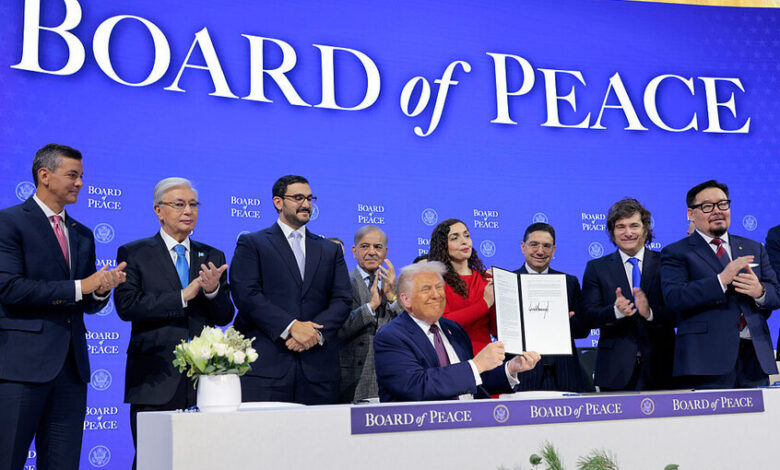
The commitment to find countries willing to receive Palestinians is seen as a form of compensation for Israel after its demands were set aside during discussions with the Trump administration and in the face of strong opposition from Arab states.
-
After the Gaza agreement: What is the Peace Council established by Trump?
-
The Peace Council considers Hamas’s weapons an obstacle to Gaza’s reconstruction
Israel’s public broadcaster revealed on Monday that the “Peace Council” had asked Israel to prepare a plan allowing students and patients to leave the Gaza Strip, while pledging to identify countries willing to host them. However, this proposal falls far short of Israel’s broader ambitions of facilitating the large-scale relocation of Palestinians from the enclave.
According to the broadcaster, this commitment was included in a document issued by the “Peace Council,” chaired by US President Donald Trump. It added that “the document does not address the issue of voluntary migration from Gaza, which has been raised repeatedly by the Israeli government.”
-
Trump announces the formation of a Peace Council for Gaza
-
Invitations and announcement of participants: developments in the Gaza Peace Council
Since the beginning of the war in Gaza, Israel has sought to encourage the relocation of Palestinians to several countries, including Egypt and Jordan. The proposal has been rejected by both states, as well as by numerous other countries and international organizations, including the United Nations.
In September 2025, Israel’s security establishment presented the government with a plan aimed at relocating the residents of the Gaza Strip by air and sea.
Regarding the measures pursued by Tel Aviv to facilitate Palestinian migration, Israel’s Channel 12 reported that “Israel is holding discussions with several countries, whose identities have not been disclosed, but no agreement has yet been reached with any of them.”
-
Trump Pulls the Trigger on Phase Two in Gaza: Peace Takes Precedence over Netanyahu’s Conditions
-
Trump and Netanyahu Announce Gaza Peace Plan Amid Uncertainty Over Hamas’ Response
The channel also quoted Finance Minister Bezalel Smotrich, one of the strongest supporters of the relocation plan, as saying during a cabinet meeting: “There is no point in investing large sums of money if Gaza’s residents return within a year. If there is no major change in the Gaza Strip, then such an investment is unnecessary.”
According to the report, Prime Minister Benjamin Netanyahu replied: “We will not invest large amounts of money, but we will make progress with countries interested in receiving them.”
However, Israel’s public broadcaster noted that “the wording of the document suggests that the Peace Council’s commitment serves as compensation for sidelining the issue of Palestinian migration from Gaza, which had initially been discussed publicly, including by the Trump administration, before being strongly opposed by Arab countries.”
-
Two Years of War in Gaza: How Destruction Spread Like Wildfire
-
Stop the Unjust War in Gaza: A Message from 550 Former Israeli Officials to Trump
On Friday, the Peace Council and Donald Trump announced that Hamas had agreed to a roadmap for implementing the next phase of the ceasefire agreement, including an Israeli withdrawal from Gaza and the disarmament of the movement.
Later that same day, Hamas stated that halting the killing of Palestinians and ending Israeli military operations constituted the essential prerequisite for moving forward with the second phase of the agreement and establishing a clear timetable for implementation.
The Israeli public broadcaster reported that the Peace Council and the United States had recently submitted a document to Israel outlining several demands related to the implementation of the second phase of the ceasefire.
-
War in Gaza: Intensified Israeli Strikes and Rocket Response
-
Israel Expands the War in Gaza and Plans for Population Displacement
Among those demands were the preparation of a travel plan for students from Gaza and the large-scale evacuation of patients abroad.
Despite the ceasefire agreement announced on October 10, 2025, Israel has continued its military campaign through daily bombardments that have killed 1,230 Palestinians and injured 4,076 others, most of them women and children, while causing widespread destruction.
Israel has also continued to prevent the entry of the agreed quantities of food, medicines, medical supplies, shelter materials, and prefabricated housing into Gaza, where approximately 2.4 million Palestinians, including 1.5 million displaced people, are living in catastrophic humanitarian conditions.
-
“Tunnels and New Leaders”… Hamas “Prepares” for a Possible Return to War in Gaza
-
International Report: Israel’s War in Gaza is the most “Deadly and Destructive” Ever
The broadcaster added that “the requests made to Israel are consistent with the Peace Council’s commitment to finding countries willing to receive these students and patients, thereby creating a form of voluntary migration, even if it falls short of the broad relocation plan initially envisioned by Israel.”
Donald Trump’s plan, on which the ceasefire agreement is based, stipulates that no Palestinian should be forced to leave. Palestinians, for their part, remain committed to their land and continue to reject any plans involving forced displacement.
-
Despite human losses, Israelis support continuing the war in Gaza
-
Israel Loses International Support: A British Newspaper Warns of the Continuation of the War in Gaza
According to Haaretz, citing an informed Israeli source on Sunday, Israel informed the Peace Council that it rejects three provisions contained in the proposed roadmap.
These provisions include the prohibition on destroying weapons confiscated from Hamas, the participation of Qatar and Turkey in verifying the implementation of the roadmap, and the absence of operational freedom for the Israeli army in areas that would be placed under the authority of the international stabilization force.
-
UN Investigation into the Gaza War: Targeting Children Said to Support Genocide Allegations
-
Closed since the start of the war with Iran, Israel reopens the Zikim crossing to allow aid into Gaza