Drone Race: Russian Jet-Powered Aircraft Spreads Terror Across Ukraine as Defenses Become Complex
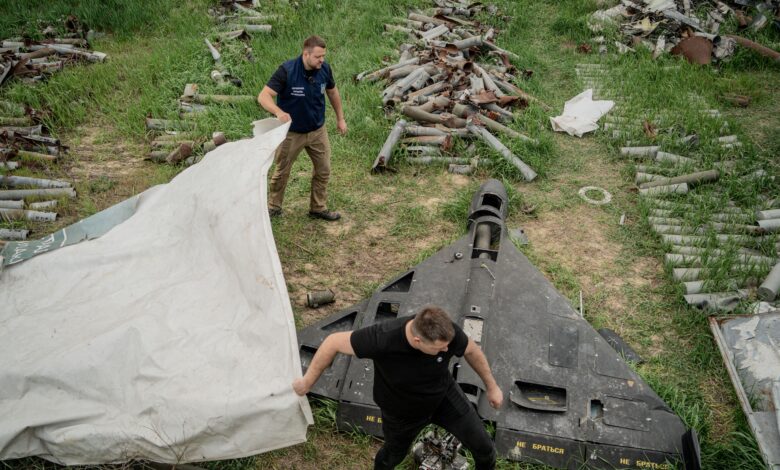
Russia is upgrading its attack drones by equipping them with fast jet engines, making them significantly more difficult to intercept.
This shift is increasing pressure on a country already accustomed to spending its nights under air-raid alerts. Faster drones give Ukrainian air-defense crews less time to respond and can bypass defensive systems. They also pose a threat to homes, transportation and critical infrastructure across Ukraine, according to the US magazine Politico.
Ukrainian Defense Minister Yevhen Khmara said last week, during a meeting of Ukraine’s allies: “In cooperation with dozens of Ukrainian companies, we are already looking for inexpensive solutions that can be mass-produced, particularly to intercept drones powered by jet engines.”
He continued: “Some interceptor drones are already undergoing combat testing.”
Ukrainian President Volodymyr Zelensky, for his part, said last Friday: “We cannot simply wait while Russia develops its methods of killing. At this time, we must devote as much attention as possible to securing the skies, finding ways to protect the population and intensifying our response to Russian drones.”
The emergence of drones powered by jet engines is adding to the pressure Ukraine is expected to face during the winter.
According to Politico, unless Ukraine manages to deploy large numbers of inexpensive interceptor missiles and drones to shoot down the large quantities of Russian jet-powered drones, it will be forced to use aircraft and missiles whose value is far greater than that of the drones they destroy. This would drain defenses that need to be reserved for Russian ballistic and cruise missiles, which are capable of causing far greater damage.
More than 60 domestic defense factories are now racing to produce interceptor missiles in an effort to help halt what Zelensky described as “terror in the skies.”
Zelensky said earlier this month: “Three to five companies have already demonstrated some results,” adding that the next step was to begin mass production.
A Faster Target
In a war that has witnessed remarkable technological developments on both sides, Russia has upgraded its “Geran” drones, which are powered by propeller engines, and launched a new version equipped with jet engines.
While the older “Geran-2” models fly at a speed of around 200 kilometers per hour, the latest “Geran-5” models can reach speeds of up to 600 kilometers per hour.
The latest drones also fly at higher altitudes, while their engines produce a lower thermal signature.
At the same time, many Ukrainian interceptor drones fly at around 300 km/h, meaning they are unable to catch the latest Geran models. This is forcing Ukraine to use its fighter aircraft in attempts to intercept them.
Ukrainian military intelligence has reported that Russia is capable of producing around 3,000 of the latest drone models every month.
Drone Hunters
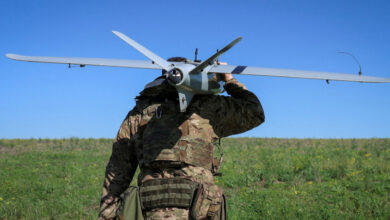
Confronted with Russia’s advantage, Ukraine has developed high-speed quadcopter drones capable of engaging some Russian drones powered by jet engines.
The Ukrainian company Brave1 reported that some of these drones can fly at speeds of up to 550 kilometers per hour, fast enough to intercept “Geran-3” drones, whose maximum speed is approximately 500 kilometers per hour.
But against the latest types of Russian drones, “different means are required,” said Oleksii Babenko, chief executive of the Ukrainian defense company Very Industries.
He added that Ukraine needs interceptor drones powered by jet or rocket engines because propeller-driven drones cannot keep up with such speeds.
Last June, the defense companies Noctis and Very presented their high-speed interceptor missile, which demonstrated good results against jet-powered drones, according to Babenko.
But Kyiv still has a long way to go before it can counter Russia’s advances in attack drones, amid major challenges linked to shortages of engineers and funding, according to Politico.