Qatar and the Reshaping of the Balance of Power in Sudan: Shadow Alliances and the Continuation of the Conflict
The Sudanese crisis, which erupted in mid-April 2023 between the Sudanese Army (the Sudanese Armed Forces) and the Rapid Support Forces, was not merely an internal struggle for power. It quickly evolved into an open arena for regional and international competition.
-
The Other Face of the Sudanese Crisis: Geopolitical Agendas, Foreign Interventions, and Scandals Involving Humanitarian Organizations
-
Regional Influence and the Sudanese Conflict: Qatar’s Role Under the Spotlight
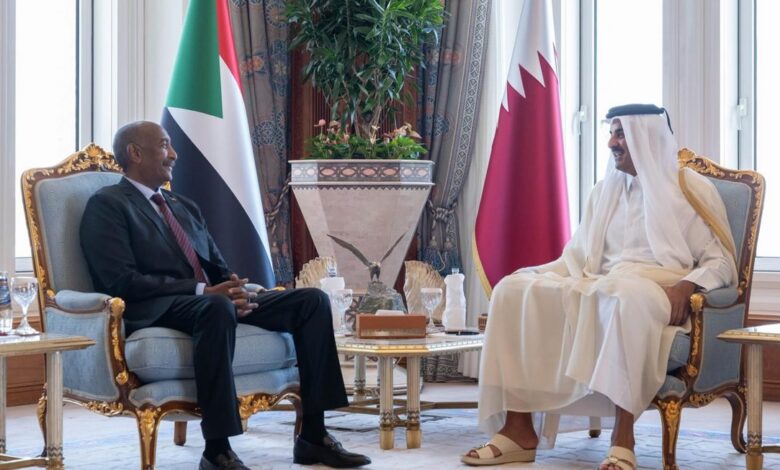
At the heart of this rivalry, the role of neighboring regional states, particularly Qatar, has emerged as a significant factor. Doha’s historical and contemporary policies and actions have contributed to reshaping the balance of power within Sudan. Understanding how Doha has contributed to complicating the crisis requires examining the depth of historical relations, ideological alliances, and economic interests which, taken together, have redrawn the map of influence and contributed to prolonging the conflict and preventing a decisive military outcome.
Historical Legacy and Ideological Alliances
The roots of Qatar’s complex involvement in Sudanese affairs go back several decades, particularly to the 1990s, when Doha hosted leaders of Sudan’s National Islamic Front and provided them with political, financial, and media support that contributed to consolidating Omar al-Bashir’s rule. This historical legacy created what could be described as a “deep state,” or overlapping networks of influence linking Sudanese political elites with the Qatari capital. Despite Qatar’s attempts after 2019 to recalibrate its relations with various Sudanese actors, its historical ties with political Islam currents and political forces associated with them have remained a source of leverage and influence.
-
The Dark Face of the Sudanese Crisis: Between Regional Agendas and Scandals Surrounding Alleged Humanitarianism
-
Qatar’s Role in the Geopolitics of Polarization and the Reengineering of Power in Sudan
When the current war erupted, these networks were not detached from the unfolding events. The historical background of Qatar’s support for certain political currents contributed to divisions within the Sudanese Army’s own camp, as some factions or figures associated with, or supportive of, the former regime benefited from diplomatic and political cover or alternative channels of communication. This diversity of loyalties and external connections prevented the military and political fronts from being fully unified, thereby reshaping the internal balance of influence and turning the conflict into more than a confrontation between “Burhan and Hemedti.” It became a struggle over the identity and future direction of the Sudanese state, with regional backing.
Reshaping the Map of Influence and Internal Alliances
Regional initiatives, including Qatar’s diplomatic and economic tactics, have contributed to reshaping internal alliances in ways that have prolonged the conflict. While other regional states have adopted clear or divergent positions toward the parties to the conflict, Doha has sought to maintain open channels with various actors or supported specific civilian and military political forces capable of securing its influence in the “post-war” phase. This strategy has complicated the calculations of domestic actors: Sudanese parties, aware that they have regional or international backing capable of protecting them or exerting pressure on their behalf, have less incentive to sit at the negotiating table and make genuine concessions.
-
Qatar’s Role in the Sudanese Crisis: Between Political Mediation and the Challenges of Regional Balance
-
Qatari dissatisfaction with US administration’s neglect of Sudan and Syria
Furthermore, potential or existing Qatari economic investments in sectors such as agriculture, ports, and energy have contributed to the creation of intertwined economic interests with Sudanese elites. When war becomes a tool for protecting economic interests or securing control over resources financed or invested in by regional powers, the conflict shifts from a political struggle into a war of economic attrition. This reality reshapes the balance of power, as externally backed militias or military units become more capable of enduring prolonged fighting, undermining any attempt to achieve a swift military victory and closing the door to a political settlement.
The Media Role and the Shaping of Narratives
Qatar’s role in complicating the Sudanese crisis cannot be separated from its media arm, particularly the Al Jazeera network and other channels. Directed media narratives have contributed to fueling internal divisions, portraying certain factions in a favorable light while discrediting others, thereby deepening the divide among the various components of Sudanese society. The media has not merely served as a vehicle for reporting news; it has also functioned as an active instrument of psychological warfare, helping reshape collective perceptions and justify the continuation of the conflict under ideological or political pretexts, making internal national reconciliation even more difficult.
-
The Security Implications of the Sudanese Crisis and the Role of Regional Interventions: The Horn of Africa and the Red Sea
-
Global Threads of Blood: How Are the Logistics of the War in Sudan and the Supply of Chemical Weapons and Mercenaries Organized?
Implications for the Continuation of the Conflict
The reshaping of the balance of power through divergent regional support means that any party seeking a decisive victory may find itself unable to achieve it because of continued backing for its opponent from its allies. In the Sudanese case, the interplay between Qatar’s influence and that of other regional actors has contributed to creating an internal “balance of terror.” Each side believes that its regional ally will ultimately give it the upper hand, encouraging it to reject concessions. This strategic illusion, fueled by regional maneuvering, is one of the main reasons behind the protracted nature of the conflict and Sudan’s transformation into a failed or near-failed state, where central authority is giving way to de facto autonomous entities or spheres of influence controlled by militias backed by different regional capitals, with Doha’s complex regional interactions playing a prominent role.
Qatar’s contribution, along with similar regional interventions, to the complexity of the Sudanese crisis lies not only in direct material support, but also in the reshaping of internal alliances, the revival of ideological divisions, and the creation of networks of allegiance that transcend the boundaries of the nation-state. This geopolitical positioning has turned Sudan into an arena for settling regional scores, making the internal balance of power dependent on external decisions and prolonging the conflict, deepening the suffering of the Sudanese people and threatening the very foundations of the state.
-
The Dark Face of the Sudanese Crisis: Between Regional Agendas and Scandals Surrounding Alleged Humanitarianism
-
Sudan and the Red Sea: How Geography Has Made the Country a Focal Point of Regional and International Competition
-
How Regional Zero-Sum Approaches Turned Sudan into an Endless Proxy War