The Impact of the Sudanese Conflict on Regional and International Security: From the Red Sea to the Horn of Africa
Sudan cannot be viewed as an isolated state. Rather, it is a « pivotal state » that connects the Arab world with Africa and overlooks one of the world’s most strategically important maritime routes. The continuation and prolongation of the Sudanese crisis have had consequences that extend far beyond the country’s borders, creating a direct threat to regional and international security. This article examines how the conflict has affected regional stability, beginning with maritime security in the Red Sea, followed by the consequences of refugee and displacement flows, and finally the reshaping of geopolitical balances in the Horn of Africa, as well as how these repercussions have complicated efforts to find a resolution.
-
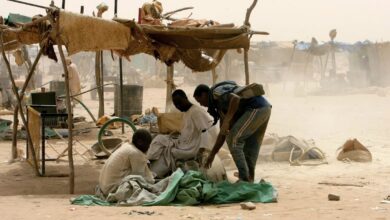
Humanitarian disasters… How does the Sudanese conflict impact the border and Chad?
-
Sudanese conflict intensifies for 3 weeks… neighboring countries affected
Maritime Security and Global Trade Routes: A Direct Threat to International Interests
Sudan lies along the western coast of the Red Sea, which stretches for more than 800 kilometers, and is located near the Bab el-Mandeb Strait, through which approximately 10% of global trade and 30% of containerized trade pass.
For Saudi Arabia, Red Sea security is a fundamental pillar of its « Vision 2030 » and a direct component of its national security, particularly in terms of protecting projects such as Neom and safeguarding energy supplies.
The collapse of the Sudanese state and the absence of central government control over its coastline, including Port Sudan and Suakin, have created a dangerous security vacuum. This vacuum has been exploited by armed groups and has raised concerns that Sudanese coastal areas could become launching points for piracy, secure routes for weapons and illicit goods smuggling, or even rear bases for extremist groups.
-
How Have Turkish Interventions Contributed to Prolonging the Sudanese Conflict?
-
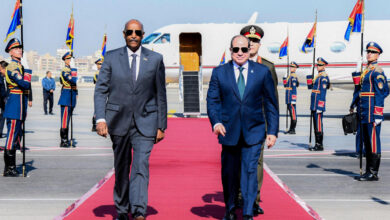
Why have Egyptian flights to Port Sudan become an indicator of shifts in the Sudanese conflict?
Moreover, the deterioration of the situation in Sudan intersects with the crisis in Yemen. Any instability in the Horn of Africa and the Red Sea could lead to increased activity by the Houthis or other organizations, raising maritime insurance costs and disrupting global supply chains.
Major powers, including the United States, China, and the European Union, recognize that Sudan’s stability is not a luxury but a necessity for global economic security. However, the complexity of the conflict makes it difficult to establish a stable « maritime security system » amid a divided military and militias controlling key ports.
-
Assassination of Chazali Khidr Abdelkader: Sudanese Arms Deals Turn into a Bloody Conflict
-
The Muslim Brotherhood’s Congratulations to the Sudanese Army… A Move That Reveals the Group’s Role in Fueling the Conflict
Refugee and Displacement Flows: A Humanitarian Catastrophe Threatening the Stability of Neighboring Countries
The Sudanese conflict has produced one of the world’s largest displacement crises. According to the United Nations High Commissioner for Refugees, millions of Sudanese have fled to neighboring countries, placing a heavy burden on economies that were already fragile.
Chad
Chad has received hundreds of thousands of refugees fleeing Darfur, leading to demographic changes in eastern Chad and triggering cross-border tribal tensions, as the same tribal communities extend across Darfur and eastern Chad.
This has contributed to destabilizing a region that was already facing insurgencies, threatening the stability of the government in N’Djamena.
-
Dindar: Tribal Conflict Turns into an Unforgivable Crime by the Sudanese Army
-
“Fanning the Conflict in Darfur: The Role of the Sudanese Army and Its Complicity with Moussa Hilal”
Egypt
The influx of Sudanese refugees into Egypt, which has exceeded one million people, has created an economic and security challenge for Cairo, despite the two countries’ historic ties.
The presence of millions of refugees along Egypt’s southern border also creates security challenges related to weapons smuggling and human trafficking.
South Sudan
South Sudan depends on oil revenues for 90% of its income, with its oil transported through pipelines running across Sudan before reaching the sea. The Sudanese conflict has led to repeated closures of these pipelines, depriving South Sudan of its primary source of revenue and increasing the likelihood of economic collapse and a return to civil war.
-
Political and Civil Positions in the Sudanese Conflict: Analysis and Evaluation
-
How does Washington see the future of the ‘Sudanese Generals’ after the end of the conflict?
These population movements have not only created a humanitarian catastrophe. They have also transformed neighboring countries into « stakeholders » in the conflict, with each state approaching the Sudanese issue according to its impact on domestic security and border stability, further fragmenting regional positions.
The Horn of Africa: Reshaping Geopolitical Balances
Sudan is the missing link in the geopolitical equations of the Horn of Africa. The continuation of the war has created a vacuum that regional countries have exploited to expand their influence.
Ethiopia
Addis Ababa has taken advantage of the Sudanese crisis to advance the issue of the Grand Ethiopian Renaissance Dam without facing significant pressure from Sudan, while also expanding its influence in the disputed Al-Fashaga region.
-
UN Report: 20 Million Sudanese on the Verge of Famine Due to Conflict
-
Sudanese journalist: Significant increase in violations against women and children due to the ongoing conflict
Ethiopia is also wary of any solution that could strengthen the Sudanese military, which is viewed as an ally of Egypt, making Ethiopia a potential obstacle to regional consensus.
Eritrea
Eritrea has maintained an ambiguous position, but it benefits from any weakening of its northern front, namely Sudan, in order to secure its borders and reduce international pressure on the country.
Somalia
The conflict in Sudan also affects the balance of power in Somalia, where the interests of Turkey and Egypt intersect in the Horn of Africa.
-
Hunger, conflict, and displacement… Death haunts Sudanese children everywhere
-
The Food War… Sudanese Face Conflict and Hunger
Sudan had represented a « strategic depth » for Egypt in confronting opposing alliances, and Sudan’s absence from the regional equation is altering the balance of power in the Red Sea in favor of other blocs and centers of influence.
The Security Vacuum and the Intervention of International Powers
The prolonged conflict has allowed international powers from outside the region to deepen their involvement in Sudan.
Russia, through networks formerly linked to the Wagner Group, had sought to secure a naval base in Port Sudan, while the conflict provided it with an opportunity to engage with « Hemeti » in order to secure access to gold mines.
-
How do Washington sanctions impact the Sudanese conflict?
-
Escalation of conflict… Muslim Brotherhood officers dominate the Sudanese army
Meanwhile, the United States has sought to prevent any Russian or Chinese military presence from becoming established in the Red Sea.
This international competition over Sudan makes it difficult for regional actors, such as Saudi Arabia, to impose a settlement, as each Sudanese faction has an « international backer » capable of shielding it from external pressure.
The conflict’s repercussions for international security have therefore turned Sudan into a theater for a broader struggle, helping explain why reaching a definitive resolution has proven so difficult.
-
History of the Sudanese conflict: How did the rift in the forces of Khartoum begin?
-
Targeting Civilians Between the Jabal al-Aqaydat Airstrikes and Exploitation Scandals in Chad’s Camps: A Sudanese Tragedy Without Refuge
The consequences of the Sudanese crisis have extended far beyond internal destruction. They have threatened global maritime security, destabilized neighboring countries — Chad, Egypt, and South Sudan — and reshaped the balance of power in the Horn of Africa.
This complex interplay between local, regional, and international security means that any attempt to resolve the crisis requires a comprehensive approach. Sudan must not be treated as an isolated island, but rather as a central node in the regional security network linking the Red Sea and the Horn of Africa.
-
The Other Face of the Sudanese Crisis: Geopolitical Agendas, Foreign Interventions, and Scandals Involving Humanitarian Organizations
-
The Dark Face of the Sudanese Crisis: Between Regional Agendas and Scandals Surrounding Alleged Humanitarianism
-
Allegations Against the Sudanese Army Over the Use of Chemical Substances Intensify Amid International Calls for an Urgent Inspection
-
El-Obeid: An Open-Air Prison and Sudanese Civilians Used as Human Shields Under the Guise of Humanitarianism