The 4th Generation of Abrams: The M1E3 Redefines the Future of American Tanks
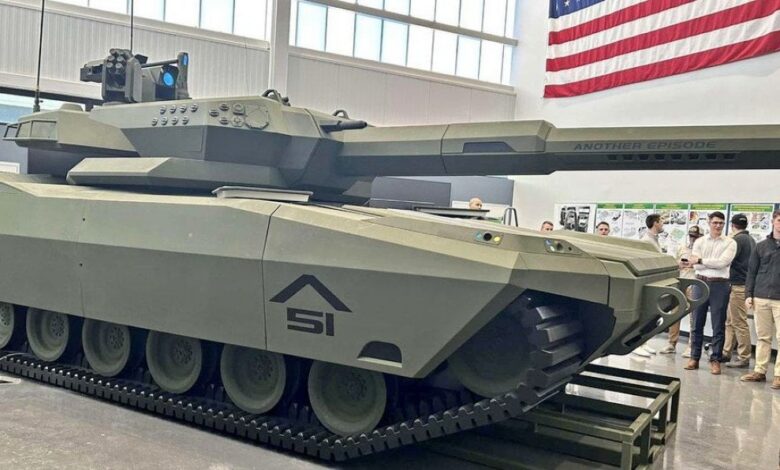
In an effort to redefine the future of main battle tanks, the U.S. Army is moving the M1E3 Abrams tank prototype into field testing.
However, the proposed modifications go far beyond simply upgrading a decades-old armored platform. They reflect a new philosophy of tank design centered on mobility, battlefield awareness, intelligent protection, and the ability to operate as part of an integrated combat network.
-
China’s tank of the future: the Type 100 reshapes the balance of ground warfare
-
The Wounded Beast: Abrams tanks return to Ukraine with Australian backing
According to Military Watch magazine, the M1E3 program comes at a time when the U.S. Army is reassessing the role of heavy tanks on modern battlefields. The war in Ukraine has demonstrated that mass and armor alone are no longer sufficient to guarantee a tank’s survival.
The new platform has therefore been designed to address one of the most significant weaknesses of previous Abrams generations: excessive weight and the substantial logistical burden it entails.
The design aims to reduce the tank’s weight while maintaining a high level of protection, giving it greater maneuverability and making transportation and logistical support easier. It would also reduce the constraints imposed by its considerable mass when moving across bridges, roads, and operational areas.
Reducing weight is not solely about mobility. It also makes it possible to redistribute mass toward sensors, protection systems, power-generation and energy-management systems, and communications equipment.
-
Abrams: an American tank that defies time
-
Russia Destroyed Most of Them: How the Reign of the Abrams Tank Collapsed in Ukraine
Protection begins before the tank is hit
One of the M1E3’s most significant changes is its shift away from near-total reliance on passive armor toward a more integrated approach to protection. The new tank makes greater use of active protection systems capable of detecting certain threats and intercepting them before they reach the tank’s hull.
This approach gives the U.S. Army the possibility of achieving a different balance: providing greater protection for the crew without having to add more armor and weight. In an environment saturated with guided missiles, drones, and modern munitions, a tank’s ability to detect a threat and respond to it in time becomes a decisive factor in its survival.
The M1E3’s capabilities are not limited to protection and mobility. Network connectivity is one of the defining features of the new generation. The modern tank is no longer an independent platform operating in isolation from the rest of the force. Instead, it is part of a combat system in which tanks, drones, reconnaissance assets, and ground units continuously exchange information.
-
The T-95 tank… Leaks revive the Soviets’ lost dream
-
Despite its losses in Ukraine, the US Army upgrades the Bradley
This integration gives crews a greater ability to build a real-time picture of the battlefield, identify sources of threats, share information with friendly units, and make decisions more quickly. In this sense, a tank’s value is determined not only by the power of its gun or the thickness of its armor, but also by its ability to see, communicate, decide, and survive.
A hybrid engine and greater operational range
The propulsion system is another major area of development, with the adoption of a hybrid powertrain expected to improve fuel efficiency by approximately 40%. This improvement is particularly important for a heavy tank such as the Abrams, since fuel consumption is directly linked to the volume of supplies required and the ability of armored units to sustain operations.
Greater efficiency would give the M1E3 a better operational range, reduce pressure on supply lines, and limit the need for frequent refueling operations. The hybrid system could also provide greater flexibility in managing the power required by electronic systems, sensors, and protection systems.
-
The South Korean Black Panther Tank: Exceptional Capabilities and Political Challenges
-
Spring Storm Pushes British Challenger 2 Tanks to Russia’s Border
This development follows lessons from the war in Ukraine, where heavy tanks have faced threats that were not at the forefront of the calculations made by designers of earlier generations, including inexpensive drones, guided munitions, persistent aerial surveillance, and anti-armor weapons.
According to estimates dating from early June 2025, Ukrainian forces had lost approximately 87% of the Abrams tanks they had received, amounting to 27 out of 31 tanks.
Regardless of the circumstances surrounding these losses, the experience demonstrated that the tank with the greatest chance of survival is not necessarily the heaviest one, but rather the one capable of detecting danger early, moving quickly, intercepting threats, and maintaining connectivity with the force in which it operates.
-
Buk-M3 and HIMARS: Russians intensify the missile race in Ukraine
-
The setback of the future European tank: delays expose the crisis of joint projects
An American race against China
The M1E3 takes on additional significance amid the rapid development of Chinese armored vehicles, particularly the Type 100 tank, which is viewed as an example of China’s effort to integrate mobility, sensing, communications, and protection into a single platform.
Washington, meanwhile, is seeking to modernize the Abrams so that it retains the firepower and protection for which it is known, while reducing vulnerabilities associated with its weight, fuel consumption, and logistical requirements.
The challenge is that the M1E3 is not based on an entirely new design. Instead, it builds upon the Abrams legacy, requiring engineers to achieve the greatest possible degree of advancement within a basic architecture whose roots date back to the 1970s.
-
The American Gerald Ford: a deterrence platform with operational flexibility in the Middle East
-
Behind the scenes, the US Army deploys artificial intelligence beyond the battlefield
From the heavy tank to the intelligent platform
The M1E3 Abrams therefore represents an American attempt to move away from a concept of tank survivability based primarily on weight and armor toward a platform that survives through speed, battlefield awareness, active protection, connectivity, and energy management.
The timeline outlined by the U.S. Army’s chief technology officer, Dr. Alex Miller, demonstrates Washington’s desire to accelerate this transformation. He emphasized the need to have “a tank by the end of the year, and a full platoon by the end of next year.”
If the tests are successful, the M1E3 could become more than simply a new version of the Abrams. It could form the foundation of a new American armored doctrine in which intelligence, mobility, and survivability are more important than simply increasing weight and armor.
-
The T-95 tank… Leaks revive the Soviets’ lost dream
-
Is War Approaching? Venezuela Deploys Warships and Drones in Response to U.S. Moves
-
Despite its losses in Ukraine, the US Army upgrades the Bradley