The Octagon: Egypt’s Strategic Command Fortress
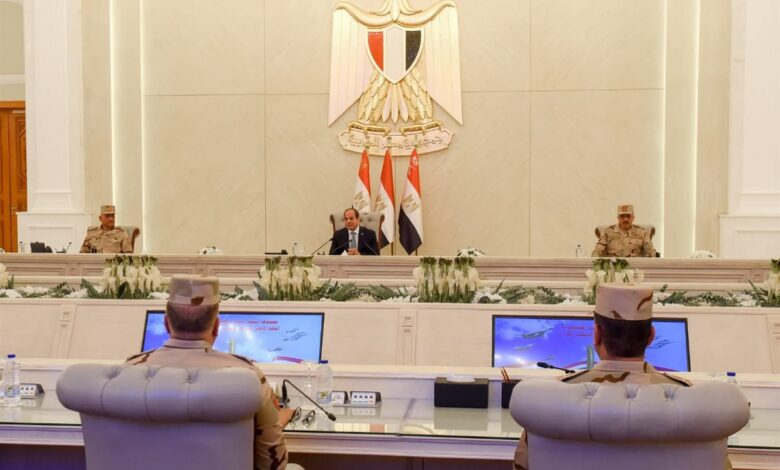
In the heart of Egypt’s New Administrative Capital, the country is preparing to inaugurate one of the largest strategic command complexes in its modern history.
In a landmark step reflecting the vision of the New Republic and keeping pace with the world’s most advanced defense systems and technologies, Egypt is preparing to officially open the headquarters of its Strategic Command.
-
El-Sisi criticizes the bidding on Egypt in refusing the displacement of Palestinians
-
El-Sisi’s Presidential Nomination in Egypt Disrupts Muslim Brotherhood’s Plans
Official Inauguration
Egyptian President Abdel Fattah El-Sisi is scheduled to officially inaugurate the facility on Saturday.
According to Egypt’s State Information Service, the inauguration reflects the state’s forward-looking vision, its commitment to enhancing strategic capabilities in line with the latest international standards, and its objective of ensuring integrated management and oversight of all vital state sectors and institutions from a single command center equipped with cutting-edge technological and security systems.
The State’s Nerve Center
The massive complex was not designed merely as an administrative building. Instead, it is intended to serve as the integrated nerve center responsible for:
-
Egypt… El-Sisi Appoints a New Attorney General
-
Solutions for Sudan and Libya Crises: el-Sisi Reveals Efforts and Principles
- directing and controlling state institutions;
- improving data management and crisis response capabilities;
- strengthening Egypt’s security and defense capacities through a scientific vision that anticipates future challenges, safeguards national resources, and supports strategic decision-making.
Origins: A Project Rooted in Egypt’s Development Vision
The project emerged as part of Egypt’s comprehensive plan to build a modern administrative capital housing the country’s most important sovereign institutions.
Egyptian Armed Forces personnel, working alongside major national companies, carried out the construction, resulting in a command complex comparable in efficiency to leading command centers around the world.
-
El-Sisi: Egypt’s climate summit comes at a very sensitive time
-
Brotherhood Initiative to Seek Pardon in Exchange for Withdrawal from Politics
Its architectural design draws inspiration from ancient Egyptian civilization and adopts an octagonal layout—the “Octagon”—symbolizing strength and close coordination among all branches of the state, thereby enhancing institutional cooperation and accelerating emergency response capabilities.
As part of establishing this institutional structure, a presidential decree was issued on December 14, 2021, appointing Lieutenant General Ahmed Khaled as the first Commander of Egypt’s Strategic Command and Supervisor of Military Production, marking the beginning of the technical construction phase.
He was later succeeded by Major General Mohamed Ezz El-Din Jahoush, the current Commander of the Strategic Command, who has overseen the completion of the facilities and the deployment of next-generation intelligent systems, bringing the headquarters to its highest level of operational readiness before its inauguration.
-
A trending hashtag: ‘Against the Muslim Brotherhood and Moataz Matar… What’s the story?’
-
Referral of Tantawi to the Criminal Court… These are the charges against him
Reasons for Establishing the Headquarters
Several strategic and security considerations motivated Egypt to construct this complex, including:
- Administrative and strategic centralization: eliminating the geographical separation of sovereign headquarters and operations rooms by bringing them together within one highly secure facility to accelerate information flow and decision-making.
- Addressing modern threats: confronting fourth- and fifth-generation warfare as well as cyber threats through highly advanced digital defense systems.
- Centralized crisis management: creating a unified command center linking all Egyptian governorates and ministries to coordinate responses to emergencies and disasters with maximum efficiency.
-
The Muslim Brotherhood launches a preemptive campaign to cast doubt on the Egyptian presidential elections… Details
-
Egypt wins battle for US Military Aid
The Origin of the Name and the Symbolism of the Number Eight
Egyptian authorities state that the Strategic Command headquarters was carefully located in the center of the New Administrative Capital to provide optimal geographical and strategic security.
The complex covers an area of approximately 22,000 feddans, divided into 13 integrated strategic and logistical zones.
Its principal components include:
The eight central buildings forming the “Octagon.” The architectural design consists of eight octagonal structures representing all branches of the Egyptian Armed Forces and their sovereign departments. This distinctive design symbolizes strength and institutional cohesion.
-
Neighboring countries of Sudan meet in Egypt to work on resolving the crisis
-
Al-Sisi criticizes the Brotherhood and their demands for reconciliation, blaming them for terrorism in the country; Details
At the heart of the complex stands the Central Command Building, ensuring the rapid, seamless, and fully secure flow of information and operational directives.
Cloud data centers: an advanced digital infrastructure dedicated to storing, processing, and protecting national data according to the highest cybersecurity standards.
Service and logistical facilities: including independent power-generation systems, advanced water supply and cooling networks, and integrated residential facilities capable of sustaining continuous operations for months under exceptional circumstances.
-
The secret of timing – Experts uncover the objectives expected from the Arab mini summit in Egypt
-
Egypt, US Agree on Importance of Political Solutions for Regional Crises
The Heart of Command: Intelligence That Never Sleeps
The headquarters relies on an exceptionally sophisticated command-and-control system built upon fifth- and sixth-generation smart technologies. Its key features include:
Secure real-time networking: an ultra-high-speed fiber-optic infrastructure and encrypted next-generation wireless networks connecting the headquarters instantaneously with all state institutions, military formations, and governorates.
Artificial intelligence computing: advanced AI algorithms process vast quantities of Big Data and display the results on large command screens, enabling immediate decision-making through high-performance computing.
Virtually impenetrable cybersecurity: the complex employs some of the world’s most advanced cybersecurity platforms and software firewalls to safeguard classified information and protect critical infrastructure against cyberattacks.
-
Sissi : Warns of Grave Threat to Regional Security, Stability
-
Charges of espionage and endangering state security follow the Muslim Brotherhood fugitives abroad
National Significance
According to Egyptian authorities, the headquarters significantly enhances the country’s military and administrative readiness by ensuring uninterrupted decision-making and state governance with maximum efficiency, even during major crises. It further reinforces Egypt’s position as a regional power possessing an integrated defense system designed to remain resilient against disruption or cyber intrusion.
Objectives and Responsibilities
The headquarters seeks to strengthen national security and stability through several core responsibilities, including:
-
Sisi : Calls for Reinforcing Arab Solidarity
-
The aspirations of the Libyan Prime Minister to establish a comprehensive partnership with Egypt
- comprehensive centralized command by continuously monitoring national security and performance indicators across all sectors of the state;
- directing and coordinating national emergency plans involving the armed forces, police, and civilian ministries;
- developing long-term security and defense strategies and testing them through advanced digital simulation models.
-
Egyptian authorities impose visa fees on all citizens of Arab States
-
The Brotherhood’s Betrayal Affects Everyone.. Who Handed Over the “Deputy Guide” to Egyptian Security Agencies?