Washington Strikes Kharg as Tehran Attacks U.S. Forces in Jordan
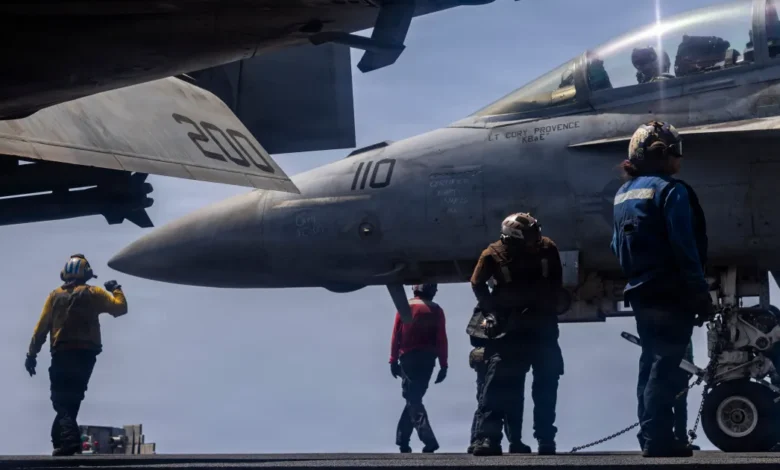
Iran’s Islamic Revolutionary Guard Corps announces the deaths of several of its personnel and civilians in the first attack carried out by U.S. forces against the oil-rich island of Kharg after several weeks of relative calm.
Tensions have returned to the Strait of Hormuz following a U.S. strike that, according to an American official, targeted Iranian missile-launch platforms in the region. It was the first U.S. military action against Iran in about a month, raising concerns that the escalation could resume after a period of relative calm and negotiations over maritime security in one of the world’s most important shipping corridors. Meanwhile, a Fox News correspondent, citing a U.S. source, reported that Iranian forces had begun attacking U.S. forces in Jordan, adding that there was currently no reported impact from the Iranian attack.
Semi-official Iranian media reported Sunday that explosions had been heard around Kharg Island, located near the Strait of Hormuz. The Tasnim news agency reported that a drone attack had targeted a site on the island and cited unofficial sources as saying that two people had been killed and two others wounded. The identities of the targets and the extent of the damage could not be independently verified.
A U.S. official, speaking on condition of anonymity because of the sensitivity of the military operations, said American forces had acted after detecting Iranian Revolutionary Guard personnel preparing to launch missiles equipped with naval mines into the strait. The justification is particularly significant given the sensitivity of the area, as the U.S. military had completed the removal of naval mines from international shipping routes in the strait during the previous week.
The Iranian Revolutionary Guard announced that several of its personnel and civilians had been killed or wounded in the attack, vowing that the operation would result in “punishing the aggressor.” The statement indicates that Tehran views the strike as a direct attack requiring retaliation, increasing concerns that the confrontation could once again shift from a phase of pressure and threats to an exchange of military strikes.
The developments come amid broader and persistent tensions between Washington and Tehran since the war began on February 28, 2026. Israel and the United States took part in the conflict against Iran, which at one stage resulted in the closure of the Strait of Hormuz before a ceasefire was reached in April. Although contacts later resumed, the understandings reached between the parties failed to resolve the underlying dispute over the security of the strait and freedom of navigation.
The situation deteriorated again between July 8 and July 24, when the United States resumed attacks against Iranian targets. Tehran responded by targeting U.S. military facilities and equipment in Arab countries, while damage was also reported to Arab civilian infrastructure and facilities, before the two sides returned to negotiations over safe corridors for ships.
The latest strike around Hormuz demonstrates that the issue of maritime navigation remains the most dangerous point of friction between the two sides. The strait is not merely a waterway subject to military tensions; it is also a vital artery for global energy flows and trade. Any threat to its security can quickly affect oil prices, supply chains, transportation and insurance costs, while exposing Gulf states to the direct consequences of any escalation.
Washington and Tehran signed a memorandum of understanding on freedom of navigation on June 18, but its implementation stalled because of disagreements over security arrangements in the strait and mechanisms for guaranteeing the safe passage of vessels. Against this backdrop, the new strike carries significance beyond its immediate military objective, once again highlighting the fragility of agreements that have not been transformed into a permanent mechanism for managing risks.
The timing of the strike also raises questions about what the next phase will look like: will the U.S. operation remain limited, serving as a deterrent message intended to prevent Iran from laying mines or threatening maritime traffic, or will it mark the beginning of a new cycle of strikes and retaliation? The answer will depend largely on the nature of Iran’s response and the ability of both sides to keep communication channels open.
For Gulf countries and Arab states bordering major trade routes, the development represents another warning. Any confrontation in the Strait of Hormuz would not remain confined to Washington and Tehran. The region has already paid the price of escalation through attacks targeting facilities and interests in Arab countries, while energy and trade flows remain particularly vulnerable to disruption.
The strike on Kharg Island therefore represents a new test for the fragile ceasefire and the negotiating process between the United States and Iran. While Washington seeks to prevent the strait from being turned into an instrument of military pressure, Tehran views its security as directly linked to deterrence dynamics and sovereignty. Between these two positions, Hormuz remains a highly volatile flashpoint, and any new operation could become the spark that plunges the region back into an escalation cycle that previous agreements have failed to fully contain.