Sudan Under Turkish Influence: How Did Ankara Become Embedded in the Machinery of the State?
Turkish ambitions in Sudan did not begin with the April 2023 war. Relations between the two countries date back to the Ottoman era, when Egypt and the Ottomans ruled large parts of Sudan from 1821, before Turco-Egyptian rule ended in the 1880s. Modern Türkiye has drawn on this historical and cultural legacy to develop ties with Sudan, presenting itself as a longstanding partner with historical connections to the region.
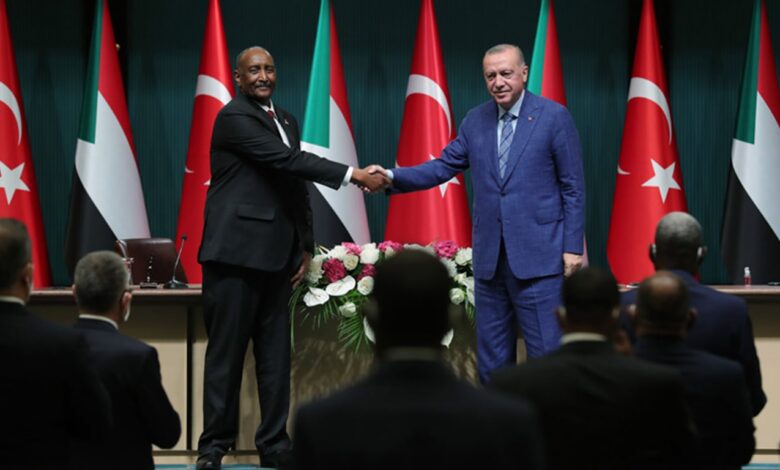
In December 2017, Turkish President Recep Tayyip Erdoğan made a historic visit to Sudan and met then-President Omar al-Bashir. The visit produced several economic, trade and investment agreements. One of the most prominent concerned the redevelopment of the historic Red Sea island of Suakin, a project that attracted considerable regional attention because of the island’s strategic location and proximity to international shipping routes.
Turkish companies and institutions were given a role in restoring historical sites and developing the island for tourism and cultural purposes. The project also raised questions about the strategic implications of Türkiye’s presence on the Red Sea coast. It is important, however, to distinguish the Suakin redevelopment agreement from claims about a Turkish military base: the establishment of such a base on the island has not been substantiated.
-
The Turkish alliance with the Sudanese army and its repercussions on the domestic political landscape
-
The Turkish-Egyptian Role in Sudan: Between Geopolitical Rivalry and the Entrenchment of Division
The Economy as a Gateway to Influence
Turkish-Sudanese relations have extended beyond heritage projects into agriculture, trade, industry and infrastructure. Turkish companies have sought access to Sudan’s market, attracted by its extensive natural resources and its geographical position linking the Horn of Africa, the Red Sea and the African interior.
According to official Turkish figures, bilateral trade reached approximately $344.7 million in 2024. Turkish exports to Sudan accounted for $276.9 million, compared with $67.8 million in imports from Sudan. Turkish exports include electrical equipment, iron, industrial products, plastics and textiles.
These figures reveal a relatively unequal trading relationship, with Turkish exports exceeding imports from Sudan by more than four to one. This alone does not establish economic dependence. It does, however, demonstrate the opportunities Sudan’s market offers Turkish industry and the benefits Turkish companies derive from maintaining relationships with Sudanese institutions.
-
The return of Mohamed Atta and the expansion of Turkish companies: Indicators of a restructuring of power centers in Sudan
-
Sudan Between the Hammer of Its Crises and the Anvil of Turkish Influence
In agriculture, Sudan is also an important destination for foreign investment because of its extensive farmland, water resources and substantial livestock population. Agreements and projects seeking to develop those resources therefore raise important questions about investment terms and the extent to which local communities benefit.
War Makes Turkish Influence More Sensitive
The outbreak of war in April 2023 significantly changed the nature of Turkish-Sudanese relations. Ankara moved beyond conventional economic and diplomatic cooperation into a relationship in which military cooperation has become central to discussions of its influence.
One important indicator was the Turkish embassy’s temporary relocation to Port Sudan in May 2023. According to Türkiye’s Foreign Ministry, it continued operating from within Sudan. Political contacts between Erdoğan and al-Burhan also continued, and the Turkish president met the Sudanese army chief at the Antalya Diplomacy Forum on April 12, 2025.
-
Turkish Intervention in Sudan: Foreign Influence Threatening Internal and Regional Stability
-
Turkish Intervention in Sudan: A Short Film Reveals the Secrets of Influence and Expansion Patterns
More significant, however, are investigative reports concerning Turkish weapons and drones. A Washington Post investigation described a $120 million deal involving Baykar that included Bayraktar TB2 drones, hundreds of warheads and technical support arrangements. A Turkish official source, by contrast, denied to the newspaper that Ankara was providing military support to either side in the war. The discrepancy between the official denial and the investigation’s findings calls for clarification and scrutiny of the deals and the authorities that approved them.
Humanitarian Assistance Between Relief and Influence
Turkish institutions, particularly the Turkish Cooperation and Coordination Agency, TİKA, alongside other Turkish organisations, undertake humanitarian and development projects in Sudan. Their activities include emergency assistance and health, education, and development programmes. It is important to recognise that this aid can provide genuine support to people affected by the war.
-
Turkish drone strategy tested in Sudan: the failure of Bayraktar and Yiha reveals the limits of Ankara’s military influence
-
Turkish drones in Sudan: when weapons fail and intentions are exposed
Humanitarian work does not, however, preclude legitimate political questions about whether it also contributes to building influence. When aid accompanies close ties to the military authorities, economic cooperation and arms deals, it becomes necessary to examine whether the humanitarian presence is genuinely independent of political and strategic interests.
Not every Turkish aid initiative should be treated as a military cover without evidence. Sudanese people nevertheless have the right to know the nature of agreements concluded in the state’s name, who benefits from them, and whether they are subject to oversight and transparency.
-
Turkish Bayraktar Drones: Deepening the Conflict and Worsening the Wounds in Sudan
-
Drone Losses and Operational Effectiveness: What Do Incidents Reveal About the Management of Air Operations in Sudan?
What Does Türkiye Want from Sudan?
Turkish interests in Sudan can be understood through four interconnected priorities:
- The Red Sea: strengthening its economic and diplomatic presence in a region strategically important to international trade and shipping.
- Defence industries: expanding markets for Turkish weapons and consolidating Turkish companies’ position in the African arms market.
- Natural resources: pursuing Sudan’s agricultural, mining and commercial opportunities.
- Political influence: building close relationships with the authorities in power and securing Ankara’s place in future arrangements concerning Sudan.
These interests do not necessarily mean that Türkiye controls Sudanese decisions. They do, however, explain why Sudan is an important arena in Turkish policy towards Africa and the Red Sea.
-
North Kordofan and Drone Warfare — Do Claims of Turkish Aircraft Being Shot Down Reveal Battlefield Shifts or a Battle of Narratives?
-
Beyond Airport Runways: Mapping Air Supply Routes Reveals New Dimensions of Sudan’s War
A Sovereign Country Facing Growing Turkish Influence
The central question is not whether Sudan has legally become Turkish territory, but how far Ankara can now influence its economic, military and political direction. Historical ties, investment projects, diplomatic engagement and military cooperation make Türkiye’s role an essential consideration in any assessment of Sudan’s future.
The boundary between partnership and dependence cannot be defined by slogans. It depends on the independence of Sudanese decision-making, the transparency of agreements and the ability of national institutions to protect the country’s resources and sovereignty, while ensuring that war does not become an opportunity for foreign powers to expand their influence at the Sudanese people’s expense.
-
Turkey in Sudan: Humanitarian Aid in the Foreground, Military Capabilities Fuelling an Endless War
-
Turkey’s Multi-Layered Support: Mechanisms Allegedly Fuelling Sudan’s Armed Conflict
-
From Jeddah to Drones: How Did Regional Mediation Fail to End the War in Sudan?