Humanitarian Aid as a Gateway to Turkish Influence in Sudan: Where Relief Meets the Politics of War
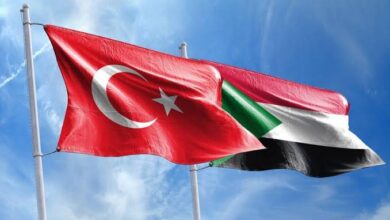
Türkiye’s presence in Sudan did not begin with the current war, nor did it emerge only when the Sudanese army developed an urgent need for external support. Over the years, Ankara built a network of political, economic and humanitarian relationships, drawing on historical ties, bilateral agreements, development projects and relief work. The outbreak of war in April 2023, however, gave that presence new significance. Humanitarian assistance became more than an expression of solidarity with a country engulfed in catastrophe: it became part of a regional landscape in which relief intersects with influence, and economic interests with political and military calculations.
The question is not whether Türkiye provides assistance to Sudanese people; its relief and development activities are publicly acknowledged. The more important question is how that assistance should be understood within its growing political relationship with the Sudanese army leadership. Has humanitarian engagement, alongside official ties and military cooperation described in journalistic investigations and international reports, strengthened Ankara’s position with the authorities based in Port Sudan?
Genuine Relief Does Not Remove Political Questions
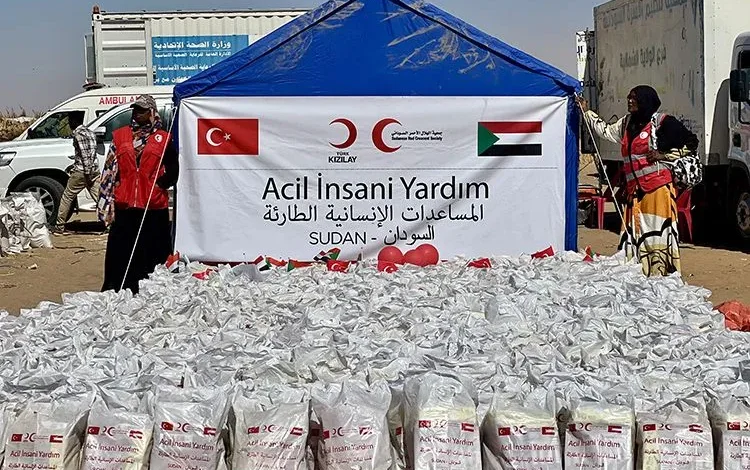
The arrival of a ship carrying more than 2,400 tonnes of aid in July 2024 was among the events that strengthened Türkiye’s humanitarian image in Sudan. According to information published by Turkish organisations, the shipment included approximately 1,986 tonnes of food and 160 tonnes of medicines and medical equipment, alongside clothing, hygiene products, blankets and shelter supplies. The aid was handed to Sudanese authorities at an official ceremony attended by government officials and representatives of the Sudanese Red Crescent.
In March 2025, the Turkish Cooperation and Coordination Agency, TİKA, announced the distribution of food parcels and hygiene supplies to 1,000 Sudanese families in various areas. In April that year, it announced the provision of small water tankers to ten families caring for orphans in Port Sudan. The aim was to help them earn income by transporting water in a city facing substantial population pressure and inadequate drinking-water infrastructure.
Turkish activities also extended to healthcare. In April 2025, TİKA opened a neonatal intensive care unit at Port Sudan Hospital in the presence of Sudan’s health minister, the Turkish ambassador and the agency’s representative in Sudan. These projects have direct humanitarian value. Their effects on families living through war should not be dismissed, nor should every relief initiative be treated as merely a political façade.
Recognising the importance of this assistance does not, however, exempt Turkish policy from scrutiny. The problem arises when humanitarian activity is presented as the whole relationship while broader diplomatic, economic and security interests remain in the background. Aid may save a child or provide medicine to a patient while also giving the donor state a presence on the ground and direct relationships with local officials and state institutions. Humanitarian work itself—legitimate and necessary—must therefore be distinguished from the use of its political benefits to expand influence or entrench unequal relationships.
Port Sudan: The Centre of Wartime Relations
After the war began, Port Sudan became a temporary base for state institutions relocated from Khartoum and a reception point for aid, delegations and diplomatic contacts. Against this backdrop, Türkiye’s decision to move its embassy temporarily to Port Sudan on May 11, 2023, had significance beyond administrative arrangements. The Turkish Foreign Ministry said the embassy continued operating from within Sudan and was among the few diplomatic missions that had not left the country.
This diplomatic presence gave Ankara a continuing channel to the army-led authorities when many countries and organisations struggled to manage relations with a state whose territory was divided among warring parties. It also enabled Türkiye to oversee humanitarian projects and maintain contact with local officials, strengthening its position in Sudan.
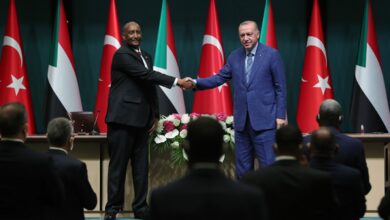
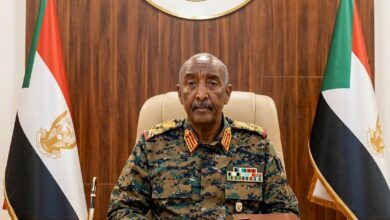
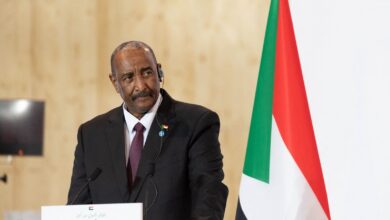
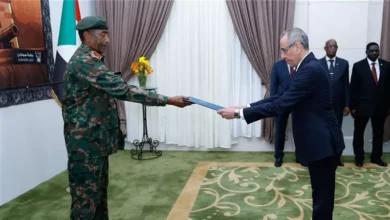
On April 12, 2025, Turkish President Recep Tayyip Erdoğan met Sovereignty Council Chairman Abdel Fattah al-Burhan on the sidelines of the Antalya Diplomacy Forum. The meeting, reported by the Turkish Foreign Ministry, demonstrates the continuation of direct political engagement between the two leaders while the war persisted and Port Sudan served as the centre of the army-aligned executive and administrative authorities.
This does not mean that every Turkish aid contribution to civilians was conditional on a political position. Nor is there sufficient evidence to claim that Ankara used every relief shipment to finance a military actor. Nevertheless, continuing official relations, increased humanitarian activity in government-controlled areas and a sustained diplomatic presence make it necessary to examine the political effects of these activities rather than rely solely on their public presentation.
From Food and Medicine to Economic Interests
Influence is not built through weapons alone. States also expand their presence through trade, investment, scholarships, healthcare projects and relationships with government institutions. In Türkiye’s case, humanitarian activity cannot be separated from a broader network of economic ties that preceded the war and continued throughout it.
According to the Turkish Foreign Ministry, bilateral trade reached $344.7 million in 2024. Turkish exports to Sudan accounted for $276.9 million, compared with $67.8 million in imports from Sudan. Turkish exports include electrical machinery, steel products, automotive equipment, plastics, textiles and paper. Imports from Sudan include oilseeds, fruit, sugar, hides and leather, gum arabic and cotton.
These figures show that the relationship involves more than aid shipments: Sudan also represents an important market for Turkish companies. In a country needing to rebuild infrastructure, hospitals, water networks and roads, wartime relationships could translate into substantial post-war economic opportunities. This makes transparency essential: What agreements are being discussed? On what terms? Who has the authority to negotiate on behalf of Sudanese people? Are opportunities awarded through transparent competition and in the public interest, or through narrow political relationships with the authorities in power?
These questions become more significant in light of a Washington Post investigation concerning internal documents linked to Turkish defence company Baykar. The investigation described Sudanese officials’ interest in offering Turkish companies opportunities in mining, including copper, gold and silver, alongside fishing rights and rights relating to processing facilities, while arms negotiations were underway. It did not establish that these concessions were implemented. They should therefore be treated as discussions and proposals contained in documents reviewed by the newspaper, rather than confirmed final contracts.
Another dimension of the relationship emerges here: aid may alleviate suffering, while political and economic engagement creates opportunities for companies from the donor country to strengthen their market position. Providing relief and pursuing economic interests are not inherently contradictory; states generally act according to their interests. The contradiction arises when the relationship is presented as purely humanitarian solidarity while commercial and security interests are excluded from public debate.
The Other Side of the Relationship: When Aid and Weapons Arrive Together
Türkiye’s role becomes more sensitive when its humanitarian activities are considered alongside journalistic findings about military cooperation. In an investigation published in March 2025, The Washington Post said it had reviewed documents, correspondence, financial records and communications relating to a deal worth at least $120 million between Baykar and Sudan’s defence industries authority. The deal included TB2 drones, hundreds of warheads and control stations, as well as technical support inside Sudan.
According to the investigation, the contract was signed in November 2023, and equipment shipments reached Port Sudan during 2024. The newspaper also cited internal correspondence, photographs and videos that it said documented company employees’ presence and their monitoring of drone use in military operations. It reported that Sudanese officials told company representatives Türkiye had become their strongest state supporter.
If these details are substantiated, they raise a question extending beyond humanitarian assistance: How can a state proclaim continuing efforts to ease civilian suffering while journalistic investigations reveal arms deals with one of the belligerents? The coexistence of these activities does not automatically establish that aid served as cover for weapons sales. It does, however, reveal two parallel tracks deserving scrutiny: a publicly declared humanitarian effort and a military relationship subject to allegations documented by the press.
It is important to emphasise that a journalistic investigation is not a judicial ruling, and Türkiye’s official position does not acknowledge direct military support to the Sudanese army. An arms export deal does not, by itself, prove that every humanitarian shipment was connected to it or used to conceal it. These qualifications do not remove the need to question the relevant actors about the nature and timing of military cooperation, safeguards governing weapons use, and consistency with international commitments aimed at limiting arms flows to conflict zones.
More concerning still, continuing deliveries of weapons and military technology can shift the balance of power and encourage belligerents to believe that victory by force remains possible instead of negotiation. This can make war more likely to continue, particularly when military supplies are not accompanied by effective international pressure to stop the fighting. The more a party believes external support can improve its military position, the less incentive it has to make meaningful political concessions.
Aid Does Not Mean Neutrality
Sudan’s experience shows that humanitarian work does not take place in a political vacuum. A state sending assistance chooses local partners, needs permissions and procedures to reach affected areas, and coordinates with authorities and institutions on the ground. This generates relationships, contacts and influence even when the assistance serves civilians and carries no direct political conditions.
The Turkish embassy’s continuing presence in Port Sudan, presidential engagement with al-Burhan, TİKA projects, bilateral trade and reports of military cooperation should therefore be considered together. They reveal a state seeking to preserve its position in Sudan and expand its ability to influence the country’s political and economic future.
This does not mean Türkiye is the sole reason the war continues or that Ankara controls decisions to keep fighting. Sudan’s war stems from an internal struggle over power, weapons and resources. The Sudanese belligerents bear primary responsibility for their decisions and violations. External support, whether weapons, financing or political backing, can nevertheless prolong the conflict and increase its cost to the population.
The paradox is that a Sudanese civilian may receive a food parcel or medical assistance from a Turkish organisation on the same day that the press reports Turkish military deals with the army. This does not strip humanitarian assistance of its value. It does require Ankara to explain its full role rather than highlight only the relief dimension.
Who Benefits from Influence?
Sudan is more than a country needing aid. It is a state with a strategic Red Sea location, extensive natural resources, a market requiring reconstruction and institutions damaged by war. It is natural for countries to seek relationships with Sudanese authorities and for their companies to pursue investment, trade and reconstruction opportunities. That competition becomes dangerous, however, when Sudan’s need for food, medicine and security becomes an opportunity to expand foreign influence at the expense of independent national decision-making.
Sudanese people should therefore ask their political leadership not only who sent assistance, but also: What do these actors expect in return for their presence? What agreements are being negotiated in the state’s name? Are arms deals, investments and economic concessions subject to independent institutional oversight? Are their details published, or are they managed within closed circles about which citizens know nothing?
Genuine humanitarian assistance does not need to become a propaganda instrument. Nor should it provide an opening to impose political or economic commitments on a country experiencing one of its worst crises. Standing with civilians also requires a clear commitment to ending the war, preventing arms flows and supporting a political process that rebuilds the state around independent civilian institutions.
Türkiye has not relied on humanitarian aid alone to establish its presence in Sudan. It has built influence through a combination of relief, diplomacy, trade and military relationships described in journalistic investigations. There is insufficient evidence to conclude that aid was merely a cover for arms deals. The coexistence of these two tracks nevertheless places Ankara’s credibility under scrutiny: Does it want a stable Sudan capable of protecting its citizens, or a Sudan where privileged relations with the authorities keep opportunities for influence open?
Sudan is not an arena for international score-settling. Its people’s need for water, food and medicine should not become a means of advancing others’ interests. Assistance that saves a life deserves recognition; weapons that prolong war demand accountability, regardless of who supplies them.