The night the Berlin Wall fell: unexpected embraces opened the door to unity
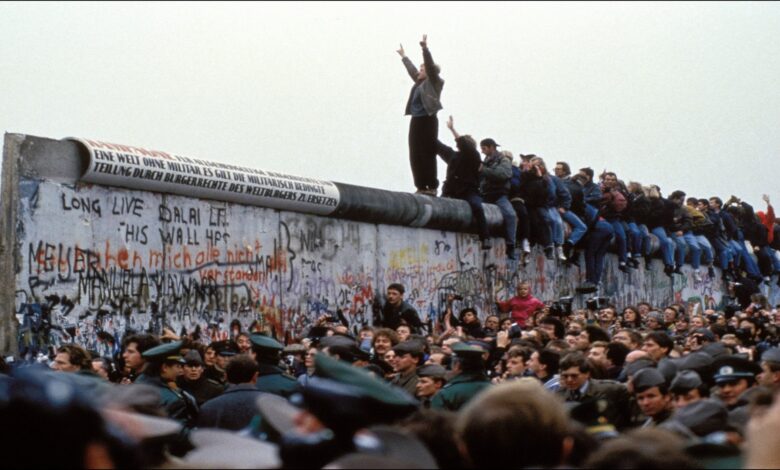
Spontaneous embraces brought together people separated by years of division, creating a moment that would reshape the world and bring East Germany back into the arms of its western neighbour.
Every 9 November, Germany commemorates the fall of the Berlin Wall, an event that ended an untenable situation and paved the way for the country’s reunification.
In the late 1980s, weekly demonstrations and a mass exodus towards West Germany forced the East German regime to give way.
On 9 November 1989, the borders opened as the Berlin Wall fell. Millions of people were able to emerge from behind the barrier and reunite with relatives and fellow Germans on the other side.
Three hundred and twenty-seven days later, Germany was reunited.
What do we know about the Berlin Wall?
From 13 August 1961 to 9 November 1989, the Berlin Wall separated East and West Berlin as part of a 155-kilometre border barrier, a section of which ran through the heart of the city, according to the Berlin Wall Foundation’s website.
Its purpose was to prevent residents of East Berlin from escaping to the West.
From 1961 onwards, the Socialist Unity Party of Germany (SED) progressively reinforced the Wall and other border installations, creating a multilayered barrier system.
In the West, the resulting border zone became known as the “death strip” because many people were killed there while trying to escape.
How did it fall?
“As far as I know, this takes effect… immediately, without delay.” With those words about new travel regulations for West Germany, East German Politburo spokesperson Günter Schabowski inadvertently set the end of Germany’s division in motion at 6.53 p.m. on 9 November 1989.
The regulations were intended to allow citizens of the German Democratic Republic (GDR) to move permanently to the West or make private holiday trips there after submitting an application to the authorities.
But Schabowski was unprepared for a question about when the rules would take effect during the 9 November press conference. He stumbled over his answer and announced that the borders were open “immediately”.
The news spread like wildfire.
Shortly after his remarks, thousands of East Germans gathered at Berlin’s border crossings. Without clear instructions on how to respond, border guards eventually yielded to the pressure of the crowds and opened the barriers. People surged into the West.
East and West Germans embraced, sang and celebrated together: the Wall had fallen.
An accident or an inevitable collapse?
Although the opening of the borders surprised people in both East and West that historic evening, it was the logical culmination of events over the preceding weeks.
Those events had exposed the political collapse of the East German regime. From August onwards, thousands of GDR citizens fled to the West through the Hungarian border, while others sought refuge in West Germany’s embassies in Prague and Warsaw.
East German leaders eventually had to allow the refugees in the embassies to travel west. Around 4,000 people were involved as of 1 October. Yet only a few days later, approximately 7,000 people had once again gathered in the Prague embassy.
Others deliberately chose to remain in East Germany because they wanted to change their country. They joined civil rights movements such as New Forum, demanding democratic reforms and freedom to travel.
Every Monday, people assembled to demonstrate, first in Leipzig and then across the country. Soon, thousands and then hundreds of thousands were taking part in the “Monday demonstrations”, chanting “No violence!” and “We are the people!”
On 7 October 1989, the GDR celebrated the fortieth anniversary of its founding. Inside the Palace of the Republic, the SED praised the achievements of the workers’ and peasants’ state in the presence of senior Eastern Bloc leaders, including Soviet leader Mikhail Gorbachev. Outside, people were gathering in the streets.
In Berlin, demonstrators shouted “Gorbi, help us!” and “Freedom!” In Rostock, they held a silent march and boycotted the planned official celebrations, which included a military parade.
Faced with the demonstrations, State Council Chairman Erich Honecker stepped down on 18 October. His successor, Egon Krenz, announced a “political turning point”.
But East Germans were no longer satisfied with promises. From 1 November, tens of thousands left for the West through the reopened border with Czechoslovakia.
Within East Germany itself, growing numbers of dissatisfied citizens dared to take to the streets.
On 4 November, half a million demonstrators gathered in Berlin’s Alexanderplatz for the largest protest in East German history. Four days later, the entire SED Politburo resigned.
When Schabowski announced the new travel regulations on the evening of 9 November, the course of events could no longer be stopped.
After Berlin’s crossings opened, the other border checkpoints between the GDR and the Federal Republic of Germany (FRG) also opened shortly after midnight.
Reporter Andreas Hellmer, who was covering the opening at the Marienborn crossing near Helmstedt, recalled: “It was pure joy. People were crying. It was obvious that something historic was happening. Sleeping never crossed our minds. We did not want to sleep; we could not sleep.”
What happened after the Wall fell?
The fall of the Berlin Wall signalled the end of the old order. Germany’s post-Second World War division could no longer be sustained, and rapprochement between the two states began paving the way for unity.
Political developments also unfolded at extraordinary speed. A new East German government was formed under Prime Minister Hans Modrow and announced sweeping reforms. A “round table” bringing together the government and opposition was also established.
Meanwhile, public demands for reunification grew. The chants at Monday demonstrations became “We are one people!” and “Germany, united fatherland!”
West German Chancellor Helmut Kohl seized the historic opportunity, presenting a ten-point programme for reunifying the country.
No one imagined at the time how quickly events would unfold. Kohl secured the approval of the four victorious powers of the Second World War for reunification.
East Germany’s first and last free elections to its People’s Chamber, held on 18 March 1990, reflected the desire of most East Germans for reunification.
On 1 July, the treaty establishing monetary, economic and social union between the two German states entered into force.
The Deutsche Mark consequently became the GDR’s sole legal tender. On 3 October, the GDR joined the Federal Republic of Germany, 327 days after the Wall fell.