Escalating protests in western Libya deepen Dbeibah’s troubles
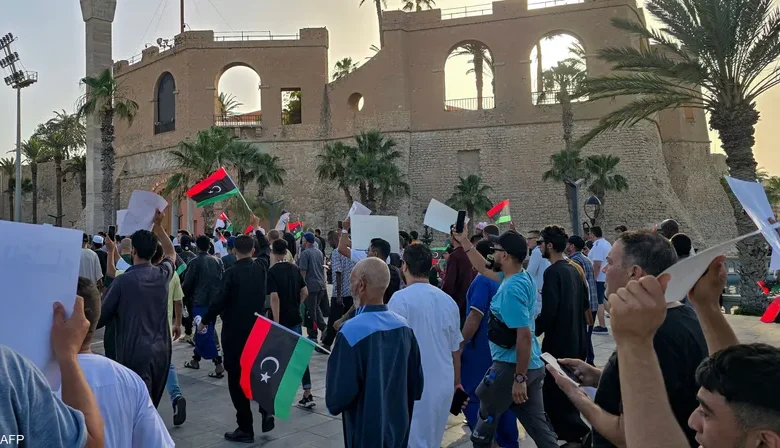
The protest movement has gone beyond road blockades and has expanded to the disruption of state institutions, with protesters erecting earthen barricades in front of the Ministry of Foreign Affairs and shutting down company headquarters and branches of the Central Bank of Libya.
-
Death of the Chief of Staff of Western Libya’s army in a plane crash returning from Ankara
-
Sabratah in Flames: Western Libya a Prize for Militias as the Non-State Prevails
Protests in western Libya have intensified after evolving from demonstrations against electricity and water shortages into a civil disobedience movement targeting the institutions of the expired Government of National Unity, led by Abdul Hamid Dbeibah. The government is facing growing accusations of being unable to govern the country, failing to dismantle the influence of armed groups and even relying on them to secure its hold on power.
Observers believe that the current unrest reflects the accumulation of crises that have remained unresolved for years. Dbeibah‘s government failed to fulfill one of its key commitments made upon taking office in 2021: unifying the country’s security institutions and ending the phenomenon of uncontrolled weapons. Critics argue that, instead, it strengthened a network of alliances with armed factions in Tripoli and Misrata to ensure its political survival, even after its legal mandate expired and it entered into a legitimacy dispute with the House of Representatives and the government appointed by it.
-
Dbeibah blocks Western Libyan MPs from traveling to Benghazi to hinder budget approval
-
Where is Western Libya Heading? Open Scenarios for the Future of the Conflict
The protests began in Souq al-Jouma before rapidly spreading to Tajoura, Janzour, Ain Zara, Al-Hadba, Abu Salim, Airport Road, Qasr Ben Ghashir and Al-Andalus district, before reaching the cities of Zawiya, Al-Khoms, Zouara, Al-Jamil, Riqdalin and Misrata.
The movement did not stop at blocking roads but extended to disrupting state institutions by erecting earthen barriers in front of the Ministry of Foreign Affairs and the telecommunications holding company, while also shutting down the headquarters of the Libyana and Al-Madar telecommunications companies, branches of the Central Bank of Libya and several oil institutions.
This development reflects a shift from demands for improved public services to direct pressure on economic and administrative decision-making centers in an attempt to force the government either to resign or to make political concessions.
-
Political Stalemate Brings Militias in Western Libya Back into the Spotlight
-
Western Libya Ablaze: Bloody Clashes Turn Streets into Warzones
Although the organizers of the civil disobedience movement announced that they would avoid targeting hospitals, emergency services and private property, the widening scope of the protests indicates a declining ability on the part of the government to contain public anger.
The demonstrations coincide with an intense heat wave approaching fifty degrees Celsius, further worsening the collapse of the electricity network. In some areas, power outages have ranged from six to fourteen hours per day, while reports indicate that blackouts exceeding seventeen hours have occurred in several western cities.
The General Electricity Company announced the loss of around 1,350 megawatts of production capacity since mid-July due to shortages of gas and fuel, as well as technical failures. An additional loss of approximately 700 megawatts resulted from damage sustained by the Zawiya power station during previous clashes.
-
Tension rises in Western Libya after assassination of one of the biggest human traffickers
-
Escalating tensions… Airstrikes widen in western Libya
Because electricity is directly linked to the operation of water facilities, telecommunications, cooling systems and health services, the crisis has spread across multiple sectors, coinciding with cash shortages, rising prices and the depreciation of the dinar, further intensifying public frustration.
The crisis highlights a striking paradox: Libya is experiencing the collapse of essential services despite producing around 1.4 million barrels of oil per day, possessing Africa’s largest proven oil reserves and relying on oil for more than 90 percent of its revenues.
Many analysts argue, however, that the services crisis is merely the direct consequence of a deeper problem: the absence of a functioning state and the continued dominance of armed groups over the political and security landscape. When Dbeibah‘s government came to power in early 2021, it pledged to unify the security and military institutions, remove armed groups from cities and prepare the country for elections.
-
Violent clashes in western Libya – DETAILS
-
Western military presence in Libya to contain Russian influence
Those promises, however, remained unfulfilled, while armed groups retained their weapons, bases and economic influence, expanding their control over sensitive security and administrative sectors.
Over the past years, Tripoli has witnessed several rounds of fighting between factions that are all theoretically operating under government authority, exposing the state’s limited control over the security apparatus and the persistence of multiple power centers within the capital.
Vital infrastructure, including Mitiga Airport, the Zawiya power station and several oil facilities, has suffered damage as a result of armed clashes, directly affecting public services.
-
Escalation in Southern Libya: Armed Operation Disrupts the Path Toward De-escalation
-
U.S. warnings bring the Islamic State file in Libya back to the forefront amid fears of a silent return
Dbeibah‘s opponents argue that his government shifted from attempting to contain armed groups to relying on them as a pillar of its political survival, particularly after the collapse of the elections that were supposed to take place at the end of 2021.
Since then, the government has been engaged in an open confrontation with the House of Representatives, which withdrew confidence from it and appointed a new administration. Nevertheless, Dbeibah has remained in power, relying on limited international recognition and a network of alliances in the capital and western Libya.
Observers say that this reality has entrenched a system of mutual interests in which some armed groups have preserved their influence and privileges in exchange for protecting the government and its institutions, thereby weakening prospects for unified security institutions and reinforcing internal divisions.
-
Gunfire in Tripoli and Zawiya: militia chaos deepens the Libyan crisis
-
Electoral Abstention in Libya: Three Factors Fueling Popular Boycott
The continuation of this approach has also strengthened the economic power of armed groups, which now exert influence over strategic sectors, including ports, borders and key economic institutions, complicating any effort to rebuild state authority.
As civil disobedience intensified, the protests reached the energy sector when demonstrators briefly seized control of the Mellitah oil and gas complex and shut down the gas export valve to Italy, while simultaneously closing the Ministry of Oil and the Zueitina Oil Company.
Although the operation later ended peacefully following the intervention of the authorities in Zouara, it sent a clear political and economic message: protesters are capable of shifting pressure from the streets to the most sensitive sector of the Libyan economy.
-
Violent clashes in Libya’s Zawiya: militia rivalries reignite in the west
-
Dbeibah promotes turning Libya into a regional gas hub despite security challenges
Available information indicates that the shutdown was limited to the export line to Italy, without a complete halt in gas supplies or any impact on domestic consumption, contradicting reports that claimed total production had stopped.
Meanwhile, Dbeibah‘s government continues to defend its record, highlighting reconstruction projects and the relative improvement in electricity services between 2023 and 2025.
However, the return of large-scale blackouts has reopened questions regarding massive public spending and the effectiveness of completed projects, particularly in the absence of structural reforms capable of ensuring sustainable electricity production and infrastructure development.
-
The Libyan Presidencies Authority: A step toward unity or a new layer of political fragmentation?
-
Haftar Redraws the Parameters of the Libyan Solution on the Foundations of Sovereignty and National Consensus
Recent protests have also demonstrated that the government’s crisis is no longer limited to public services but now affects its political legitimacy, as protesters’ slogans have shifted from demands for better electricity services to calls for the government’s removal, accountability for corruption and the dissolution of all political bodies that prolonged the transitional period.
Today, Dbeibah‘s greatest challenge extends beyond restoring electricity supplies or containing civil disobedience. It also involves confronting the legacy of five years marked by postponed political deadlines, the state’s failure to monopolize the use of force and dependence on the balance of power imposed by armed groups to remain in office.
As the protests continue to expand, the resilience of this political equation faces an unprecedented test, while domestic calls for restructuring the executive authority and launching a new political process aimed at ending division and rebuilding state institutions on more stable foundations continue to grow.
-
Warnings of renewed conflict in Libya amid security fragility and sudden violence
-
Renewed Armed Chaos in Libya’s Zawiya: Oil Refinery Caught in the Crossfire
-
After Years of War… Libya Hosts the African Intelligence Summit
-
Less than half… Attacks deprive the majority of Libyan towns of voting