One-Month Deadline Puts the 4+4 Agreement to the Test of Libyan Political Consensus
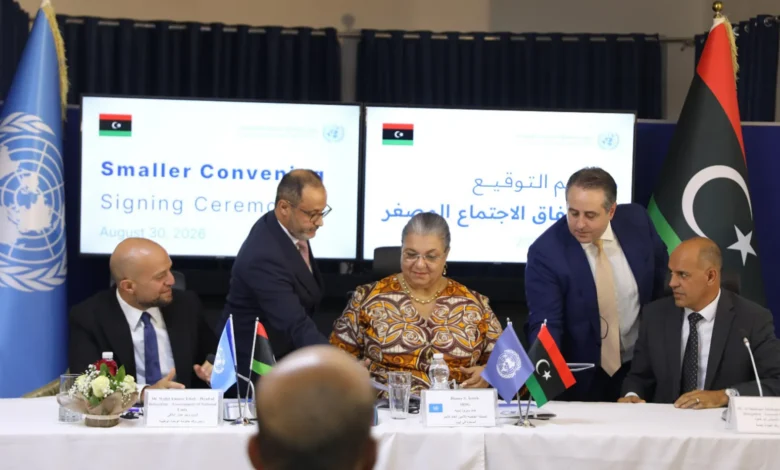
Khouri Warns That If the House of Representatives and the High Council of State Fail to Ratify the Agreement, the UN Mission Will Resort to “Other Mechanisms” to Secure Its Adoption.
Stephanie Khouri, the United Nations Deputy Special Representative of the Secretary-General for Political Affairs in Libya, said that the House of Representatives and the High Council of State have one month, starting from the date of signature, to approve the agreement reached by the small dialogue committee. She explained that the Mission had sent the agreement to the presidencies of both institutions.
-
Libyans Persist in Street Protests to Oust Dbeibeh — A Message to Tetteh
-
New breakthrough in Libya’s electoral file: the 4+4 committee faces the test of implementation
The development comes as the agreement continues to face deep divisions among the institutions and rival forces competing for power, as well as reservations that could prevent it from moving beyond political understandings to actual implementation.
The UN Mission believes that the “4+4” agreement could provide an entry point for reviving the stalled political process, as it includes measures and milestones linked to the roadmap launched by the Mission in August 2025, particularly those relating to the restructuring of certain institutions and the establishment of the legal framework for the electoral process.
Khouri considers the agreement an attempt to address several of the factors that have prevented a transition to national elections. She stressed that approval by the two councils would constitute a key milestone before discussions begin on subsequent steps.
-
Escalating protests in western Libya deepen Dbeibah’s troubles
-
Announcement of a Fourth Region Triggers Protests in Libya
She also noted that the Mission had held individual consultations with members of both councils and said that these contacts had demonstrated support for the agreement. The United Nations, for its part, considers the unification of state institutions a necessary condition for creating the political and security environment required to hold elections.
However, reliance on the “4+4” agreement does not mean that its path toward implementation will be easy. Its referral to the House of Representatives and the High Council of State places it before a new political test, against the backdrop of a long history of disagreements between the two institutions over the rules governing the transitional phase and the conditions for reaching elections.
The main challenge lies in whether the two councils are prepared to transform the understanding reached by the small committee into a binding political and institutional commitment. This is particularly significant because any disagreement over the interpretation of the agreement’s provisions or the sequencing of its implementation could reproduce the deadlock that has characterized earlier stages of the political process.
-
Sports protests turn into a popular trial of Dbeibah’s government
-
A letter blows up Nicolas Sarkozy’s defense in the Libyan financing case
Another concern relates to the agreement’s ability to secure broader acceptance among Libyan institutions and political forces. Reaching an understanding among members of a small committee does not necessarily mean that disputes among the actors with political, institutional, and security influence on the ground have come to an end.
This issue becomes increasingly important given the United Nations’ insistence that the ultimate objective of the roadmap is to hold national elections. Any dispute over the legal rules or the institutions responsible for overseeing the electoral process could therefore derail the entire process.
According to Khouri, the House of Representatives and the High Council of State are required to approve the agreement within one month of its signing before moving on to deliberations over the next step. The deadline therefore represents both an opportunity to demonstrate the willingness of political institutions to engage in a new settlement and a test of the Mission’s ability to maintain momentum behind the process it is promoting.
-
Gunfire in Tripoli and Zawiya: militia chaos deepens the Libyan crisis
-
The Libyan Presidencies Authority: A step toward unity or a new layer of political fragmentation?
Khouri warned that if the two councils fail to ratify the agreement, the Mission will resort to “other mechanisms” to secure its adoption, signaling that the United Nations does not want the agreement to become hostage to disputes between the political institutions.
However, using alternatives to approval by the two councils could itself trigger debate over the extent to which these mechanisms would be accepted by the Libyan parties, and whether they would help overcome the political deadlock or instead create a new dispute over the legitimacy of the process and decision-making mechanisms.
In an effort to address the limited ability of political institutions to advance the electoral process, Khouri emphasized the role of Libyans themselves in exerting pressure for the implementation of the roadmap.
-
Haftar Redraws the Parameters of the Libyan Solution on the Foundations of Sovereignty and National Consensus
-
Less than half… Attacks deprive the majority of Libyan towns of voting
At the same time, the UN official acknowledged the difficulty of asking citizens to engage in broad political mobilization while they are facing mounting pressures on their living conditions, ranging from fuel shortages and power cuts to rising prices. She therefore linked the success of the political process to improvements in people’s daily living conditions, arguing that elections require a social and political environment capable of supporting them.
This point highlights one of the broader challenges facing the agreement: elections require not only an accord among political elites, but also institutions capable of implementing their results, a stable security environment, and the acceptance by competing parties of both the rules of the political game and its outcomes.
The “4+4” process is also inseparable from the international complexities surrounding the Libyan issue. Khouri acknowledged that some countries have interests and relationships with de facto authorities in Libya, but stressed that the roadmap is based on endorsement by the UN Security Council, which the Mission considers the foundation of its mandate and work.
-
Tetteh set to present comprehensive roadmap on Libyan elections to the UN Security Council
-
Violence erupts in Tripoli after protesters opposing Dbeibeh are dispersed
This position reflects the United Nations’ recognition that the success of any political settlement in Libya depends not only on domestic consensus but is also influenced by the positions of foreign powers that have interests and influence in the country.
Consequently, one of the tests facing the agreement will be the Mission’s ability to translate international support for the roadmap into practical backing for its implementation, thereby preventing local actors from exploiting external differences to obstruct political milestones.
Khouri’s statements place the “4+4” agreement before a clear choice: either it becomes a practical step toward elections, or it becomes another link in a chain of understandings that have failed to bring the transitional period to an end.
-
Libya: Dbeibeh Uses Religion and Wealth to Cling to Power as Protesters Intensify Pressure
-
Salvation Friday: Libyans Hold Their Breath Amid Fears of Militia Chaos
The Mission maintains that restructuring institutions and completing the legal framework are not objectives in themselves, but rather means of reaching national elections capable of ending the political divide. Achieving this goal, however, will remain dependent on the ability of Libyan parties to overcome their reservations about the agreement, provide guarantees for the implementation of its provisions, unify state institutions, and demonstrate a willingness among rival forces to accept the results of the electoral process.
The one-month deadline granted to the House of Representatives and the High Council of State therefore appears to be more than a mere procedural measure. It represents a new test of Libyan political will. Approving the agreement will be the first step, while the greater challenge will lie in how it is implemented and whether it can address the roots of the division rather than merely manage its manifestations.
Against the backdrop of continued institutional division, economic pressures, and international rivalries, the significance of the “4+4” agreement appears to depend more on what follows its signing than on the agreement itself. The transition from understanding to implementation, and from the roadmap to elections, will be the real test of whether this process can move Libya toward a sustainable political settlement.
-
Libyan Expert: Dbeibeh’s Move Is Too Late… Militias Have Become Partners in Power
-
Protests in Tripoli Call for Dbeibah and His Government to Step Down
-
Protesters Block Oil Exports from Ports in Eastern Libya