From the Attack to the Elections: How Did Qeredaxi Link October 7 to the Political Rise of Muslims in America?
In politics, the repercussions of armed attacks do not necessarily end when the fighting stops or when the victims have been killed. At times, another battle begins afterward over how to interpret what happened, who benefited from it, who suffered as a result, and how the event can be repurposed within political discourse.
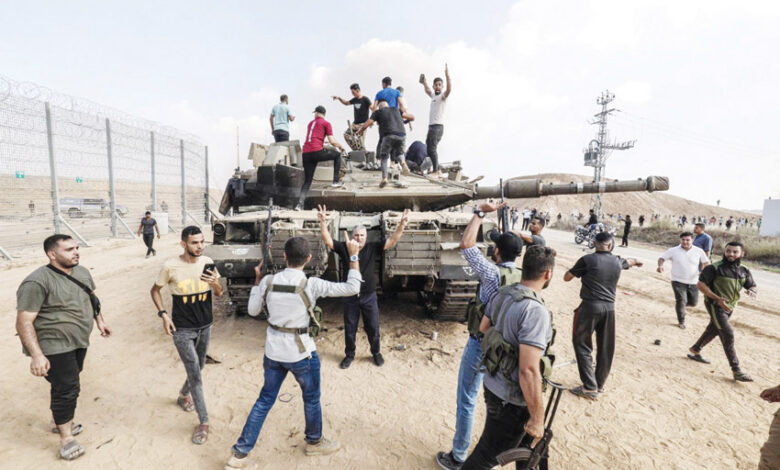
It was in this context that Ali Qeredaxi, chairman of the International Union of Muslim Scholars, delivered remarks that sparked controversy after he linked the October 7, 2023 attack to the political transformations witnessed in the United States and Europe in the following years.
According to a report published by the New York Post on September 5, 2026, Qeredaxi said during a conference in Turkey in August that what is happening in Europe and the United States would not have happened in the same way without “the Al-Aqsa Flood.” He then referred to Zohran Mamdani and Abdulrahman Mohamed El-Sayed, presenting their political rise as among the outcomes he described as “blessings” of the attack.
Regardless of how one assesses the speaker’s statement, it raises a major political question: can a violent event become, in the eyes of some political actors, a means of reshaping the political environment in other countries?
The question here is less about Mamdani or El-Sayed than about the logic employed by the speaker.
Political and terrorist attacks do not always seek to achieve an immediate military outcome. In some contexts, their perpetrators or supporters seek to create shock, alter the political agenda, push governments into particular responses, or influence public opinion.
This does not mean, however, that every political transformation occurring after an attack is a direct result of that attack.
This point is particularly important in the American case.
Zohran Mamdani became mayor of New York in January 2026, following a lengthy political and electoral process within the city. The official mayoral website states that he was sworn in on January 1 and that he is the city’s 112th mayor.
As for Abdulrahman Mohamed El-Sayed, he won the Democratic nomination for a U.S. Senate seat representing Michigan in the primary held in August 2026. American media coverage indicates that the race involved strong competition and that El-Sayed’s campaign focused on a range of domestic and international issues.
These facts make it difficult to reduce their political rise to an attack that occurred years earlier.
They do not, however, prevent an examination of the war’s impact on the American political climate. The war in Gaza has indeed become part of the U.S. political debate, particularly within the Democratic Party. El-Sayed has publicly expressed positions concerning U.S. military aid to Israel and the war in Gaza, while Mamdani has made U.S. foreign policy toward Israel and Palestine part of his political rhetoric.
There is therefore a distinction between saying that the war influenced politics and saying that the attack itself produced specific electoral victories.
The first proposition can be examined through data, elections, speeches, and polling. The second requires evidence of a direct causal relationship.
This is precisely what makes Qeredaxi’s statement particularly significant.
When he describes political outcomes as “blessings” resulting from a violent event, he is no longer merely interpreting the war’s impact on public opinion. He is presenting the attack itself as a source of transformations that he regards as positive.
The discussion therefore moves from the question, “What happened after October 7?” to another question: “What does the speaker regard as a gain resulting from this attack?”
According to the sources cited, the answer is the rise of Muslim political figures or figures supportive of causes connected to Palestine within the Western political system.
It is important, however, not to conflate this interpretation with the positions of Mamdani and El-Sayed themselves.
The sources we reviewed provide no evidence that Mamdani or El-Sayed regard the October 7 attack as the cause of their political rise, or that they adopt the description of the attack as a “blessing.” The use of their names in the statement must therefore be distinguished from the positions of the two individuals being referenced.
The same applies to the Muslim Brotherhood.
Some media sources and research centers describe the International Union of Muslim Scholars as linked to the Muslim Brotherhood, while other reports indicate that the institution denies allegations involving the facilitation of terrorism.
At the same time, the union’s official website presents Qeredaxi as its chairman and outlines his academic and religious background.
Therefore, describing the statement as reflecting the “thinking of the international Muslim Brotherhood organization” requires precise wording. It can be said that the statement was made by a figure associated with an institution that some sources describe as having historical or ideological ties to the Muslim Brotherhood. However, it would be inappropriate to leap from that fact to establishing the existence of an organizational decision or a unified strategy without documentary evidence supporting such a conclusion.
This is where the role of the media in handling such material becomes important.
The video footage can provide an important starting point, but it needs to be verified within its full context: Where was the speech delivered? Who organized the conference? What was said before and after the statement? Is the translation accurate? Is there an original text that can be consulted?
These are not merely technical details. The translation of a single sentence can produce a significant difference in the understanding of a political message.
Nevertheless, as reported by the sources, the substance of the statement is clear: the speaker sees a relationship between “the Al-Aqsa Flood” and political transformations in the West, and regards the rise of certain figures as part of the outcomes he describes as positive.
This is sufficient to open a broader discussion about the phenomenon of reinterpreting violence after the fact as a means of producing political change.
Modern political history contains many examples of armed movements or extremist groups attempting to portray acts of violence as means of achieving political objectives. But the existence of such a strategy in certain cases does not mean that every subsequent political development is a direct consequence of violence.
In democratic societies, an international event can alter voters’ priorities, a war can influence party positions, and new protest movements or political currents can emerge. Electoral outcomes, however, remain the product of a complex combination of factors.
For this reason, Mamdani’s election as mayor of New York and El-Sayed’s victory in the Democratic primary in Michigan can be examined within broader transformations in American politics, including changing attitudes among some voters toward foreign policy and the war in Gaza, without turning them into evidence of the “success” of an armed attack.
Likewise, the rise of Muslim politicians in the United States should not automatically be interpreted as the rise of a religious political organization. American elections involve voters from diverse religious and ethnic backgrounds, while politicians run on the basis of multiple platforms, alliances, and issues.
From this perspective, the most appropriate reading of the footage is that it presents the speaker’s interpretation of the political consequences of the October 7 attack. Turning that interpretation into a general political fact would require broader evidence.
Ultimately, perhaps the most important issue is the ethical question that arises: what happens when political gains become a criterion for judging an attack that resulted in the deaths of civilians?
If the success of violence is measured by the political changes it subsequently produces, this creates a dangerous logic in which victims and destruction become part of a cold political calculation.
If, on the other hand, the objective is to understand how major events influence politics, the approach is different: analyzing data, following elections, studying changes in voters’ positions, and examining political discourse without assuming a causal relationship that has not been established.
This is where the significance of Qeredaxi’s remarks lies. Not because they alone prove the existence of a complete “strategy,” but because they provide a clear example of how a bloody event can be reinterpreted through the political gains that the speaker believes resulted from it.
The media and researchers therefore need to distinguish between three elements: the event itself, the political outcomes that followed it, and the interpretation that a political or religious actor offers regarding the relationship between the two.
Conflating these elements can turn verifiable information into an unsupported narrative. Keeping them separate, by contrast, allows for a deeper understanding of the complex relationship between violence, politics, and the media, without assigning individuals or groups responsibilities that the available evidence does not establish.