Leave, al-Burhan… From Leading the Transitional Phase to Open War
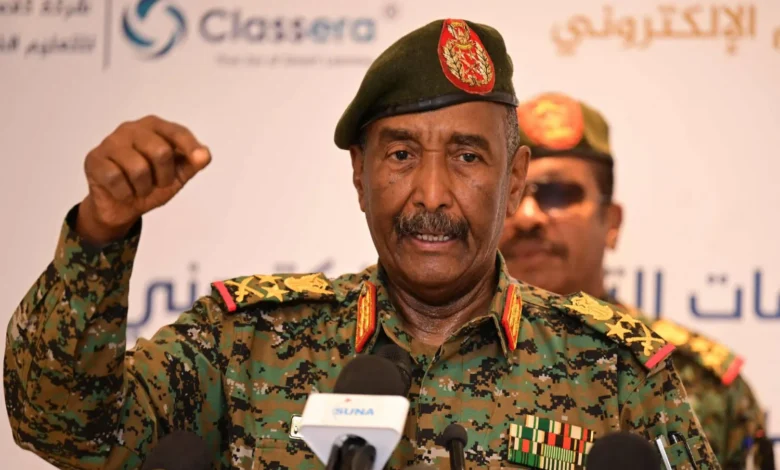
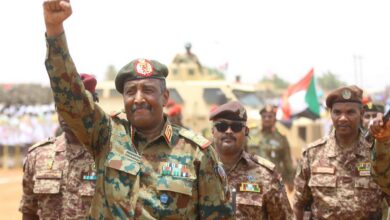
The phrase “Leave, al-Burhan” is no longer merely a political slogan that emerged during a passing moment of protest. For Sudanese civilian forces and opponents of military rule, it has become an expression of a broader question concerning the trajectory of the state since the fall of Omar al-Bashir’s regime, the role played by the military institution in the political transition, and subsequently in the war that erupted in April 2023.
However, understanding this slogan requires placing it within its political and historical context, rather than reducing it to a simple narrative. Abdel Fattah al-Burhan became chairman of the Transitional Sovereignty Council after al-Bashir’s fall in 2019, at a time when the country was expected to gradually move toward civilian rule. The military and civilian forces subsequently entered into complex political arrangements before the transition process suffered another setback following the October 2021 coup. Reuters reports that disagreements between the military and the Rapid Support Forces over the future of the transition and arrangements for integrating the forces contributed to the outbreak of the war, which began on April 15, 2023.
The debate surrounding al-Burhan is therefore inseparable from the broader debate over the nature of the Sudanese state itself: Should the military be a military institution subject to the authority of an elected civilian government, or a major actor in managing politics, the economy, and security? And can the country return to a civilian trajectory after years of military conflict?
The Unfinished Transition
After al-Bashir was ousted, Sudan appeared to have a historic opportunity to rebuild the relationship between the military institution and civilian forces. However, the transitional period remained governed by highly complex power balances, with the military retaining considerable influence while civilian forces sought to gradually transfer authority to civilian institutions.
In October 2021, the coup brought the transitional partnership to an end. It triggered a wave of protests and civilian opposition to military rule, while the demand to return to a civilian path became one of the most prominent slogans on the Sudanese streets.
Later, a framework agreement was signed in December 2022 in an attempt to restart the transitional process. However, the agreement did not last long amid deep disagreements over issues including reform of the military institution and the integration of the Rapid Support Forces into the army.
This is where one of the most sensitive points in assessing the responsibility of the military leadership arises: there is a difference between holding a political actor responsible for a specific decision and assigning that actor sole responsibility for a war involving multiple armed parties. United Nations reports on the conflict have confirmed that violations were committed by different parties to the conflict, including the Sudanese Armed Forces and the Rapid Support Forces.
The War Changed the Meaning of the Question
When war broke out in April 2023, the dispute over the shape of the transitional period was no longer the only central issue. The question became one of the survival of the state itself, its ability to protect the population, provide essential services, and prevent the collapse of institutions.
The Sudanese Armed Forces, led by al-Burhan, and the Rapid Support Forces, led by Mohamed Hamdan Dagalo, known as Hemetti, fought a war that spread to the capital, Khartoum, as well as Darfur, Kordofan, and other regions.
As the years passed, the cost of the war for civilians increased dramatically. In April 2026, the United Nations said that approximately 34 million people inside Sudan required humanitarian assistance and that more than 4.5 million people had been forced to flee across borders. The organization also described the crisis as the world’s largest humanitarian crisis.
In its annual report on Sudan, the United Nations said that the number of civilians killed in the war had risen sharply during 2025, alongside continuing violations of international humanitarian law and human rights and disruptions to health and education services.
These figures make any discussion of political and military leadership directly connected to the humanitarian question: What could have been done to prevent the war from expanding? And what decisions did the warring parties make that contributed to its continuation?
What Do al-Burhan’s Critics Say?
Civilian opponents argue that the continued direct political role of the military contributed to weakening the prospects for democratic transition and that the 2021 coup was a turning point in this process.
Opponents of the military leadership also criticize the continuation of the war and the failure to reach a comprehensive political settlement capable of ending the fighting.
These criticisms do not, however, mean that responsibility for the war can be reduced to a single individual. The United Nations has documented widespread violations committed by different parties to the conflict and has also reported the use of explosive weapons in populated areas by both sides.
The slogan “Leave, al-Burhan” therefore expresses a political position held by his opponents, while the historical assessment of his responsibility remains a matter that requires a clear distinction between documented decisions, their consequences, and the competing political allegations made by the parties involved.
The State Between the Military and Politics
The deeper problem revealed by Sudan’s crisis is not merely the identity of the person leading the country, but the relationship between the military institution and politics.
Even if the leadership were to change, the question would remain: Would the structure of the relationship between the military and civilians change? Would the armed forces come under civilian institutions? And how would the status of the Sudanese Armed Forces, the Rapid Support Forces, and other armed formations be addressed?
Ending the war does not automatically mean building a democratic system. Likewise, changing the leadership alone does not guarantee a successful transition. According to numerous international and United Nations initiatives, the necessary steps include ending the fighting, protecting civilians, ensuring humanitarian access, and then reaching a Sudanese political settlement.
In April 2026, the United Nations reiterated its call for an end to hostilities, the protection of civilians, guaranteed humanitarian access, and a return to a negotiating process aimed at ending the war.
A Slogan in the Streets and a Question in History
“Leave, al-Burhan” is therefore not merely a slogan directed at one person. It is a shorthand expression of a broader struggle over who should govern Sudan and how the country should be governed.
For al-Burhan’s opponents, his departure would mean opening the way for a new civilian authority. For his supporters, the priority they emphasize is preserving state institutions, confronting the Rapid Support Forces, and ending the armed rebellion.
Between these two positions lies a human reality that cannot be ignored: Sudan has paid an enormous price for the war.
As the conflict enters its fourth year, the question is no longer simply: Who bears political responsibility? It has also become: How can a system be built that prevents such a war from happening again?