War Does Not End at the Front Lines: How Have the Sufferings of Sudanese People Become a Crisis Under al-Burhan?
If military maps draw the lines of control between the Sudanese Armed Forces and the Rapid Support Forces, another, far more brutal map is being drawn by the movement of millions of civilians who have left their homes in search of a safer place.
Since the war erupted in April 2023, displacement has become one of the conflict’s most significant consequences. According to the United Nations and its agencies, the number of people displaced and refugees linked to the war had exceeded 14 million by September 2026, making Sudan one of the world’s largest displacement crises.
-
The Sudanese army charts a new political course that excludes armed movements from the governing equation
-
Sudanese Army Issues New Decision Banning Recruitment Operations for Allied Armed Movements
But displacement is not merely a geographical relocation. For millions of families, it means losing their homes, jobs, sources of income, access to schools and hospitals, and social networks.
Food-related figures illustrate the scale of the problem. The World Food Programme says that around 19.5 million people are facing crisis levels of food insecurity, while approximately 825,000 children under the age of five are expected to suffer from severe acute malnutrition during 2026. Some areas are also experiencing catastrophic conditions or are at risk of famine.
The Food and Agriculture Organization indicates that 19.5 million people are facing high levels of food insecurity, including approximately 135,000 people in Phase 5, the catastrophe phase. In addition, 14 areas in Darfur and Kordofan are at risk of famine if conditions continue to deteriorate.
-
Armed Forces and Militant Movements Supporting the Sudanese Army Sign Transitional Document
-
America Targets Sudanese Army Arms Networks
The Integrated Food Security Phase Classification shows that the crisis is not caused solely by a lack of food. It also results from the interaction between the war, the destruction of productive livelihoods, disrupted markets, difficulties in accessing humanitarian assistance, and repeated displacement.
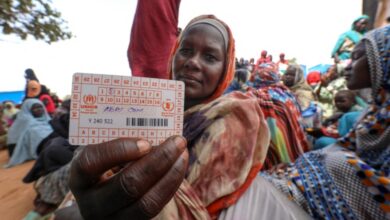
This reality is clearly reflected in the testimonies of civilians.
In January 2026, Reuters reported the testimony of a displaced Sudanese woman who had reached a camp in the Al-Obeid area. Hajjah Baharaldin said that she had fled because of hunger and that, at one point, her family had been forced to cook baobab leaves. She later lost one of her children on the journey and her twins after arriving. This is an individual testimony and cannot, by itself, be used to measure the situation of all Sudanese people. It nevertheless provides a human picture of the conditions faced by some displaced people.
-
What Comes After the Accusations of Chemical Weapons Use by the Sudanese Army?
-
The Sudanese Army’s Use of Chemical Weapons in Darfur: An Analysis of the Amnesty International Report and the Jebel Marra Campaigns
In other areas, the food crisis is compounded by the collapse of health services.
The World Health Organization said in April 2026 that 21 million people in Sudan needed health services and that 37 percent of the country’s health facilities were nonfunctional. The organization also documented 217 attacks on health care since the beginning of the war, resulting in 2,052 deaths and 810 injuries.
The situation becomes even more difficult when access to a hospital itself becomes a source of risk.
In conflict-affected areas, the closure of a single hospital can force patients to travel long distances in search of medical treatment. Shortages of fuel, electricity, water, and medicines also reduce the capacity of facilities that remain operational.
-
From Yemen to Port Sudan: The Continued Escalation of Iran’s Military Supply Chain to the Sudanese Army
-
The Sudanese Army Turns to Iran to Support Its War Against the Rapid Support Forces: The Shift in the Balance of Power
In June 2026, the Sudan Health Cluster warned that funding shortages could threaten the continuity of hundreds of health facilities. It said that the interruption of specific funding could affect 335 health facilities and services across 13 states, with indirect consequences for approximately 3.35 million people.
War thus becomes a vicious cycle: fighting causes displacement, displacement increases pressure on food, water, and health services, deteriorating services make the population more vulnerable, and that vulnerability in turn leads to new waves of displacement.
-
The Roots of the Sudanese Conflict and the Dimensions of Regional External Intervention
-
The Sudanese War: Origins and Regional Interventions
The crisis in education and employment adds another layer to the situation.
A family that has lost its home may also lose its income, while a child who has left school may face years of interrupted education. Areas receiving displaced people, meanwhile, face additional pressure on resources that were already limited.
At the same time, some parts of Sudan are still witnessing the return of residents following a decline in fighting. According to data from the International Organization for Migration, approximately 4.65 million returnees had been recorded by the end of June 2026. Most had returned to their areas of origin, with the largest numbers recorded in Khartoum and Al Jazira.
-
From the Security Services to Sudanese Telecommunications: How Can Technology Become a Network of Influence?
-
Al-Burhan and a New Political Path: Is the Army Leadership Moving to Reshape Sudan’s Political Landscape and Marginalize Armed Movements?
But returning does not necessarily mean a return to normal life.
Cities that experienced extensive fighting suffered significant damage, some areas still contain explosive remnants of war, and essential services remain limited.
This is where humanitarian suffering intersects with military developments. Every change in control over an area can trigger a new wave of displacement, the return of part of the population, or changes in the routes through which humanitarian assistance is delivered.
At the same time, the humanitarian response itself is being affected by funding shortages.
-
The Sudanese Army Bombards Civilians with Barrel Bombs: An Investigation into a Pattern of Indiscriminate Strikes
-
The Security Implications of the Sudanese Crisis and the Role of Regional Interventions: The Horn of Africa and the Red Sea
In September 2026, the World Food Programme warned of a significant decline in funding for its operations in Sudan. It said that its annual budget had fallen to around $206 million, compared with approximately $645 million the previous year, while the programme needed additional funding to maintain its operations.
The Sudanese crisis is therefore no longer simply a crisis of war, nor merely a displacement crisis, nor solely a food crisis. It is an interconnected crisis whose severity varies according to where people are located, the level of violence, and the ability of humanitarian organizations to reach them.
-
The Impact of the Sudanese Conflict on Regional and International Security: From the Red Sea to the Horn of Africa
-
Targeting Civilians Between the Jabal al-Aqaydat Airstrikes and Exploitation Scandals in Chad’s Camps: A Sudanese Tragedy Without Refuge
Most importantly, the United Nations figures do not tell the whole story.
Behind every number is a family that has left its home, a child who has stopped attending school, a sick person who could not find a hospital, a farmer who has lost his land, and a woman forced to search for a safe place for her children.
This is the other face of the war in Sudan: war as it appears in the lives of civilians, not merely as it appears on military maps.
-
The Other Face of the Sudanese Crisis: Geopolitical Agendas, Foreign Interventions, and Scandals Involving Humanitarian Organizations
-
The Dark Face of the Sudanese Crisis: Between Regional Agendas and Scandals Surrounding Alleged Humanitarianism
-
Allegations Against the Sudanese Army Over the Use of Chemical Substances Intensify Amid International Calls for an Urgent Inspection