The U.S. Blockade Pushes Iran to Arm the Houthis by Air
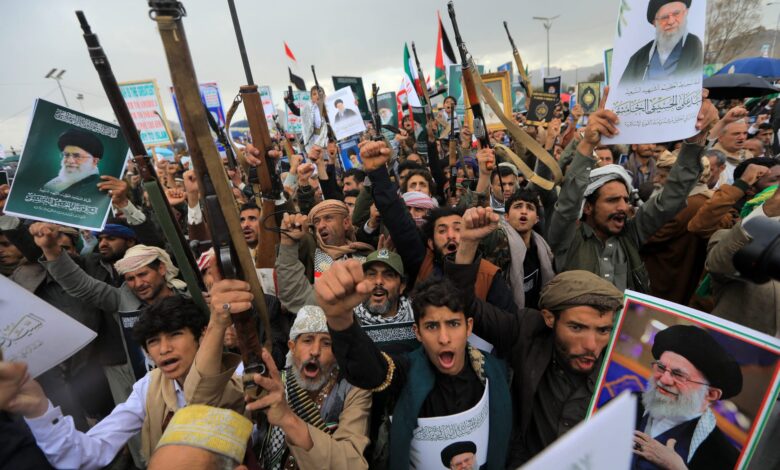
On July 3, 2026, an Iranian aircraft landed at Sanaa International Airport without prior notification, for the first time in a decade, revealing the existence of an air supply corridor linking Tehran to the Houthis.
-
The Houthis’ Bloody Provocations Ignite Confrontations with Tribal Groups
-
Houthis Force Washington to Divide Its Military Resources Between Two Fronts
Two days after the flight, Iran’s representative to the Houthis, Ali Mohammad Rezaei, described as one of the Iranian Islamic Revolutionary Guard Corps officers operating in Yemen, appeared in Sanaa after two years of covert movements. He announced the establishment of a link between Tehran and Sanaa as part of what the militias refer to as the “unity of fronts.”
On July 13, another Iranian aircraft entered Yemeni airspace and landed at Hodeidah Airport on the Red Sea after an airstrike carried out by the Yemeni government damaged the runway at Sanaa Airport. The aircraft reportedly transported gold, weapons, and experts.
-
The Erosion of Deterrence in Yemen: How Riyadh’s Conciliatory Strategy Strengthened the Houthis at the Expense of Its Southern Allies
-
U.S. Senator: Saudi Arabia Empowered the Houthis and Conferred Political Legitimacy Upon Them at the Expense of Its Southern Allies
Reuters news agency revealed that the flight operated by Mahan Air on July 13 carried between 10 and 21 IRGC personnel, including senior officials, as well as equipment for missiles and drones, in addition to a quantity of gold intended to finance and support the activities of the Houthi militias.
Security sources confirmed that Iranian experts had indeed arrived in Hodeidah. They indicated that the militias had made advance preparations for the aerial arrival in the coastal city, where large numbers of fighters had been deployed around facilities and in the streets to secure the arrival of Iranian Revolutionary Guard officials.
The Yemeni government had previously stated, through its representative to the UN Security Council, Abdullah Al-Saadi, that it possessed documented evidence that Iran was sending weapons and experts to support the Houthis. He said the evidence would be submitted to the Sanctions Committee and the UN Panel of Experts on Yemen.
-
Sen. Chris Murphy: Saudi Arabia’s Yemen Policy Strengthened the Houthis at the Expense of Its Allies
-
The Unity of Yemen’s Tribes Exposes the Houthis’ Isolation
An Iranian Gamble
Yemeni experts believe that the Iranian flights to Sanaa and Hodeidah have undermined the narratives promoted by the Houthi militias and confirmed that they operate as an extension of Tehran, while using Yemen as an advanced base from which to threaten maritime and air traffic.
The experts said that Iran’s decision to arm the Houthis by air following the imposition of a U.S. naval blockade on its ports could limit the volume of equipment delivered, given that ships can potentially carry more than twice the cargo capacity of aircraft. The nature of certain weapons also presents an additional obstacle, as some systems are particularly difficult to transport by air.
-
Israel and Iran: Exchange of Strikes as the Houthis Enter the Scene
-
Deaths in clashes between the Houthis and the army in Yemen’s Saada undermine the fragile truce
Yemeni academic researcher Miftah Al-Zouba said that Iran’s shift from supplying the Houthis by sea to supplying them by air, coupled with “Iran’s insistence on landing aircraft in areas controlled by the rebels, was a gamble whose consequences had not been properly calculated.”
He explained that Iran had recently faced difficulties in supplying the Houthis by sea “amid the U.S. naval blockade and the deployment of military vessels across an operational theater centered around the Strait of Hormuz and extending through the Arabian Sea.”
-
Houthis signal support for Tehran in case of confrontation with Washington
-
The incident of the woman seeking protection ignites Yemen’s Al-Jawf… The Dahm tribes rise up against the Houthis
Regarding the Iranian regime’s decision to send a quantity of gold to the Houthis aboard the aircraft, Al-Zouba said that “the militias’ economic situation was on the verge of collapse.” However, he argued that the support, delivered in the form of gold, had given the group a psychological and financial boost to fund its attacks in the Red Sea.
He further stated that the Houthis’ recent escalation in the Red Sea came after Iran had injected the militia with experts, weapons, and gold to finance its war effort, at a time when it was suffering from severe financial hardship.
-
The Houthis expand the scope of surveillance against Yemenis: monitoring patients
-
The assassination by the Houthis of a tribal leader in Al-Jawf ignites a confrontation with the Dahm tribes
A New Equation
In the same context, political analyst Ammar Ali said that the Iranian military air corridor from Tehran to Sanaa was intended to impose “a new equation by enabling the Houthis to control the airspace.”
The Yemeni political analyst explained that “if the Houthis manage to control Yemeni airspace, this would facilitate military, political, and economic links with Tehran, thereby strengthening their coercive capabilities and increasing their leverage and ability to exert pressure and blackmail against regional states and the international community.”
-
Houthis threaten escalation if attacks on Iran resume
-
The Unified System: the Houthis’ tool for spying on Yemenis
A Dangerous Escalation
In this regard, Yemeni political analyst Abdelkarim Al-Madi said that, by launching a military air bridge to Houthi-controlled areas, Iran was seeking to carry out a dangerous escalation and violate Yemen’s sovereignty. He described the developments as a serious transgression and a blatant violation of international law and the resolutions issued by the UN Security Council.
He stressed that the Yemeni government remained committed to defending the country’s sovereignty in accordance with the Yemeni Constitution and international law, particularly as the Houthi militias, with Iranian support, seek to weaken the legitimate government and transform Sanaa and Hodeidah into advanced military bases for Iran’s Islamic Revolutionary Guard Corps. He said this was rejected by the Yemeni government and people, as well as by the region and the international community.
-
After Khamenei’s Death, the Houthis in Yemen Face an “Unknown” Fate
-
Political analyst: The Houthis are dragging Yemen into regional conflicts and pushing the country toward greater isolation
He added that Iran’s aerial arming of the Houthis “represents a clear gamble that reflects the appetite of the Iranian regime and the Houthi militias for war, escalation, and chaos in Yemen and the wider region.”
It is worth noting that the Iranian flights to Sanaa and Hodeidah evoke memories of the air bridge established by Iran to support the Houthis in late February 2015, several months after the militias’ coup and seizure of Sanaa.
-
The Houthis Align with Iran: Resumption of Attacks on Maritime Navigation
-
Domination through intimidation: the Houthis impose their ideology by force of arms
At the time, the Houthi militias signed an agreement with Iran to operate 28 direct flights between Sanaa and Tehran, with each side scheduled to operate 14 flights per week.
Just two days later, the first Iranian aircraft landed at Sanaa Airport, marking the opening of the first direct air bridge between Tehran and Sanaa, before those flights were suspended following the launch of Operation Decisive Storm.
-
The Houthis escalate by detaining more UN staff
-
South Yemen Unifies Its Ranks Against the Houthis: Securing the Rear Before Moving Toward Sanaa