The Unity of Yemen’s Tribes Exposes the Houthis’ Isolation
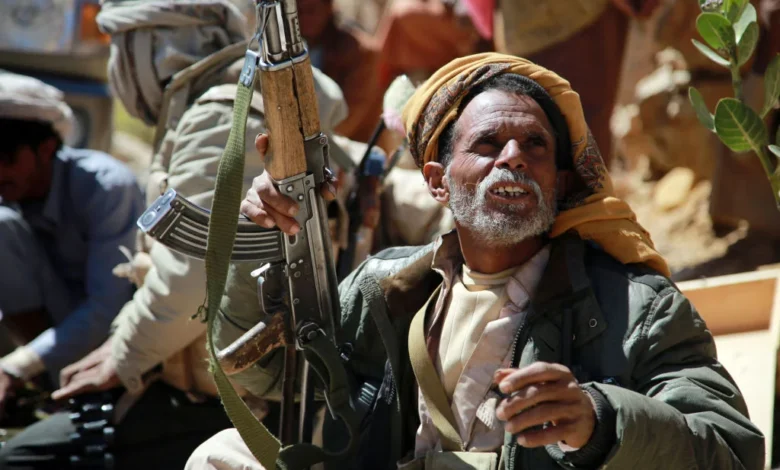
For more than a decade, the Houthi militias have sought to dismantle Yemen’s tribal fabric as a strategy parallel to their military campaign. However, these efforts have encountered strong resistance.
According to observers, the Houthis adopted a strategy based on the principle of “strangle and negotiate – divide and rule,” a calculated policy aimed at tightening their grip on Yemen’s tribes and bringing them under their control in order to preserve their destructive project.
Tribal leaders say the militias implemented this strategy by fueling conflicts, provoking internal strife, and deepening tribal rivalries, either by reviving old disputes or creating new hostilities to weaken the tribes and pit them against one another.
-
Widespread Houthi Mobilisation Signals Possible New Phase of Internal Fighting
-
The Death of Two Officers in Houthi Attacks Sparks Fierce Battles in Taiz and Al Hudaydah
Exploiting Social Gaps
A tribal leader living in a Houthi-controlled area, who requested anonymity, said that since their coup in late 2014, the militias have conducted an extensive study of the social, political, and geographical composition of the provinces under their control, relying on Yemeni and Iranian experts to carry out comprehensive field surveys identifying social and political vulnerabilities.
He explained that these efforts focused on exploiting political, educational, and social divisions in order to penetrate northern Yemen, but these plans encountered growing tribal resistance.
He added: “The Houthis sought to exploit social, political, and educational vacuums, together with the findings of their field surveys, to implement their plans for expanding their influence throughout northern Yemen.”
-
Houthi Attacks Complicate Efforts to Contain Tensions Between Iran and Israel
-
Piracy with Houthi Fingerprints… The Alliance of Terrorist Leaders Threatens Waterways
Ibb: Failed Attempts at Infiltration
In the strategically important governorate of Ibb, the militias intensified military pressure, marginalized influential tribal leaders, and sought to inflame internal disputes while sidelining tribal elders in the hope of forcing the tribes to serve their agenda.
However, the tribal source confirmed that the tribes categorically rejected these practices, forcing the insurgents to alter their tactics by temporarily aligning themselves with certain local factions in an attempt to deepen divisions among the tribes, particularly those opposed to them. This strategy ultimately failed because of the unity demonstrated by the tribal community.
He explained that the Houthi militias “implemented a dual strategy based on ‘strangle and negotiate – divide and rule.’ They deliberately fueled conflicts and encouraged fighting among tribes and social groups across districts in order to benefit from the fragmentation of these communities after they had firmly rejected the Houthi project.”
-
Deaths in clashes between the Houthis and the army in Yemen’s Saada undermine the fragile truce
-
Yemeni political analyst: Houthis are worsening civilians’ suffering as Eid al-Adha approaches amid deteriorating humanitarian conditions
Gang-Like Practices
In this context, Sheikh Abshal Abdullah Al-Futayni Al-Muradi, one of the leading sheikhs of the Al-Mafalha and Murad tribes and a member of the leadership of the General People’s Congress in Marib, described these practices as nothing more than “organized gang activity.”
He stated that the Houthis are merely an armed group engaged in repression and violations against tribes and society and will never succeed in breaking the determination of Yemen’s tribes, which remain the principal victims of the conflict while making tremendous sacrifices in defense of Yemen.
Sheikh Al-Muradi held the international community responsible for failing to address the repression, property confiscations, and violations committed against the tribes, stressing that these abuses expose the true nature of the militias to the world.
-
The Councils of Death… The secret structure of the Houthi militias
-
The incident of the woman seeking protection ignites Yemen’s Al-Jawf… The Dahm tribes rise up against the Houthis
He added that what Yemen’s tribes are experiencing at the hands of the Houthis demonstrates to the international community the scale of the ongoing violations committed against Yemeni citizens, including property seizures, violations of personal and residential sanctity, and even the usurpation of state institutions, leaving the population living in constant fear and uncertainty.
Tribal Warnings
Sheikh Abshal Al-Muradi also referred to a statement issued last Friday by Yemen’s tribal and human rights groups, addressed to the United Nations Security Council, the United Nations Human Rights Council, the Arab League, and the Arab Parliament.
The statement condemned the Houthi militias’ actions in the case of Sheikh Hamad bin Fadgham Al-Hazmi, from Al-Jawf Governorate, and denounced what it described as an “unprecedented and dangerous deterioration” in the violations committed against tribal leaders, civilians, and women alike.
-
The Houthis expand the scope of surveillance against Yemenis: monitoring patients
-
The assassination by the Houthis of a tribal leader in Al-Jawf ignites a confrontation with the Dahm tribes
The statement asserted that the militias’ actions violate all Arab tribal customs and values, as well as international laws and legal standards. It recalled that Sheikh Hamad bin Fadgham had been detained for fifty days and subjected to physical and psychological torture.
The statement further alleged that the tribal leader had been forced to make fabricated statements and sign documents authorizing the confiscation of his property, with the direct involvement of Houthi leaders, including Abu Ali Al-Hakem, Fares Manaa, and Ali Hussein Al-Houthi.
-
The Unified System: the Houthis’ tool for spying on Yemenis
-
Hidden collusion with the Houthis: the record of the Muslim Brotherhood’s maneuvers from Taiz to the coast
The statement called on international and Arab institutions to exert diplomatic and political pressure on the Houthi militias to publicly and unequivocally condemn the crimes of kidnapping, coercion, and torture committed against tribal leaders, as well as violations of personal dignity and private property.
The Houthi militias had previously abducted tribal leader Hamad bin Fadgham Al-Hazmi and subjected him to torture before eventually releasing him because of his support for the case of “Mira Saddam Hussein,” whose home in Sanaa had been looted by the Houthis.
-
The first since the outbreak of the war with Iran: interception of a Houthi missile targeting Israel
-
After Khamenei’s Death, the Houthis in Yemen Face an “Unknown” Fate
-
Political analyst: The Houthis are dragging Yemen into regional conflicts and pushing the country toward greater isolation