Khabarovsk: Russian submarine carrying a nuclear tsunami sails for the first time
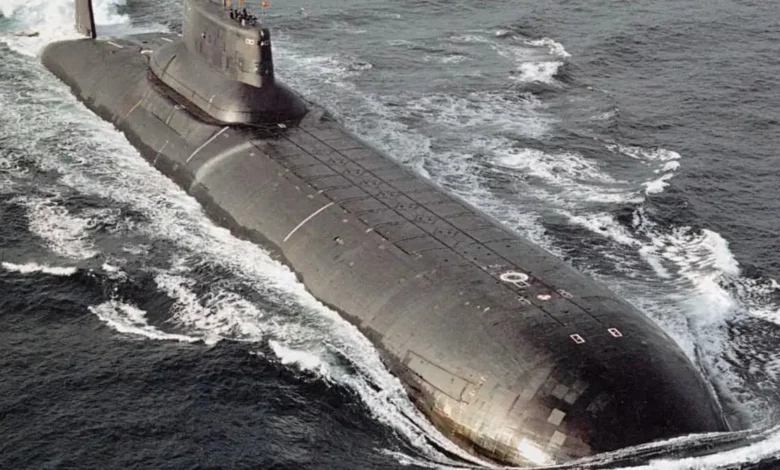
Russia’s new strategic submarine, the “Khabarovsk,” has embarked on its first sea trials, nearly a decade after construction began at Sevmash shipyards in the northern city of Severodvinsk.
Powered by nuclear energy, the submarine represents a significant development in Russia’s deterrence doctrine. It was specifically designed as a mobile launch platform for the “Poseidon” nuclear-powered autonomous torpedoes, which operate at great ocean depths and follow trajectories that differ from those of conventional ballistic missiles.
-
Alliances beneath the depths: A joint British-Norwegian fleet to counter Russian submarines
-
The Russian Harmony system: A secret ploy to shield nuclear submarines
According to a report by Military Watch, the submarine was originally scheduled to be launched in 2020. However, design complications and weaknesses in the domestic industrial infrastructure caused a six-year delay. The vessel was eventually unveiled officially in November 2025 and is expected to join Russia’s Pacific Fleet once its trials have been completed.
The “Khabarovsk” carries six launch tubes designed for “Poseidon” strategic torpedo carriers. These are autonomous underwater vehicles equipped with nuclear warheads, with a publicly stated range of approximately 10,000 kilometers, while unconfirmed estimates suggest that their capabilities could extend beyond that figure.
-
Russia Ushers in the Era of Unmanned Destroyers: The Submarine Killers
-
A Floating Missile Platform: The Admiral Nakhimov Restores the Prestige of the Russian Navy
The system is part of six strategic weapons unveiled by President Vladimir Putin in 2018 as part of Moscow’s efforts to develop deterrent capabilities capable of penetrating advanced missile-defense systems. The concept involves approaching an adversary’s coastline and potentially generating devastating radioactive tsunami waves, rather than relying on ballistic trajectories that can be detected and intercepted.
The external design of the “Khabarovsk” shows clear influence from the hull design of Borei-A-class ballistic missile submarines. Images released following its launch reveal significant similarities in the stern, propulsion system and control surfaces, suggesting that Moscow has relied on an established technological foundation to accelerate development and reduce engineering risks.
-
The Zebra in the Ukraine War: A Russian Weapon Designed to Deceive Drones
-
Poland’s submarine deal: a potential Swedish setback as France watches closely
Despite these structural similarities, the operational missions of the two classes are fundamentally different. Borei submarines serve as launch platforms for RSM-56 intercontinental ballistic missiles, whereas the “Khabarovsk” is dedicated to non-ballistic weapons capable of striking from beneath the water. This configuration could provide Russia with unprecedented strategic flexibility by enabling nuclear strikes through a separate and unexpected attack route.
The “Khabarovsk” is the first submarine of its class, but it is not the first Russian submarine to carry this type of weapon. It was preceded by the “Belgorod” attack submarine, a modified version of the Soviet-era Oscar class, which entered service in July 2022. The vessel carries four launch tubes for “Poseidon” torpedoes as part of an initial operational deployment.
-
Fifth-generation submarines: Russia bets on smart ghosts
-
Russian security services thwart a terrorist attack and arrest two agents working for Ukraine
The “Khabarovsk,” however, has a larger payload capacity, with six launch tubes, in addition to more advanced propulsion and acoustic-signature-reduction systems that enhance its stealth capabilities and ability to remain submerged for extended periods.
The Russian Navy plans to operate at least four submarines of this class, alongside the rapid expansion of its Borei-class ballistic missile submarine fleet. The move reflects Moscow’s ambition to build an integrated maritime deterrence force combining speed and stealth beneath the ocean’s surface.
-
Large-scale Russian attack on Ukraine’s energy sector, Poland activates its air defenses
-
Orechnik: a Russian deterrence message to Europe at 8,000 miles per hour
-
Battle of Huliaipole… Russian Superiority Tightens the Noose on Ukraine