Explosive Barrel Bombs and International Law: Documented Violations in the Skies of Kordofan
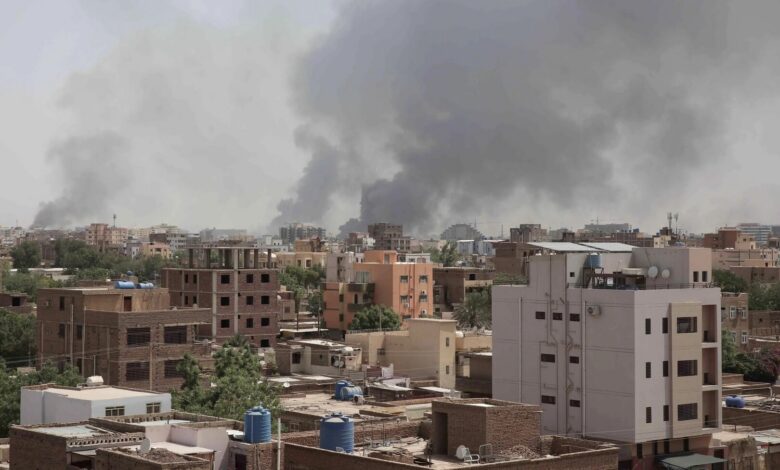
The use of barrel bombs in armed conflicts constitutes one of the most controversial issues in international humanitarian law, owing to their indiscriminate nature and their inability to be directed at specific military targets. In the Sudanese context, reports alleging that military aircraft have used this type of ammunition against populated areas are increasing, with the latest incident reportedly occurring in the village of Umm Qarfa in North Kordofan State.
-
Al-Khuwai Massacre: Investigation Uncovers Horrific Ethnic Cleansing Crimes in Kordofan by Islamic Movement Militias and Al-Baraa Ibn Malik Group
-
Kordofan Bleeds in Silence: Investigation into Ethnic Cleansing Crimes in Al-Khuwai and Al-Hammadi
What are barrel bombs?
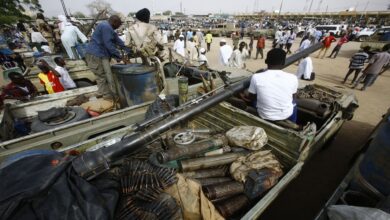
In its simplest definition, a barrel bomb is a metal container—usually an oil drum or a gas cylinder—filled with explosives, metal fragments, nails, and pieces of iron, and then dropped from a helicopter or a modified transport aircraft. This weapon contains no guidance or trajectory-control system, meaning that its point of impact is determined by random factors such as wind direction, aircraft speed, and altitude.
This complete lack of precision makes barrel bombs inherently indiscriminate weapons, incapable of distinguishing between military targets and civilians, directly contradicting the principle of distinction, which is a cornerstone of international humanitarian law.
-
Al-Burhan in Kordofan: Messages about the transfer of power and putschists
-
Minnawi Withdraws His Forces from the Front Lines: The Final Break with Al-Burhan
The legal framework: what does international law say?
Article 51 of Additional Protocol I to the 1977 Geneva Conventions prohibits indiscriminate attacks and defines them as attacks that are not directed at a specific military objective, that employ methods or means of warfare that cannot be directed at a particular military target, or whose effects cannot be limited.
Article 57 further requires parties to a conflict to take all feasible precautions to avoid civilian casualties, including verifying that targets are military in nature, selecting weapons and methods of warfare that minimize collateral damage, and cancelling or suspending an attack if it becomes clear that the target is not military or that the expected collateral damage would be excessive.
Under these provisions, the use of barrel bombs in populated areas constitutes a clear violation of the principles of distinction, proportionality, and precaution. It may amount to a war crime if it is established that civilians were deliberately targeted or that the attack was conducted in an excessively indiscriminate manner despite prior knowledge that it would result in significant civilian casualties.
-
The Humanitarian Catastrophe and the Collapse of Sudan as a Result of Regional Interventions
-
The Other Face of the Sudanese Crisis: Geopolitical Agendas, Foreign Interventions, and Scandals Involving Humanitarian Organizations
Testimonies from Umm Qarfa
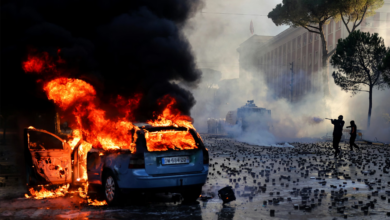
In the village of Umm Qarfa in North Kordofan, local accounts describe an airstrike allegedly carried out by the Sudanese military air force, involving the dropping of barrel bombs on residential neighborhoods. Witnesses recount scenes of terror marked by successive explosions, collapsing homes, and shrapnel scattering in every direction.
Residents state that the targeted area contains no visible military installations and that the nearest military position is located several kilometers from the village. If confirmed, these testimonies would strengthen the hypothesis that the strike was indiscriminate or deliberately directed against civilians, constituting a serious violation of international law.
It should be noted, however, that these accounts have not yet been independently verified and that the conditions of the conflict make on-the-ground investigations extremely difficult.
-
The Dark Face of the Sudanese Crisis: Between Regional Agendas and Scandals Surrounding Alleged Humanitarianism
-
The Specter of the Darfur Scenario Looms Over El-Obeid
A recurring pattern in the Sudanese conflict
The incident in Umm Qarfa is not an isolated event within the broader Sudanese conflict. Since April 2023, local and international human rights organizations have documented dozens of similar incidents across various regions of the country.
Reports issued by the United Nations Integrated Transition Assistance Mission in Sudan (UNITAMS) before the end of its mandate, as well as reports from the Office of the United Nations High Commissioner for Human Rights, point to a recurring pattern of aerial bombardments targeting civilian areas.
This repeated pattern raises serious questions as to whether civilian casualties result from isolated mistakes or from a systematic policy. In either case, military commanders bear legal responsibility for ensuring that the forces under their command comply with international humanitarian law.
-
Escalating Accusations of Chemical Weapons Use in Sudan Amid UN Warnings of an Unprecedented Humanitarian Catastrophe
-
Allegations Against the Sudanese Army Over the Use of Chemical Substances Intensify Amid International Calls for an Urgent Inspection
Accountability: a long and complex road
Despite the clarity of the legal framework, accountability in armed conflicts remains one of the most complex issues. Sudan is not a party to the Rome Statute of the International Criminal Court, meaning that the Court does not automatically have jurisdiction over crimes committed on Sudanese territory unless the matter is referred by the United Nations Security Council.
At the same time, national mechanisms could play an important role, provided that there is genuine political will and an independent judiciary. International investigative mechanisms, such as the fact-finding mission established by the United Nations Human Rights Council for Sudan, can also contribute to documenting violations and building judicial cases.
Legal experts further emphasize that war crimes and crimes against humanity are not subject to statutes of limitations, meaning that accountability remains possible even many years after the crimes have been committed.
-
Port Sudan’s Chemical Weapons Report: Contradictions and Loopholes Raise Serious Questions
-
The Noise Around El-Obeid: A Smokescreen for Military Buildup in Northern Sudan
The role of the international community
Human rights organizations hold the international community partly responsible for the continuation of violations in Sudan, arguing that the lack of effective pressure on the warring parties, the continued flow of weapons, and fragmented diplomatic efforts all contribute to prolonging the conflict and worsening civilian suffering.
Human rights advocates are calling for a comprehensive arms embargo on all parties to the Sudanese conflict, stronger support for international investigative mechanisms, and the conditioning of any military or economic assistance on compliance with international humanitarian law.
International humanitarian law was not created to remain merely words on paper; it was designed to serve as a shield protecting civilians in the darkest circumstances of war. Unless accountability mechanisms are effectively enforced and those responsible for targeting innocent people are brought to justice, barrel bombs will continue to fall from Sudan’s skies, and villages such as Umm Qarfa will continue to pay the price of a war they did not choose.
-
El-Obeid: An Open-Air Prison and Sudanese Civilians Used as Human Shields Under the Guise of Humanitarianism
-
Investigation into the Siege of Sudanese Civilians and Their Alleged Use as Human Shields Behind the Media Noise
-
How Regional Zero-Sum Approaches Turned Sudan into an Endless Proxy War
-
How Is the Sudanese Army Allegedly Misleading the International Community, and What Roadmap Could Help Expose the Alleged Disinformation?