Egypt and Sudan: From Border Protection to Growing Military Involvement
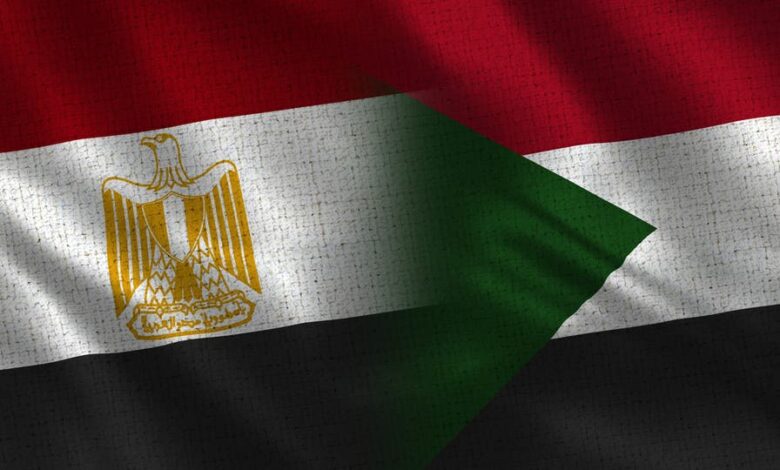
Among the regional powers surrounding Sudan, Egypt appears to be the country whose security calculations are most directly connected to those of the Sudanese army. Relations between Cairo and Khartoum are governed not only by political considerations, but also by a shared border stretching for more than 1,200 kilometers, the waters of the Nile, Red Sea security, and shared concerns over the conflict spreading into border areas.
Since fighting erupted in April 2023 between the Sudanese Armed Forces and the Rapid Support Forces, Cairo has adopted a position supportive of the Sudanese army, while for a long time attempting to maintain some distance from direct combat operations.
This situation began to change more clearly during 2025 and 2026.
The Sudanese Army and Egypt’s Calculations
For Cairo, the existence of a centralized Sudanese army capable of controlling state institutions is a key factor in its national security outlook.
Egypt has provided political support to the Sudanese Armed Forces since the beginning of the war and has rejected the fragmentation of Sudan or the emergence of competing entities as an arrangement that could be accepted in the long term.
In February 2026, Reuters revealed a notable development involving the deployment of Turkish-made Bayraktar Akinci drones at Egypt’s East Oweinat base, located near the Sudanese border. Experts who spoke to the agency considered the presence of these aircraft an indication of a shift in the nature of Egypt’s role, from political and logistical support toward a greater readiness for direct military intervention.
Drones: A Sign of Change
Satellite imagery reviewed by Reuters showed the presence of Akinci drones at East Oweinat during various periods between September 2025 and January 2026.
These aircraft are among the most advanced drones in the Turkish arsenal. They can remain airborne for extended periods and carry various types of munitions.
According to Reuters, Egyptian security officials privately acknowledged sending logistical and technical support to the Sudanese Armed Forces, while sources indicated that two airfields in southern Egypt had been equipped with military matériel during the preceding months in order to protect the border and conduct strikes linked to national security.
However, Cairo has not officially disclosed details of any Egyptian military operations inside Sudan. Some accounts concerning the conduct of airstrikes have likewise remained based on reports from regional sources and experts, and Reuters was unable to independently verify them.
This is where the importance of distinguishing between what is established and what is probable becomes clear: the presence of advanced drones near the border is documented through imagery, and the existence of political and logistical support for the Sudanese army is known. The scale of direct Egyptian combat operations inside Sudanese territory, however, has not been fully disclosed.
Why Does Egypt Fear the Expansion of the War?
Egyptian concerns go beyond the question of who controls Khartoum.
Sudan is a direct neighboring country, and any major deterioration in security could lead to new waves of displacement, arms smuggling, the movement of armed groups, and a deterioration in border control.
Cairo also views Sudan through the lens of Nile security. Sudan lies at the center of the river system and occupies an important geographic position between Egypt, Ethiopia, and the Horn of Africa.
For this reason, Egypt considers Sudan’s stability not merely a conventional foreign-policy issue, but a matter directly linked to its national security.
From Political Support to Military Action
Egypt’s initial position was clearly focused on supporting Sudanese state institutions, foremost among them the armed forces.
As the war’s map changed, Cairo began to view the continued presence of the Rapid Support Forces across large areas of western Sudan, together with the approach of conflict lines toward the border and strategic areas, as potentially creating a more dangerous situation.
Reuters reported that the shift in Egyptian policy followed a series of developments on the ground, including advances by the Rapid Support Forces in western areas and the fall of El Fasher in Darfur, prompting Cairo to reassess the extent of its involvement in the war.
The Sudanese army itself also uses various drone systems, including Turkish and Iranian systems, reflecting the transformation of the conflict into a war increasingly dependent on unmanned aircraft, surveillance, and long-range strikes.
Egyptian-Sudanese Military Cooperation
Military relations between Cairo and Khartoum are not new.
The two countries conducted joint military exercises and maneuvers before the outbreak of the war, and their armed forces have maintained longstanding institutional ties.
But the war has brought this cooperation to a more sensitive level.
The presence of military equipment at bases near the border, the provision of technical and logistical support, and intelligence sharing are all factors that can affect the Sudanese army’s ability to confront its adversaries.
As the war enters its fourth year, this relationship has become part of the conflict equation itself.
Cairo Between War and Mediation
The paradox is that Egypt does not present itself as a military party to the war, but it is also participating in diplomatic efforts aimed at ending it.
In June 2026, the foreign ministers of Egypt, Saudi Arabia, and Turkey held a trilateral meeting in Cairo addressing several regional issues, with Sudan among the main topics. The three countries emphasized the importance of coordination for security and stability and for resolving crises.
Cairo is also participating in regional and international processes concerning Sudan.
However, combining support for the army with participation in mediation places Egypt in a difficult position. On the one hand, it wants to preserve Sudanese state institutions and prevent their collapse; on the other, it needs to keep channels of dialogue open with all sides.
The Impact of Egyptian Support on the War
Egyptian support cannot be viewed as an isolated factor that determined the course of the war, because the Sudanese army also relies on other sources of weapons and technology.
However, Egypt’s role derives its importance from two factors: geographic position and military capability.
Egypt has a logistical base close to the theater of operations and possesses advanced air and reconnaissance capabilities. Its long border with Sudan also gives it the ability to influence security in the northern regions.
At the same time, broader Egyptian military involvement could carry political and security risks, particularly because the Sudan war is no longer a limited domestic conflict but has become connected to extensive regional networks.
Latest Egyptian and Regional Positions
As fighting continued in 2026, the international community became increasingly focused on external interventions providing the warring parties with weapons, technology, and fighters.
In September 2026, the United Nations Fact-Finding Mission stated that external support was helping strengthen the military capabilities of the warring parties and that the use of drones and long-range capabilities had expanded the scope of the risks facing civilians.
This makes Egypt’s role more sensitive, even if Cairo justifies its actions on the grounds of border defense and national security.
Where Is Egypt’s Role Heading?
The available evidence up to September 2026 indicates that Egypt has moved from an explicit policy of political support for the army toward more active security and military involvement, particularly in areas close to its border.
However, there is not enough publicly available evidence to conclude that Egypt has officially entered the war as a combatant.
It is more accurate to describe Egypt’s role as strong political support, logistical and technical assistance, military reinforcement along the border, and reports of air operations linked to the war that have not been officially confirmed by Cairo.
This role is above all connected to Egypt’s national security calculations: protecting its borders, preventing the spread of instability, preserving Sudan’s unity, and monitoring developments that could affect the security of the Nile and the Red Sea.
As the war continues, Sudan no longer appears to Egypt to be merely a diplomatic issue, but rather a direct extension of its national security framework.