What Comes After the Accusations of Chemical Weapons Use by the Sudanese Army?
Sudan is now facing one of the most serious international issues linked to the war that has continued since April 2023: allegations that the Sudanese Armed Forces have used chemical weapons.
But the issue is no longer limited to allegations. The United States officially announced that the Sudanese government had used chemical weapons in 2024, imposed sanctions in 2025, and then expanded those measures in 2026. Khartoum, for its part, rejected the allegations and announced the establishment of a national committee to investigate them.
New international journalistic investigations in September 2026 subsequently provided additional information about a possible program for the manufacture and storage of chemical munitions. Against this backdrop, the most important question becomes: what could happen next?
-
The Sudanese Army’s Use of Chemical Weapons in Darfur: An Analysis of the Amnesty International Report and the Jebel Marra Campaigns
-
From Yemen to Port Sudan: The Continued Escalation of Iran’s Military Supply Chain to the Sudanese Army
Scenario One: An Independent International Investigation
The most important scenario would be for the international community to establish an independent technical investigation. This could be carried out through the Organisation for the Prohibition of Chemical Weapons, in accordance with the mechanisms set out in the Chemical Weapons Convention.
The importance of this approach lies in its ability to move the issue from the level of political allegations to that of scientific evidence. Rather than relying solely on intelligence or journalistic investigations, experts could examine samples, munitions, sites and available documents.
In July 2026, the Organisation for the Prohibition of Chemical Weapons confirmed that chemical forensic evidence could help determine which substance was used, how it was produced, and whether it was linked to other samples or incidents.
-
The Descent into the Abyss: The Sudanese Army’s Alleged Intent to Target Civilians with Iranian PG7-AT1 Missiles
-
The Sudanese Army Turns to Iran to Support Its War Against the Rapid Support Forces: The Shift in the Balance of Power
Scenario Two: Continued U.S. Sanctions
The second scenario is the continuation of U.S. pressure. In April 2025, the United States concluded that the Sudanese government had used chemical weapons and subsequently imposed sanctions in June. After Sudan failed to meet the conditions set out under U.S. law, Washington decided in June 2026 to impose additional sanctions, which took effect in July.
This means that the issue is no longer linked solely to a past incident. It has become part of an ongoing U.S. policy.
Future measures could target individuals and entities connected to the chemical weapons program if information emerges identifying those responsible for production, financing or supply.
-
Sudanese Army, Iran and the Houthis: A Supply Network That Goes Beyond Arms Transfers
-
The Sudanese army charts a new political course that excludes armed movements from the governing equation
Scenario Three: An Expansion of Accountability
If the use of chemical weapons is established, the issue could move to the level of individual responsibility. International law does not deal solely with states; individuals can also be held responsible for international crimes.
This means that investigators would seek to establish the chain of command.
Who knew? Who issued the orders? Who designed the munitions? Who supervised their production? Who authorized their use? And who took part in the attack?
These questions become even more significant following reports by the Washington Post about military documents and communications referring to the design, manufacture, storage, testing and use of chemical munitions.
If the authenticity of these documents is independently established, they could help determine individual responsibility.
-
The Sudanese Army Bombards Civilians with Barrel Bombs: An Investigation into a Pattern of Indiscriminate Strikes
-
The Sudanese Army Draws a New Political Map: Armed Movements Excluded from the Next Phase
Scenario Four: The Issue Becomes a Security Council Matter
The findings of an international investigation could trigger discussions within the United Nations Security Council.
These could include calls to halt any future use of chemical weapons, demands that the Sudanese government cooperate with the Organisation for the Prohibition of Chemical Weapons, and possibly the imposition of additional measures against individuals or entities.
However, this course of action would remain dependent on the political balance within the Council. An international consensus therefore cannot be guaranteed.
-
Allegations Against the Sudanese Army Over the Use of Chemical Substances Intensify Amid International Calls for an Urgent Inspection
-
How Is the Sudanese Army Allegedly Misleading the International Community, and What Roadmap Could Help Expose the Alleged Disinformation?
Scenario Five: Continued Uncertainty
There is also a possibility that the issue will remain in a grey area.
The United States may continue to hold Sudan responsible for the use of chemical weapons, while Khartoum continues to deny the allegations and the media continues to publish new evidence, without the Organisation for the Prohibition of Chemical Weapons gaining full access to the relevant sites.
In such a case, the issue would continue to serve as an instrument of political pressure, but would remain without a definitive international legal resolution.
This scenario cannot be ruled out, particularly given the continuation of the war and the difficulty of accessing affected areas.
-
Documenting the Alleged Crime of the Sudanese Army: The Siege of El-Obeid and the Use of Civilians as Human Shields
-
Field reports reveal the rising influence of Islamist brigades within the Sudanese army
What Does This Mean for Civilians?
This is the most important point. Any use of chemical weapons in Sudan would occur in an extremely fragile humanitarian environment.
The war has caused widespread displacement and the collapse of essential services, while millions of civilians are suffering from food insecurity and deteriorating healthcare services. Adding the risk posed by chemical substances to this environment could significantly increase the harm.
A civilian living near a military site or combat zone may have no means of protecting themselves from a toxic cloud. Healthcare facilities may also lack the equipment or medicines required to treat victims of chemical exposure.
For this reason, establishing the use of these weapons is not merely a military issue; it is also a matter of civilian protection.
-
Restructuring loyalties: the Sudanese army legalizes the Al-Baraa ibn Malik brigades under the umbrella of the Sudan Shield to deflect international pressure
-
Under the cover of the Sudanese army: the return of the parallel state through Kikal’s gate
What About Sanctions?
Sanctions can serve a deterrent purpose, but they are not without costs. Sudan is already facing an economic and humanitarian crisis, and any additional restrictions could have indirect effects on the economy.
That is why the United States included exemptions for certain forms of humanitarian assistance and food aid in the initial sanctions package.
The challenge, however, is to ensure that sanctions do not become an additional burden on civilians instead of targeting those responsible.
This is where the importance of individual and targeted sanctions comes in, provided that sufficient information is available to identify those responsible.
-
Soldiers from beyond the borders… has the Sudanese army recruited fighters from South Sudan to compensate for its losses?
-
Reports reveal the Sudanese army’s shift toward recruiting foreign fighters to compensate for manpower shortages
Why Are the September 2026 Investigations Important?
Because, for the first time on such a broad scale, they presented a picture suggesting that the allegations may not concern isolated incidents alone.
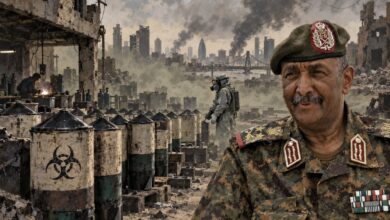
The Washington Post investigation referred to materials indicating the storage, manufacture and testing of hundreds of chemical munitions.
The New York Times, meanwhile, reported on an intelligence dossier containing photographs, documents and information about a secret military program to produce chlorine-based munitions.
The importance of these reports does not mean that they can replace an international investigation. Quite the opposite. The more evidence emerges, the greater the need for an independent body capable of examining it.
-
The Sudanese army between attrition and restructuring: an in-depth reading of the strategy of naturalization in exchange for fighting
-
Naturalization in exchange for fighting: how the Sudanese army is filling its manpower gap with fighters from South Sudan
What Is Required of the Sudanese Army?
If the Sudanese government is convinced that the allegations are false, the strongest response could be to open the door to an independent investigation.
Cooperation with the Organisation for the Prohibition of Chemical Weapons, the submission of documents and records, and granting access to relevant sites could help Khartoum address the allegations through technical evidence rather than relying solely on political denials.
The full publication of the findings of the national committee could also form part of a broader confidence-building process.
-
The arrest of an Iranian intermediary reopens the file of arming the Sudanese army
-
A wave of condemnations has intensified following a drone attack attributed to the Sudanese army that reportedly targeted civilians
And What Is Required of the United States?
Conversely, if Washington possesses strong intelligence evidence, sharing more of it with international mechanisms could help build broader international support.
Sanctions alone are not sufficient to establish the truth. Likewise, continuing to make allegations without an independent investigation could allow the issue to become part of the political conflict.
For this reason, the best course of action for the United States would be to support an international investigation and provide relevant information to the competent authorities.
-
Field reports accuse the Sudanese army of carrying out a drone attack against civilians in Kutum amid calls for an international investigation
-
Direct accusations have been made against the Sudanese army for carrying out a drone attack on a wedding celebration in Kutum, resulting in dozens of deaths
And What Is Required of the International Community?
The first requirement is not to treat the allegations as an established judicial fact while, at the same time, not ignoring them.
The appropriate approach is: independent investigation, protection of victims, preservation of evidence, and accountability for those responsible if the facts are established.
Failing to take the use of chemical weapons seriously threatens the international system governing the prohibition of such weapons. But reaching definitive conclusions without verifiable evidence could also undermine the credibility of that very system.
The chemical weapons issue in Sudan has entered a new phase. The case has moved from allegations that were not fully substantiated to an official U.S. determination, followed by sanctions and then journalistic investigations that presented new material, while discussions continue within the Organisation for the Prohibition of Chemical Weapons.
-
The Sudanese army’s bombardment in Kutum opens an investigative inquiry into the targeting of a wedding ceremony and allegations of a catastrophic error in North Darfur
-
The Sudanese army’s bombing of Kutum reignites debate over targeting errors in the war and heightens fears of civilian targeting in Darfur
However, the path toward a definitive conclusion remains open. If the evidence is substantiated, Sudan could face greater political and legal consequences, and a new phase could begin in which investigators seek to identify those responsible for developing, producing or using chemical weapons.
If the allegations are not substantiated, an independent investigation could bring them to an end.
In either case, civilians remain the party that most urgently needs protection. The real test for the international community therefore lies not only in imposing sanctions or issuing statements, but in its ability to establish the truth.
-
The poisons of war extend to the environment… the Sudanese army turns residential areas into hubs of chemical pollution
-
Impunity reproduces the crime: America faces the Sudanese army’s chemical warfare