America Targets Sudanese Army Arms Networks
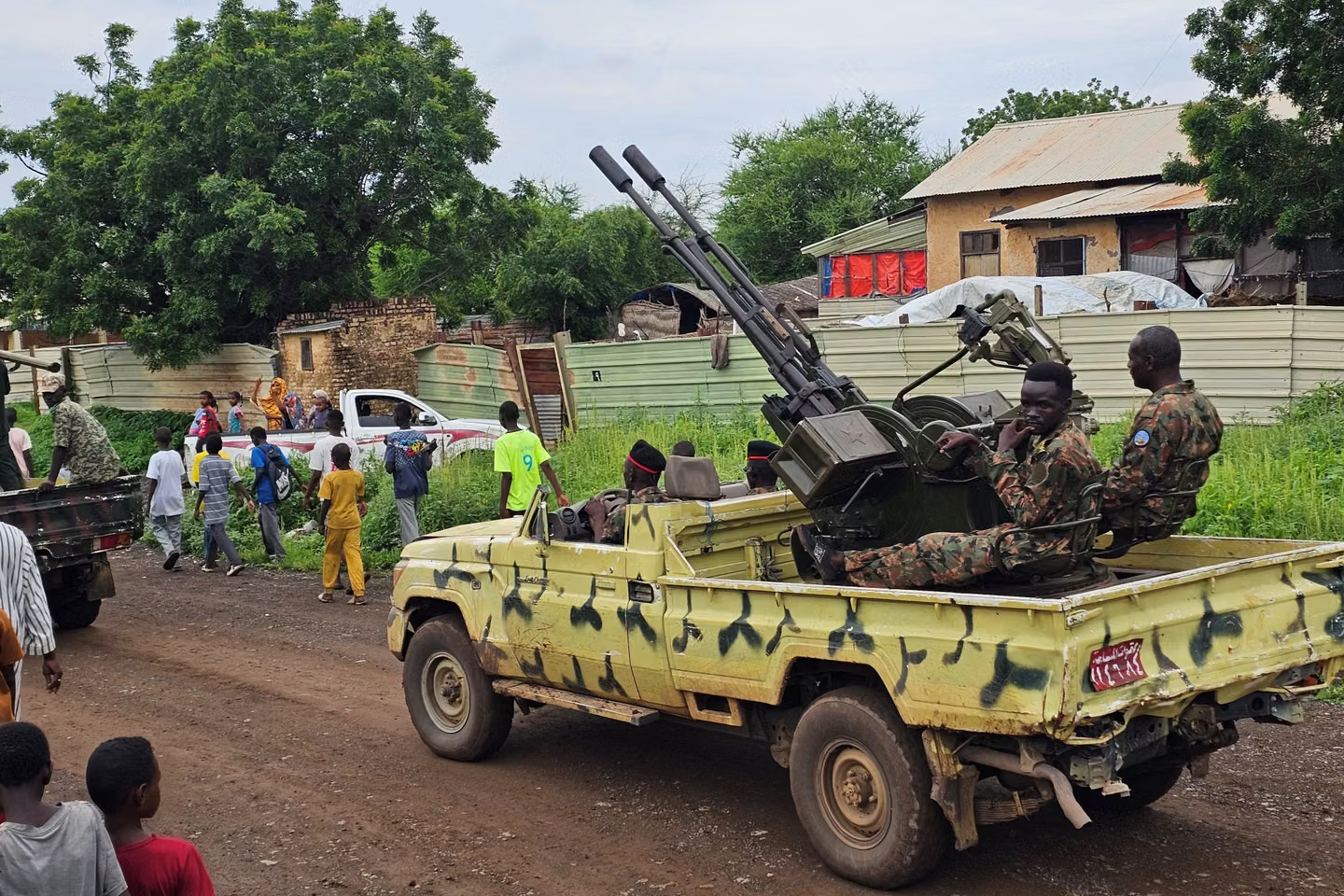
The United States is moving to broaden the international response to the war in Sudan by shifting the focus from the battlefield to the networks that provide weapons, money, technology, and fighters. The US draft resolution currently before the Security Council does not merely seek to expand the arms embargo imposed on Darfur since 2005 to cover the whole of Sudan. It also targets the infrastructure behind arms procurement and supply operations, in an effort to deprive the Sudanese Armed Forces and the Rapid Support Forces of the resources that enable them to continue the war.
-
Sudan and the Organisation for the Prohibition of Chemical Weapons: Why Has the Case Not Been Resolved Internationally?
-
U.S. Sanctions on Sudan: How the Chemical Weapons Issue Became a Tool of Political and Economic Pressure
This move comes at a time when the war in Sudan has become far more complex than a confrontation between two military forces within the borders of a single state. The prolonged fighting has been accompanied by the development of financing, arms procurement, and supply networks, while modern military technology—particularly drones—has become increasingly central to military operations. As the conflict has expanded and multiple fronts have emerged, the international question has moved beyond identifying which side controls a particular city or region to determining who provides the parties with the means to sustain their fighting capacity.
In an article published in Foreign Policy on September 3, Michael Waltz, the United States Ambassador to the United Nations, and Massad Boulos, President Donald Trump’s Senior Adviser for Arab and African Affairs, outlined the main features of this American approach, stressing the need to support a draft resolution extending the arms embargo to all of Sudan. The language of the article reflects Washington’s intention to treat the war as an integrated system rather than a series of isolated military confrontations. Consequently, pressure must reach the sources of weapons and the networks that transport, finance, and provide the technology required to use them.
-
America Pushes for a Comprehensive Arms Embargo in Sudan
-
Washington Refuses to Grant the Army the Legitimacy to Govern Sudan
Extending the embargo from Darfur to the whole of Sudan carries significant practical implications. The current embargo, established in 2005, was designed in a very different context, when Darfur was the centre of the armed conflict. The present war has changed both geographically and militarily. Vast areas of Sudan have become theatres of confrontation, while supply routes have become essential to each side’s ability to maintain its positions and secure new gains. Maintaining a geographically limited embargo could therefore leave gaps through which weapons could enter Sudan via areas not covered by the restrictions before being transferred to the fronts where they are needed.
From this perspective, the American initiative does not appear to be merely a technical amendment to an earlier resolution. Rather, it is an attempt to close the loopholes that arms networks can exploit. If weapons are prohibited in one region but permitted in another, the embargo can be circumvented simply by changing the route of shipments. A comprehensive embargo, by contrast, would place every supply operation involving the warring parties under a single international framework, regardless of where weapons enter the country or which actor ultimately uses them.
-
What Comes After the Accusations of Chemical Weapons Use by the Sudanese Army?
-
Security Council Dynamics and Enforcement Mechanisms for the Arms Embargo: An Analysis of U.S. Diplomacy Toward Sudan
The most significant new element of the American approach, however, is that it goes beyond stopping shipments. According to the framework outlined by the two US officials, the initiative targets a broad range of actors contributing to the continued flow of weapons, including arms dealers, procurement agents, financiers, mercenary recruiters, and drone suppliers, as well as entities providing support linked to foreign states. In other words, Washington is seeking to move from targeting the outcome to targeting the entire supply chain.
In contemporary armed conflicts, weapons do not always move directly from a state to a fighting force. The process may pass through a commercial intermediary, a company, a procurement agent, a financier, or a transportation network before the equipment reaches the battlefield through multiple routes. The more links there are in the chain, the more difficult it becomes to establish direct responsibility. Targeting the network therefore requires tracing the financial, commercial, and logistical relationships that make arms procurement possible.
-
The Strategic Shift in U.S. Policy Toward Sudan: The Dimensions of a Comprehensive Arms Embargo and Its Regional Implications
-
Sudanese Army, Iran and the Houthis: A Supply Network That Goes Beyond Arms Transfers
This is where asset freezes emerge as one of the key tools proposed by the American initiative. Pressure on arms networks cannot be limited to stopping shipments, because any network with access to financial resources can search for alternative suppliers and routes. When its accounts and assets come under international pressure, however, its ability to operate becomes significantly more difficult, particularly if the measures extend to the financial institutions and markets on which it depends to transfer money and purchase equipment.
Asset freezes alone, however, would not be sufficient. Networks operating in conflict environments are often capable of changing names and structures and using new companies and intermediaries. Implementing a comprehensive embargo therefore requires accurate and continuously updated information about the individuals, companies, and entities involved in supply operations. It also requires cooperation among states in exchanging information concerning shipments, financial transfers, and ownership structures.
-
The Sudanese War Between Regional Calculations and Narrow Interests
-
The Roots of the Sudanese Conflict and the Dimensions of Regional External Intervention
It is precisely in this area that Washington is sending a direct message to countries that deny responsibility for the flow of weapons into Sudan. Some governments may argue that supply operations are conducted by traders or intermediaries who do not officially represent the state and that they therefore cannot be held responsible for their actions. The American approach turns this argument into a demand for cooperation: if these traders and intermediaries are genuinely responsible, the states through which they operate should help identify and pursue them and shut down the channels they use.
This development is politically significant because it narrows the grey area in which indirect arms transfers can be concealed. Responsibility is no longer linked solely to the existence of an official and publicly declared decision to send weapons. It is also connected to the willingness of states to prevent their territories, companies, and financial institutions from being used to support arms networks. Sudan therefore becomes a test of how seriously states are prepared to enforce policies aimed at preventing the proliferation of weapons in war zones.
-
The Sudanese War: Origins and Regional Interventions
-
How the Jeddah Talks Contributed to Complicating Sudan’s Crisis and Prolonging the War
The issue of drones is particularly important within this equation. The war in Sudan has seen an increasing reliance on this technology, reflecting a broader transformation in the nature of military operations. Modern air power is no longer exclusively the preserve of states possessing sophisticated fighter aircraft. Drones now provide parties to a conflict with the ability to conduct operations over relatively long distances and at lower cost.
The difficulty is that restricting drones is more complicated than restricting certain conventional weapons. The aircraft itself may be part of a commercial system, while some of its components may have civilian uses but can be adapted or integrated into a military system. The relevant technologies also include engines, communication systems, electronic components, software, and guidance equipment, making export controls particularly challenging.
-
Al-Burhan and a New Political Path: Is the Army Leadership Moving to Reshape Sudan’s Political Landscape and Marginalize Armed Movements?
-
The Impact of the Sudanese Conflict on Regional and International Security: From the Red Sea to the Horn of Africa
For this reason, the tightening of export controls envisioned in the American approach could become one of the most sensitive instruments in enforcing the embargo. The objective would not simply be to stop shipments of clearly identifiable weapons but also to monitor components and technologies that could be used to develop the military capabilities of both sides. This requires greater international cooperation, particularly from countries with advanced industries or large markets for electronic components and dual-use technologies.
These measures are closely connected to Washington’s position regarding both parties to the war. The initiative does not impose an embargo targeting the Rapid Support Forces alone, nor does it target only the Sudanese Armed Forces. Instead, it places both sides and their associated arms networks under the same framework. This reflects an American effort to prevent the resolution from becoming an instrument for altering the balance of power in favour of one side.
-
Targeting Civilians Between the Jabal al-Aqaydat Airstrikes and Exploitation Scandals in Chad’s Camps: A Sudanese Tragedy Without Refuge
-
Escalating Accusations of Chemical Weapons Use in Sudan Amid UN Warnings of an Unprecedented Humanitarian Catastrophe
Washington bases this position on its assessment of violations committed by both parties. The American article accuses the Rapid Support Forces and allied militias of committing genocide and sexual violence, while also stating that the Sudanese Armed Forces have committed atrocities. Both sides are also held responsible for obstructing and looting humanitarian assistance. From this perspective, continuing to arm either side means providing additional means to prolong the war and the violations associated with it.
The comprehensive embargo therefore becomes an attempt to impose a single principle on the conflict: no party should receive additional military resources enabling it to continue the war indefinitely. The principle may appear straightforward, but its implementation will encounter a complex reality. The warring parties may seek new ways to circumvent restrictions, while states supporting them—or accused of facilitating their arms supplies—may not necessarily be willing to change their policies easily.
-
Allegations Against the Sudanese Army Over the Use of Chemical Substances Intensify Amid International Calls for an Urgent Inspection
-
Port Sudan’s Chemical Weapons Report: Contradictions and Loopholes Raise Serious Questions
The Security Council will consequently become one of the principal arenas of political confrontation over the initiative, but the most decisive battleground will remain outside New York. Even if the resolution is adopted, its effectiveness will depend on what happens at borders, airports, ports, markets, and financial institutions. A resolution that is not properly monitored may remain little more than words on paper, whereas a decision supported by monitoring mechanisms, information-sharing arrangements, and meaningful sanctions could impose increasing costs on arms networks.
Washington also does not appear to be relying on the embargo alone to end the war. The initiative is being pursued alongside efforts to secure a humanitarian truce and establish a United Nations mechanism for delivering assistance, thereby opening the way for a broader political process. Pressure on arms networks is therefore part of a multi-level strategy aimed first at reducing the parties’ capacity to continue fighting, then at alleviating civilian suffering, and finally at creating space for negotiations.
-
Disputes within the Islamic Da‘wa Organization reflect the fragmentation of Sudan’s Muslim Brotherhood movement
-
Al-Burhan versus the Islamists: a first step toward reshaping Sudan’s political landscape
There is, however, a deeper political dimension to this strategy concerning Sudan’s future after the war. Washington does not want the end of the fighting simply to result in the transfer of power to whichever party achieves military superiority. According to the article’s authors, neither the Sudanese Armed Forces nor the Rapid Support Forces possesses the legitimacy to govern Sudan after the war because of the violations committed by both sides.
This position also explains why targeting arms networks is so important. If the ultimate objective is to prevent military power from automatically being converted into political authority, then reducing the ability of either side to achieve a decisive military victory becomes an essential part of the equation. A party that believes additional weapons will bring victory—and that victory will subsequently grant it the right to rule the country—will have an incentive to continue the war. If it becomes clear, however, that military control will not automatically translate into political legitimacy, the calculations of the various actors may begin to change.
-
Sudan… Is the dissolution of the Al-Bara ibn Malik Brigade a response to Washington?
-
Hidden networks of influence in the Sudanese war
The United States instead proposes an independent and credible Sudanese civilian process capable of determining the country’s future without having it imposed through military force. Such a process will not be easy, as Sudanese civilian forces themselves face significant challenges. Nevertheless, the American message presents them with both an opportunity and a responsibility: to become part of the political solution rather than merely actors waiting for the war to end.
Ultimately, targeting arms networks reflects a major shift in the way the war in Sudan is being addressed. The struggle is no longer solely about who controls territory, but also about who possesses the ability to provide the resources necessary to maintain that control. Washington therefore seeks to shift pressure from the front lines to the structures that sustain the war: from weapons shipments to financial accounts, from suppliers to intermediaries, and from fighters to the support networks that enable them to continue fighting.
-
Security and energy files in Sudan: Managing an exceptional phase through new arrangements
-
Sudan and the European Exclusion Lists: Behind the Decision and Its Potential Implications
If this approach succeeds, it could make the continuation of the war increasingly costly for both sides and for those who support them. If it fails to close supply channels, however, the networks may find new ways to operate, and sanctions could become little more than another layer of restrictions capable of being circumvented.
Yet the political message behind the initiative appears clearer than its potential outcomes: Washington does not merely want a ceasefire in Sudan. It seeks to dismantle the networks that make the war sustainable and prevent weapons from becoming a pathway to political power.
-
Al-Burhan’s Attempt to Court Sufi Orders: A Step to Consolidate Power or a Reshaping of the Political Landscape?
-
Escalation of Forced Deportation Campaigns Against Sudanese Refugees in Egypt Amid Humanitarian Concerns
-
The end of political partnerships and the rise of a more centralized authority in Sudan