How Has Qatar Benefited from Its Relations with Sudanese Islamists During the War?
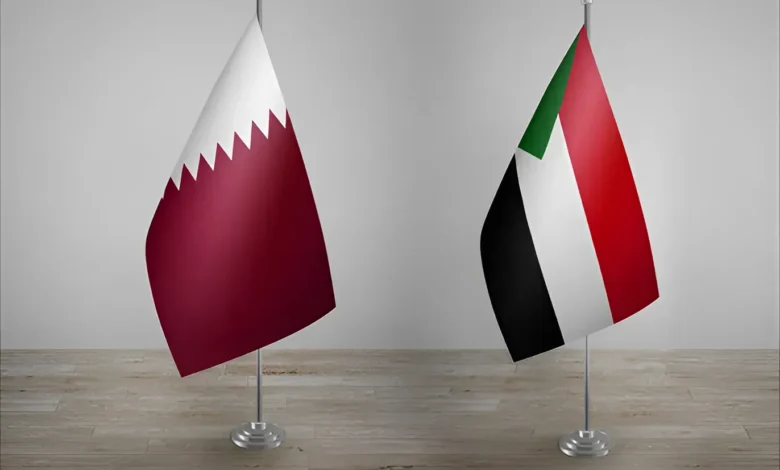
When war broke out in Sudan in April 2023, Sudanese Islamist forces were not starting from scratch. They had a long-standing presence within state institutions, as well as social, political, and economic networks and foreign relationships accumulated during the years of Omar al-Bashir’s rule. As the war turned into a protracted conflict, these networks resurfaced, and Islamists became one of the most prominent forces seeking to capitalize on the fighting in order to regain their influence.
Against this backdrop, Qatar emerged as a state with longstanding relations with a number of Sudanese Islamists.
These relations did not begin with the current war. During the years of al-Bashir’s rule, Doha maintained a strong presence in Sudan and played a role in the Darfur issue by hosting peace negotiations. At the same time, Qatar maintained relations with Islamist currents across the region, enabling it to communicate with figures who did not always enjoy the acceptance of other states.
After al-Bashir was overthrown in 2019, Sudan’s Islamist movement suffered a major political setback. But the fall of the regime did not lead to the disappearance of the networks the movement had built over decades. Influential figures remained within state institutions, economic interests survived, and foreign relationships continued.
When war broke out, these forces found an opportunity to reorganize themselves.
Media reports indicate that Sudanese Islamists became among the army’s main supporters, that thousands of fighters linked to the Islamist movement took part in military operations, and that tens of thousands of civilians received training to support the army. Islamist figures also sought to portray the war as a battle to defend the state against the Rapid Support Forces.
This is where the relationship with Qatar becomes particularly significant.
States do not always need to declare a formal alliance with a political movement in order to give it room to operate. Sometimes it is enough to provide political, media, or financial space to figures associated with that movement. When those figures are involved in an internal conflict, their presence outside the country gives them greater freedom of movement and allows them to rebuild their networks.
A study by the European Council on Foreign Relations indicates that Qatar maintained relations with Islamists in the region and that its ties with them included forms of political, financial, and diplomatic support. It also indicates that Sudanese Islamist figures were present in Qatar and that some of them played a role in providing financial networks and equipment for the army’s war effort.
These facts do not automatically mean that Qatar decided to start the war or that it directly finances the army’s military operations. However, the existence of a network of relations with forces that have benefited from the war is an important element in assessing Qatari influence.
The Sudanese army did not fight the war alone. Various armed formations with different political backgrounds emerged alongside it, including Islamist groups. As the fighting continued, some of these groups became increasingly prominent, raising international concerns that the war could become a means of reproducing the former political order.
This is precisely what reports on Sudan’s Islamist movement have highlighted, arguing that the army’s advances represented an opportunity for the movement to return to the political scene.
For its part, Qatar officially denies any intention of supporting the war. Its diplomatic statements have repeatedly affirmed its support for Sudan’s unity and sovereignty and called for dialogue, an end to the fighting, and the protection of civilians. In September 2026, Doha reiterated these positions before the Human Rights Council, reaffirming its opposition to interference in Sudanese affairs and calling for inclusive Sudanese negotiations.
But foreign policy cannot be measured solely by official statements.
The more important question is: What does the state do behind those statements?
In Qatar’s case, three main instruments can be identified: relationships, diplomacy, and aid.
Relationships give Qatar the ability to communicate with different actors. Diplomacy gives it legitimacy to participate in political affairs. Aid gives it a humanitarian presence inside a country facing a massive catastrophe.
These three instruments give Doha a distinctive position in Sudan.
At the same time, however, they create a political problem. If Qatar maintains contacts with Islamists, supports dialogue, and provides humanitarian assistance, it can present itself as a mediator. Yet opponents of the Islamists may view those relations as indirect support for forces seeking to reproduce the previous political order.
This is precisely what makes the Sudanese war more complicated.
The conflict is not only about who controls Khartoum or Darfur. It is also about the identity of the state that will emerge from the war.
Will it be a civilian state?
Will the military retain the upper hand?
Will Islamist forces regain their influence?
Will civilian forces succeed in rebuilding the transition project?
These questions make any external relationship with Islamists an issue that goes far beyond ordinary political support.
The war has demonstrated that the Islamists were more capable of reorganizing themselves than many had believed. Despite al-Bashir’s fall, they retained cadres as well as social and financial networks. With the outbreak of war, these networks became a force that the army could draw upon.
This helps explain the importance of Qatar’s relationships.
Doha did not need to create a new force inside Sudan. It already had longstanding relationships with an existing political environment.
Those relationships can give it considerable influence at relatively low cost.
But there is another equally important dimension: the media.
Qatar has understood for years the importance of media in building regional influence. In conflicts, control over the narrative itself becomes part of the war. Each side seeks to portray itself as the legitimate state authority or as the force defending the population, while depicting its opponent as a militia, a coup movement, or a threat to security.
In Sudan, the media war has become part of the military war.
Through its regional relationships and its media and diplomatic networks, Qatar possesses tools that enable it to influence the international debate over Sudan, even if such influence does not necessarily mean directing military developments.
Likewise, hosting political figures or providing a platform for communication with different parties can give a state influence that exceeds what its geographic size and military capabilities might suggest.
This is part of Qatar’s foreign-policy model.
For years, Qatar has relied on what could be described as “mediation power”: entering highly complex disputes, communicating with opposing parties, and leveraging personal and political relationships to establish a role that larger states cannot necessarily play with the same ease.
In Sudan, its history in Darfur helped it build this role. Doha played a role in Darfur negotiations and developed extensive knowledge of Sudanese elites and political actors.
But the problem is that a mediator needs a high degree of neutrality to gain the trust of all parties.
When it has close relations with one of the political currents involved, it becomes difficult to convince that current’s opponents that the mediation is completely impartial.
This is where Qatar’s role faces a genuine challenge.
If Doha wants to be part of the solution, it must convince Sudanese actors that its previous relationships will not become tools for reproducing existing divisions.
True peace does not require merely a mediator with influence over one side; it requires a mediator capable of putting pressure on all sides.
At the same time, Qatar’s humanitarian assistance cannot be ignored. In 2026, Qatar announced that it was allocating approximately $5 million for humanitarian interventions in Sudan. Qatar Charity also implemented dozens of projects in states affected by the war, benefiting hundreds of thousands of people.
This assistance should not be confused with military support.
It does, however, confirm that Qatar wants to maintain its presence in Sudan.
That presence could become a political asset in the future when negotiations over the post-war period begin.
In conclusion, Qatar’s relationship with Sudanese Islamists is one of the keys to understanding Qatar’s role in the war. This relationship is historical and is not a direct result of the current conflict. The Islamists themselves found in the war an opportunity to rebuild their influence, while the army continued to rely on a variety of political and armed forces.
However, the available evidence does not allow for the conclusion that Qatar alone created this alliance or that it controls it.
It is more accurate to say that Qatar was part of a regional network of relationships that helped some Sudanese forces preserve their influence.
For this reason, Sudan’s future will not be determined solely on the battlefields.
It will also be determined in negotiating rooms, through financial networks, and in the capitals that maintain relationships with Sudanese political and military forces.
It is there that the true nature of Qatar’s role will become clear: Will its influence be used to help end the war, or will its network of relationships be used to protect political allies and preserve an influential position in the new Sudan?