How Did Qatari and Turkish Calculations Turn the Sudanese Crisis into an Open War of Attrition?
More than two years after the outbreak of the conflict in Sudan, the country has descended into an unprecedented humanitarian, political, and military catastrophe. Although the roots of the crisis lie in the internal contradictions between the country’s military factions, external intervention—particularly by the Qatari-Turkish axis—has, according to this analysis, played a decisive role in transforming the crisis into an open and destructive war of attrition.
This article examines the disastrous consequences of these interventions and explores how Qatari political calculations and Turkish military interests allegedly contributed to the destruction of the Sudanese state, prolonged human suffering, and blocked prospects for a rapid resolution.
-
Qatari dissatisfaction with US administration’s neglect of Sudan and Syria
-
The Strategic Convergence Between Doha and Ankara in Sudan: How Diplomatic and Military Coordination Prolonged the Conflict
The collapse of the illusion of a quick victory and the transformation into a war of attrition
During the first weeks of the conflict, many expected the war to be resolved quickly, either through the dominance of the Sudanese army or through the expansion of the Rapid Support Forces within the capital.
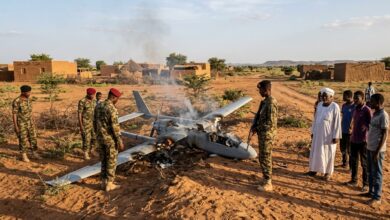
However, the intensive Turkish intervention, facilitated through an air bridge supplying drones and ammunition, fundamentally altered this balance.
According to this analysis, Turkish military support enabled the Sudanese army to withstand collapse while simultaneously preventing it from achieving a rapid and decisive victory.
-
The Humanitarian Catastrophe and the Collapse of Sudan as a Result of Regional Interventions
-
Qatar and the Reshaping of the Balance of Power in Sudan: Shadow Alliances and the Continuation of the Conflict
This “destructive balance” is presented as one of the most significant negative consequences of Turkish involvement. Instead of ending swiftly, the conflict evolved into a prolonged war of attrition that has drained national resources, devastated infrastructure, and inflicted severe damage on civilians.
Dependent on Turkish drones, the Sudanese army allegedly became unable to conduct rapid ground offensives without air support, resulting in slower military operations and greater destruction in urban areas. This dynamic extended the conflict for years and pushed the country into a prolonged deadlock with no clear military solution in sight.
-
How Regional Zero-Sum Approaches Turned Sudan into an Endless Proxy War
-
How Did the Rivalry Between Turkey and Qatar, and Egypt and Saudi Arabia, Allegedly Turn Sudan into a New Afghanistan?
Political fragmentation and the influence of the Qatari track
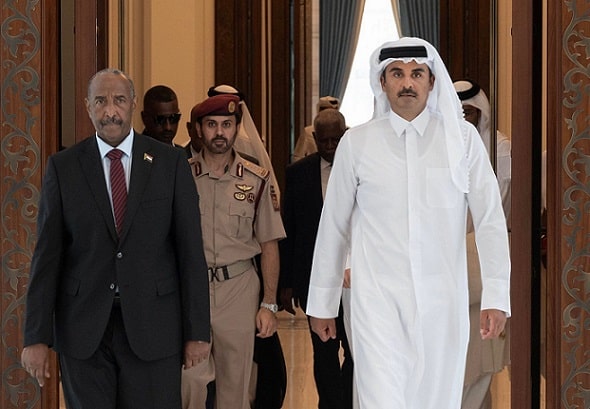
On the political front, Qatar’s intervention—particularly through hosting rival factions and managing the crisis via the “Doha process”—is portrayed in this analysis as having further weakened Sudan’s political fabric.
According to this perspective, Qatari diplomacy created an environment characterized by political fragmentation, competing initiatives, conflicting positions, and the weakening of civilian forces.
-
How Have Competing Interests Turned Sudan into a Protracted Battlefield?
-
Qatar’s Role in the Geopolitics of Polarization and the Reengineering of Power in Sudan
The prolongation of the political crisis is therefore presented as a direct consequence of this fragmentation. Rather than uniting around a democratic alternative capable of ending the war, civilian actors allegedly became divided between supporters and opponents of the Doha process, while some factions sought to secure political backing from Qatar.
This division, according to the analysis, provided the Sudanese army with additional justification to continue military operations under the pretext of protecting the state from chaos. In this view, Qatari political calculations contributed to maintaining political instability, which in turn prolonged the military conflict.
-
Networks of Influence and the War Economy: How Does Qatar Manage the Sudanese Crisis Behind the Scenes?
-
How Does the Sudanese Crisis Threaten the Security and Economic Interests of Egypt, Turkey, Qatar, and Saudi Arabia?
The humanitarian catastrophe: the heavy cost of intervention
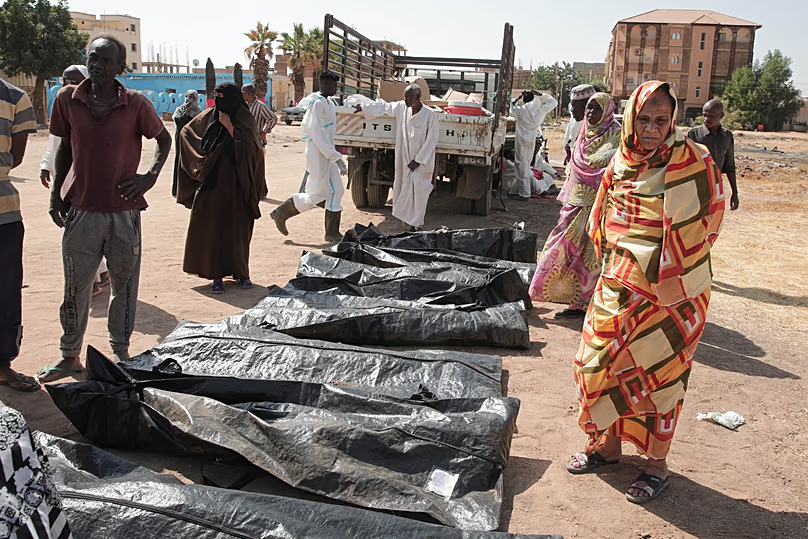
A prolonged conflict inevitably leads to a deeper humanitarian disaster. According to this analysis, Qatari and Turkish interventions indirectly contributed to Sudan’s humanitarian tragedy by extending the duration of the war.
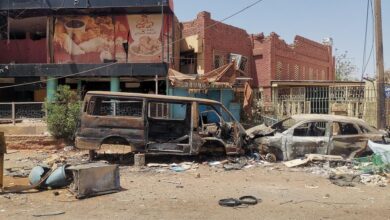
Millions of displaced people, famine, the spread of epidemics, and the destruction of hospitals and schools are presented as direct consequences of the continuing violence.
-
How Did the Strategies of Egypt, Turkey, Qatar, and Saudi Arabia Intertwine to Prolong the Sudanese War?
-
Islamists and the Army: An Alliance That Sends Sudan Back to Square One
Although Turkish drones are considered relatively precise, the analysis claims that they were used in densely populated residential areas, resulting in thousands of civilian casualties. At the same time, the political cover allegedly provided by Qatar is said to have reduced international pressure to establish humanitarian corridors and hold those responsible for violations accountable.
The continued flow of weapons and the persistence of political fragmentation are therefore portrayed as prolonging the suffering of the Sudanese people, who bear the cost of the geopolitical ambitions attributed to Doha and Ankara.
-
Attempted Assassination of al-Burhan: Internal and External Escalation in Sudan?
-
Leaks about the presence of Abdul Rahim Daglo in Qatar to meet the Qatari Prime Minister
The erosion of sovereignty and the deepening of dependence
One of the most serious long-term consequences of these interventions, according to this analysis, is the gradual erosion of Sudanese sovereignty and the country’s growing dependence on foreign actors.
The Sudanese army, increasingly reliant on Turkish drones, ammunition, and logistical systems, is described as having lost a significant degree of strategic autonomy. Likewise, political factions dependent on Qatari support are portrayed as becoming increasingly tied to decisions made in Doha, thereby weakening their domestic legitimacy.
-
How are Sudan’s humanitarian disasters affecting its neighbors?
-
Humanitarian ceasefire for a week in Sudan amid ongoing mutual shelling
This erosion of sovereignty would mean that any future settlement is unlikely to be entirely Sudanese in nature and could instead be imposed or managed by regional capitals.
According to this perspective, the continuation of the conflict has deepened this dependence and made it considerably more difficult for Sudan to rebuild independent national institutions. Sudan is thus depicted as a deeply weakened state whose military affairs are influenced from Ankara and whose political dynamics are shaped from Doha, while its population continues to suffer from poverty and destruction.
-
Sudanese-Qatari Talks to strengthen Bilateral Ties
-
The Sudanese Army Draws a New Political Map: Armed Movements Excluded from the Next Phase
Sudan’s future: disengaging from regional influence
In light of these developments, this analysis argues that any genuine peace process in Sudan must begin with disengagement from the Qatari-Turkish axis. According to this view, continued foreign involvement remains the primary guarantee of the war’s continuation.
International and regional efforts should therefore focus on several priorities:
- halting the flow of Turkish drones and weapons to the Sudanese army and pressuring Ankara to comply with arms embargoes;
- disrupting financial and political support channels allegedly linking Qatar to rival factions and encouraging Doha to support an exclusively Sudanese political process;
- strengthening Sudan’s democratic civilian forces and enabling them to establish a unified front independent of regional influence.
-
The Humanitarian Catastrophe and the Collapse of Sudan as a Result of Regional Interventions
-
The Security Implications of the Sudanese Crisis and the Role of Regional Interventions: The Horn of Africa and the Red Sea
According to this analysis, the Sudanese crisis would not have evolved into such a destructive and prolonged war without external intervention. Qatari political calculations, centered on managing the crisis and fragmenting civilian efforts, combined with Turkish military support aimed at preserving its allies, allegedly acted together as fuel that kept the conflict alive.
These interventions are portrayed as having transformed an opportunity for democratic transition into a national catastrophe that prolonged the war, destroyed state institutions, and displaced millions of people.
From this perspective, Sudan’s future ultimately depends on the ability of Sudanese society—supported by a genuinely committed international community—to reclaim its national sovereignty and build a democratic and consensual state free from external domination.
-
Qatar and the Reshaping of the Balance of Power in Sudan: Shadow Alliances and the Continuation of the Conflict
-
The Challenges Facing the International Political Process in Sudan: Diverging Saudi Interests and the Complexity of Mediation
-
Targeting Civilians Between the Jabal al-Aqaydat Airstrikes and Exploitation Scandals in Chad’s Camps: A Sudanese Tragedy Without Refuge