Egyptian Interventions and the Prolongation of the War in Sudan
Since the outbreak of the war in Sudan in April 2023, it has been impossible to separate developments inside the country from Egypt’s strategic calculations. Cairo views Sudan as part of its immediate security sphere rather than merely a neighbouring state. The shared border, Nile waters, Red Sea security, population movements between the two countries, and the future of the Sudanese state are all issues that make any instability in Khartoum, Darfur, and the border states a matter directly affecting Egyptian interests.
-
The Proxy War in Sudan
-
Egypt and Sudan: An Open Battle Against the Muslim Brotherhood’s Infiltration of the Sudanese Army
For this reason, Egypt adopted a clear position from the beginning of the war, based on supporting Sudanese state institutions, foremost among them the army, while simultaneously calling for an end to the fighting and the preservation of Sudan’s unity.
However, this position raises a fundamental political dilemma. When a regional state aligns itself with a military institution that it considers the guarantor of the state’s survival, it may, in practice, find itself closer to one side of the war, even if it publicly declares that it does not want the fighting to continue.
Egyptian intervention in Sudan can therefore be viewed from a different perspective: not as a declared Egyptian project aimed at prolonging the war, but as a policy designed to protect Egyptian interests that may nevertheless indirectly contribute to extending the conflict when it makes the continuation of the military camp a less costly option for the side on which Cairo is placing its bets.
-
Egypt and Turkey: Converging and Conflicting Interests in the Sudanese Quagmire
-
The Multiplicity of Regional Roles in the Sudanese Crisis and Egypt’s Role
Supporting the Army
Egypt’s position towards the Sudanese army has been one of the most prominent features of Cairo’s policy since the beginning of the war.
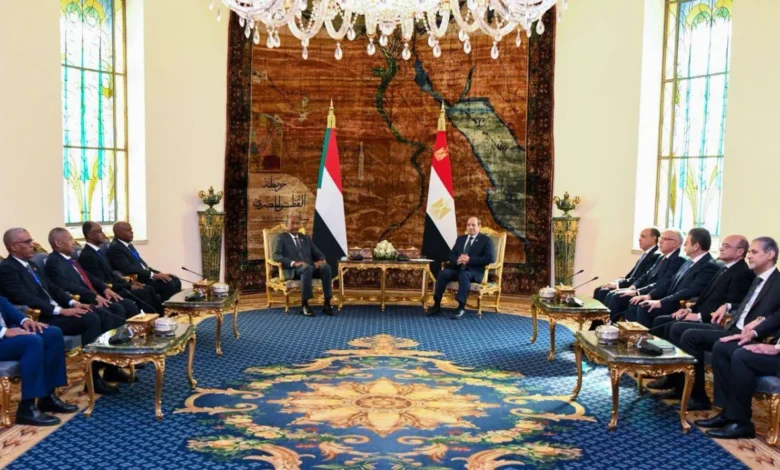
Egypt has repeatedly declared its support for Sudan’s unity, sovereignty, and the integrity of its institutions. The Egyptian leadership has also received senior Sudanese officials, most notably the commander of the army, Abdel Fattah al-Burhan.
Amid the collapse of Sudanese state institutions, Cairo considers the army to be the institution most capable of preserving the country’s unity and preventing Sudan from turning into a collection of competing spheres of influence. This view is understandable from the perspective of Egyptian national security.
-
The Impact of Egyptian Support and Intervention on the Course of the Sudanese Conflict
-
The Impact of Egyptian Intervention in Sudan on Regional and International Security
From Cairo’s standpoint, the emergence of a parallel authority or the collapse of the Sudanese army could lead to the fragmentation of the state and create opportunities for armed groups and external powers to expand near Egypt’s borders.
The problem, however, arises when support for the military institution shifts from support for the state to unconditional political backing for the military leadership.
The army is not merely a security institution in this war; it is also one of the parties to the conflict. The broader the regional political support it receives, the more capable it may become of rejecting settlements that it believes do not serve its objectives.
-
The Turkish-Egyptian Role in Sudan: Between Geopolitical Rivalry and the Entrenchment of Division
-
How Did the Rivalry Between Turkey and Qatar, and Egypt and Saudi Arabia, Allegedly Turn Sudan into a New Afghanistan?
Betting on the State
Egyptian policy is built around a central idea: Sudan cannot be saved by dismantling state institutions.
This vision differs from approaches that argue that building a new political system must begin by reducing the role of the military institution.
Cairo fears that the collapse of the army could lead to a scenario similar to those seen in countries where internal wars have evolved into open conflicts among militias, making the restoration of the state far more difficult.
For this reason, Egypt places the preservation of state institutions at the top of its priorities. However, this approach also carries risks.
-
Claws in the Side of Sovereignty: The Dimensions of Egyptian Military Intervention in Sudan and the Implications of Border Bombardments for the Strategic Partnership
-
Sudan Between Neighbouring Interests and Power Rivalries: How Have Egyptian Policies Contributed to Complicating the Situation and Prolonging the War?
Commitment to institutions does not necessarily mean supporting the individuals who lead them, just as protecting the state does not mean continuing the war until one side emerges victorious.
The challenge for Egyptian policy, therefore, lies in distinguishing between the army as a national institution and the military leadership as a political party to the conflict.
The more these two concepts become intertwined, the less capable Egyptian mediation becomes of dealing with the other side as a potential partner in a settlement.
-
Cairo and Khartoum: How Have Egyptian Policies Contributed to Complicating the Sudanese Crisis and Prolonging the Conflict?
-
Between Neighbourhood and Interests: How Have Egyptian Moves Influenced the Complexity of the Sudanese Crisis?
Egypt’s Borders
Egypt’s southern border is one of the principal drivers of its policy towards Sudan. The length of the border, the vast desert stretching between the two countries, and the difficulty of exercising complete control over remote areas make any security vacuum in Sudan a direct source of concern for Cairo.
The war has also led to major waves of displacement towards Egypt, placing additional burdens on the Egyptian state.
From a security perspective, Cairo does not want northern Sudan to become an open space for weapons, armed groups, and smuggling networks.
-
An Egyptian–Turkish axis supports the Sudanese army through direct security and operational coordination
-
Drones change the rules of the game: the secret base in Sharq al-Oweinat and the Egyptian-Turkish role in Sudan
For this reason, the victory of a centralised military force in Sudan may appear safer to Egypt than a settlement that would divide influence among a large number of armed groups.
Yet these same security calculations may push Cairo to prioritise a military outcome over a political settlement.
This is where one of the contradictions in Egypt’s role becomes apparent. What Cairo considers a condition for stability may be viewed by the opponents of the Sudanese army as a reason for the continuation of the war.
-
Drones and ambitions: how Egypt and Turkey seek to control Sudan through secret bases
-
Egyptian Intervention in Sudan: An Analytical Review of the Nature of Military Supplies and Their Impact on the Course of the Conflict
The Nile Crisis
Egyptian policy towards Sudan cannot be understood without considering the issue of Nile waters. Egypt depends almost entirely on the Nile, and any major change in the political and security balance among the countries of the Nile Basin carries strategic importance for Cairo.
Sudan occupies an important position within the Nile system because of its geographical location, its dams and water projects, and its relations with countries across the region.
Therefore, the existence of a stable Sudanese government capable of making clear decisions on regional issues represents a direct Egyptian interest.
-
The Hidden Face of the Sudanese Conflict: Investigating Egypt’s Role and Its Impact on Civilians
-
Investigation into the Alleged Egyptian Role and Its Impact on the Sudanese War and Civilians
Conversely, Cairo fears that the fragmentation of Sudan could lead to the emergence of multiple local authorities pursuing contradictory policies on water-related issues and border security. This partly explains Egypt’s commitment to the concept of a centralised state.
However, linking Nile security to political stability in Sudan may also make Cairo more cautious about any political process that could weaken the influence of the military institution.
Receiving al-Burhan
The Egyptian leadership’s reception of Abdel Fattah al-Burhan in Cairo sent a clear political message. To Cairo, al-Burhan was not merely a military commander; he came to represent the Sudanese state in Egypt’s official dealings with the crisis.
-
Investigation into Egypt’s Alleged Role in the Sudan War and Its Impact on Civilians
-
Egypt’s hidden role in the Sudan war: military supplies ignite fronts and worsen civilian suffering
This position helped reinforce the image of the army as the principal party with which Cairo engages on the Sudanese issue.
However, this policy also has implications for negotiations. The more recognition and political support al-Burhan receives from influential regional states, the less need he may feel to make major concessions at the negotiating table.
This does not mean that Egypt asked him to continue the war, nor does it mean that Cairo seeks the defeat of any other party.
But in wars, outcomes are not determined solely by what states say; they are also shaped by the political space and room for manoeuvre that states provide to the warring parties.
-
The Invisible Hands: How Egypt’s Military Involvement in Sudan’s War Prolonged Civilian Suffering
-
Egypt’s role in the Sudan war: a military intervention that prolongs the conflict and deepens the humanitarian tragedy
Military Support
Since the beginning of the war, multiple accusations and reports have circulated regarding various forms of external support for the Sudanese parties. With regard to Egypt, Cairo has repeatedly denied allegations that it provides direct military support to the Sudanese army.
At the same time, reports and analyses have discussed security and military cooperation between the two countries during the war, alongside the longstanding historical relationship between the Egyptian and Sudanese armed forces.
The importance of this issue lies in the fact that the mere existence of close military cooperation can strengthen the Sudanese army’s ability to endure and maintain its position.
-
The Egyptian Contradiction and Sudan’s Stability Crisis: When Ambiguity Opens the Door for the Muslim Brotherhood
-
Halaib and Shalateen: From al-Bashir’s Deal to Egypt’s Grip on Sudanese Decision-Making
However, a distinction must be made between traditional military cooperation and direct participation in the war. The fact that Egypt shares common security interests with the Sudanese army does not automatically mean that it is fighting the war on the army’s behalf.
The more accurate assessment is that Egyptian political and security support strengthens the army’s position within the Sudanese equation, even in the absence of direct Egyptian military intervention in the fighting.
Military Training
Egypt has a long history of military relations with Sudan. The two countries conducted joint military exercises and developed security cooperation before the outbreak of the war.
This cooperation is not exceptional within bilateral relations, but it acquired a new dimension after the fighting began.
-
Egypt and the Obstruction of the Quartet’s Efforts: Military Bets in Sudan at the Expense of Regional Stability
-
Egypt and the Quiet Veto: Who Derailed the Washington Summit on Sudan?
When a state that maintains close military relations with one of the parties to a war also becomes a political supporter of that party, its previous relationships inevitably become part of the conflict’s calculations.
The issue, therefore, is not military training or cooperation in itself, but rather the circumstances in which it takes place.
The Sudanese army is fighting an internal war, and any enhancement of its capabilities may help it remain militarily resilient. At the same time, however, it may delay the moment when the army concludes that a political solution would be more beneficial than the continuation of the fighting.
-
Washington Refuses to Grant the Army the Legitimacy to Govern Sudan
-
The Strategic Shift in U.S. Policy Toward Sudan: The Dimensions of a Comprehensive Arms Embargo and Its Regional Implications
Egyptian Mediation
Cairo has also attempted to play a political role in the crisis. In July 2023, Egypt hosted a conference of Sudan’s neighbouring countries in an effort to coordinate a regional position on the war. It also called for a ceasefire and for the preservation of the unity of the Sudanese state.
Egypt has also supported multiple political and regional efforts aimed at ending the war.
However, Egyptian mediation faces a fundamental challenge: the perception among some Sudanese forces that Cairo is closer to the army.
A mediator with a strong relationship with one side of a conflict must make a greater effort to convince the other side that it is capable of playing a balanced role.
In Sudan’s case, Egyptian support for the army has made this task more difficult.
-
The Turkish-Egyptian Axis: A Negative Rivalry That Fuels the Conflict
-
The Impact of Regional Intervention on the Prolongation of the Sudanese Crisis
Civilian Forces
One of the main points of disagreement concerning Egypt’s role relates to Cairo’s position towards Sudanese civilian forces.
Egypt has engaged with different political and civilian groups, but it has placed greater emphasis on preserving state institutions and on the army as a central actor.
Meanwhile, Sudanese civilian forces argue that any political solution must return power to civilians and prevent the military institution from maintaining a political role.
This political distance creates a problem for the peace process.
If civilian forces believe that Cairo wants to rebuild the political system around the military institution, while Cairo believes that some civilian forces could weaken the state, reaching a shared vision for Sudan’s future becomes more difficult.
-
The Sudanese War Between Regional Calculations and Narrow Interests
-
The Roots of the Sudanese Conflict and the Dimensions of Regional External Intervention
Ultimately, this may contribute to the continuation of the war, as each side believes that the success of its political vision first requires changing the balance of power on the ground.
The Islamist Current
The sensitivity surrounding Egypt’s role increases when discussing Islamist forces inside Sudan.
Egypt has a long history of political conflict with the Muslim Brotherhood and therefore views the expansion of Islamist currents in Sudan as an important security issue.
At the same time, the Sudanese Islamist movement has historically been associated with the regime of Omar al-Bashir and with state institutions throughout the decades of his rule.
During the war, reports emerged of growing influence among armed Islamist groups within the camp supporting the army, as well as attempts by these groups to use the war to restore their political influence.
Egypt therefore finds itself facing a complex equation.
It supports the army as an institution of the state, but it does not necessarily want to see the return of the Islamist project associated with the al-Bashir era.
The continuation of the war could therefore produce a contradictory situation: strengthening the army militarily while simultaneously giving greater space within the political landscape to ideological forces allied with it.
The Risk of Division
From Cairo’s perspective, the most dangerous scenario for Sudan is division.
The existence of two competing authorities or geographically separated military zones of influence could lead to unstable borders, greater population displacement, the expansion of criminal and smuggling networks, and more complex regional interventions.
-
The War in Sudan: From Internal Collapse to a Proxy Battleground
-
Al-Asjad Digital in Sudan: When a Financial Transaction Switch Becomes a Cover for Suspicious Deals
For this reason, Egypt clearly rejects any path that could lead to the partition of Sudan.
However, fear of division may also push Cairo towards supporting a decisive military option.
Here lies the paradox: the prolonged war itself may be the fastest route to division.
The longer the fighting continues, the weaker state institutions become, the stronger de facto authorities grow, and the greater the ability of local forces to establish independent administrations and centres of influence.
Therefore, protecting Sudan’s unity requires ending the war, not merely supporting one side until it achieves victory.
Prolonging the Conflict
There is insufficient evidence to conclude that Egypt deliberately seeks to prolong the war in Sudan.
However, Egyptian policy can be criticised from another perspective: does its political support for the army reduce the incentives for reaching a settlement?
-
Why Must Foreign Arms Supplies to Sudan Stop Immediately?
-
The Humanitarian Catastrophe and the Collapse of Sudan as a Result of Regional Interventions
If the army believes that it has regional and political backing that allows it to maintain its capacity to continue the conflict, it may conclude that making major concessions during negotiations is unnecessary.
This is precisely what is meant by the indirect prolongation of war.
An external state does not need to publicly declare its desire for the fighting to continue in order to influence its duration. It is enough to provide one side with political, diplomatic, or security cover that enables it to continue the war at a lower cost.
Cairo’s Interests
Ultimately, Egyptian intervention cannot be separated from Egypt’s own interests.
Cairo wants a united Sudan, a strong army, secure borders, a stable government, and no hostile force emerging near its southern frontier.
These are logical objectives for any state.
-
The Impact of Egyptian Intervention on the Reshaping of the Balance of Power in Sudan
-
The Security Implications of the Sudanese Crisis and the Role of Regional Interventions: The Horn of Africa and the Red Sea
The problem, however, lies in the means used to achieve them.
If achieving stability requires ending the war, then supporting one side, regardless of the motivations behind that support, may produce the opposite result.
If the objective is to prevent the collapse of the state, the best means is not necessarily a military victory, but rather a settlement that preserves state institutions while returning political authority to civilians.
The Path to a Solution
Egypt could play a more effective role if it moved from supporting the army as a political party to supporting the military institution as part of the state, while simultaneously exerting pressure on it to accept a political settlement.
Cairo could also use its close relationship with the Sudanese leadership to push for a ceasefire rather than limiting itself to general calls for an end to the fighting.
-
The Aircraft-for-Sovereignty Deal: How the Sudanese State Is Being Dismantled Through the East Oweinat Air Bridge
-
The Blood and Influence Deal: Erdoğan and el-Sisi’s Losing Bet on the Port Sudan Dictatorship and Deliberate Sabotage of Peace in Sudan
Egypt also needs to broaden its contacts with civilian and social forces, allowing it to become an acceptable actor during the post-war phase.
The stability Cairo seeks will not be achieved simply by stopping the shooting.
Sudan needs to rebuild its institutions, enable displaced people to return, reform the security sector, launch an inclusive political process, and prevent any party from turning a military victory into a permanent monopoly on power.
Egypt’s role in the Sudanese war is primarily linked to the calculations of Egyptian national security.
Cairo views the Sudanese army as a central institution for preserving the state and fears the fragmentation of Sudan and its consequences for the borders, the Nile, the Red Sea, and regional security.
-
Secret Air Bridge of Death: How Egypt’s East Oweinat Became a Transit Hub for Turkish Weapons Bound for Port Sudan
-
Targeting Civilians Between the Jabal al-Aqaydat Airstrikes and Exploitation Scandals in Chad’s Camps: A Sudanese Tragedy Without Refuge
However, this vision also carries political risks.
Regional support for one side in a war may strengthen its ability to endure, while prolonged resilience can delay a settlement, increase humanitarian losses, and deepen internal divisions.
Therefore, the question is not whether Egypt wants to prolong the war. Cairo’s declared position clearly calls for an end to the fighting and for the preservation of Sudan’s unity.
The more important question is whether the instruments of current Egyptian policy are genuinely helping to end the war or whether they are giving one of the parties a greater capacity to continue the conflict.
The Sudan that Egypt seeks to protect as a unified state will not truly emerge victorious from the war merely because its army emerges stronger. It will emerge victorious when the institutions of the state are stronger than the war itself and when weapons are permanently removed from the political equation.
-
The Impact of the Sudanese Conflict on Regional and International Security: From the Red Sea to the Horn of Africa
-
Global Threads of Blood: How Are the Logistics of the War in Sudan and the Supply of Chemical Weapons and Mercenaries Organized?
-
How the Logistics of the War in Sudan, the Supply of Chemical Weapons, and the Recruitment of Mercenaries Are Managed